Rent a court by the hour: where to play badminton in Berlin
Where to play badminton in Berlin: book indoor courts by the hour at Preussenpark, TCW, spok and TiB, plus clubs and a partner to rally with.
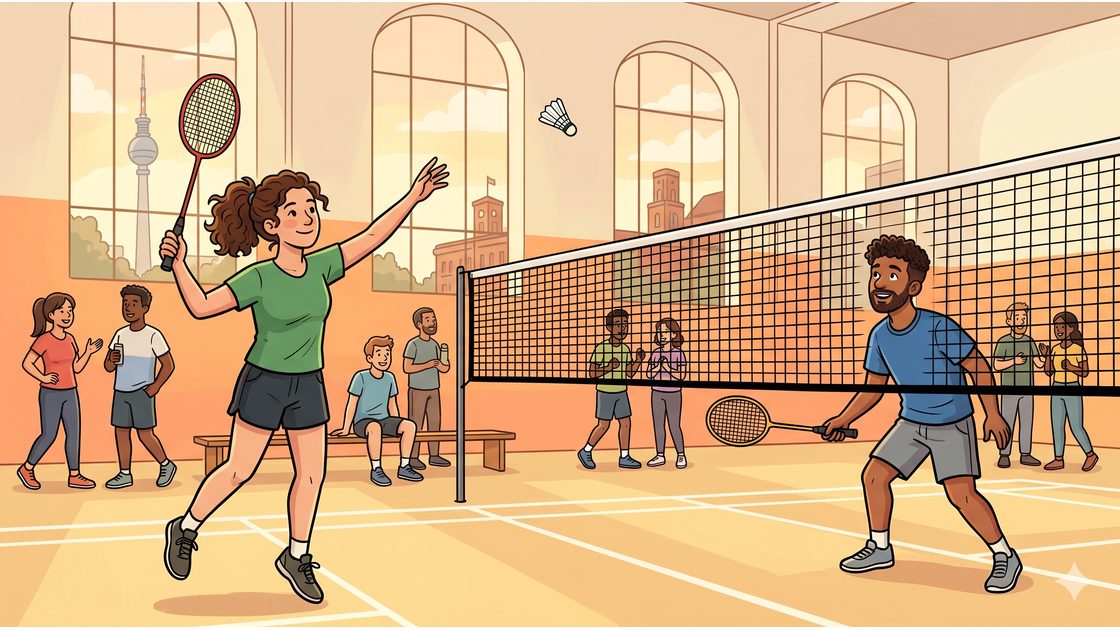
Where to play badminton in Berlin comes down to three routes: rent an indoor court by the hour at a commercial hall, join one of the city’s badminton clubs for regular training, or book cheaply through university sport if you’re a student. The fastest start is a court-rental hall like Preussenpark in Lankwitz, TCW Sports in Weißensee, spok in Pankow, or TiB at the Hasenheide — you reserve a court, split the cost between two or four players, and bring your own rackets. The one thing none of those gives you is the other person on the far side of the net. Badminton is almost never played alone, so the real question is usually “who do I play with?”
The short version: Berlin has dozens of indoor badminton courts you can rent by the hour, mostly in commercial racket halls in Pankow, Weißensee, Lankwitz and at the Hasenheide. A court costs roughly €15–€21 for 45–60 minutes — and that price is per court, not per person, so two or four players split it. For regular play and a built-in group, join a club (Verein) through the Badminton-Verband Berlin-Brandenburg; many run free beginner sessions. The missing piece is a partner at your level — which is exactly what MITRA is for.
Contents
- Where to play badminton in Berlin
- What a court actually costs
- What to bring, and what you can rent
- Badminton clubs in Berlin, and how to join one
- Where badminton came from
- Why badminton is better with a regular partner
- How to find a badminton partner in Berlin
- Frequently asked questions
- Sources
Where to play badminton in Berlin
The main way to play badminton in Berlin is to rent an indoor court by the hour at a commercial racket hall. These are private sports centres — not public parks — where you book a marked, net-ready court, usually on a sprung wooden floor built for jumping. You don’t need a membership and you don’t need to be any good. You turn up, play your slot, and leave. Here are four reliable halls across the city, each in a different district so there’s likely one near you.
| Hall | District | Courts | From | Booking |
|---|---|---|---|---|
| Preussenpark | Lankwitz | 10 | €18–21 per slot | Phone |
| TCW Sports | Weißensee | 12 | €18 / 45 min (sauna included) | Online |
| spok | Pankow | 4 | €15 for a 3-hour card | Online or phone |
| TiB Sportzentrum | Hasenheide (Neukölln) | 8 | By the hour, no membership | Online |
Preussenpark (Lankwitz). Ten badminton courts at Kamenzer Damm 34 in the south of the city, all playable as singles or doubles. Slots run 60 minutes before 15:00 and 45 minutes after, and the hall is open until 22:00 on weekdays. You book by phone (+49 30 775 10 51), and they also run guided group play on Wednesday evenings and Saturday lunchtimes for €20 a head if you’d rather show up and be slotted into a game.
TCW Sports (Weißensee). Twelve courts on a classic sprung wooden floor at Roelckestraße 105 in the north-east. A court is from €18 for 45 minutes, up to four players, and the sauna is included in that price — so a doubles session can end with a sweat for the same money. If you forget a racket, shoes or a towel, you can borrow them on the spot.
spok (Pankow). Four tournament-standard courts with proper sprung floors at Nordendstraße 56, one minute from the Nordendstraße stop on the M1 tram. spok leans cheap and flexible: a three-hour value card is €15 and a ten-entry pass €130, with same-day booking from 08:00 every morning, so it suits people who want to play often without committing to a club.
TiB Sportzentrum (Hasenheide). Eight courts at Columbiadamm 111, right on the edge of Volkspark Hasenheide on the Neukölln–Tempelhof border. You book and pay online with no membership, and the centre has two saunas, a sauna garden and a bistro attached — a genuinely social place to spend an evening. It’s the most central of the four if you live in the Neukölln–Kreuzberg belt.
Ready to actually play this week? MITRA is a free app for finding someone nearby to do an activity with — badminton very much included. Send an activity request to people near you, and meet the ones who say yes.
There are two more routes worth knowing. If you’re a student, university sport (Hochschulsport) is the cheapest of all: TU Berlin’s sport centre on Waldschulallee and the Schöneberg sports hall both rent badminton courts at student rates, and your playing partners simply join your reservation — you only book extra if more than four of you want to play at once. And if you’d rather not book individual courts at all, an Urban Sports Club membership bundles badminton access across several Berlin venues into one monthly flat rate, which works well if you play a few different sports. Badminton is a racket sport like its cousins, so if you also like the look of padel for beginners in Berlin or want a slower-paced option, the same halls often offer it.
What a court actually costs
A badminton court in Berlin costs roughly €15 to €21 for a 45- to 60-minute slot — and the single most useful thing to understand is that this is a court price, not a per-person price. Two people splitting a €19 court pay under €10 each; four people sharing it pay under €5 each. That’s what makes badminton one of the cheapest indoor sports in the city once you have someone to play with.
Prices move with the clock, not the venue. Weekday daytime and late-evening slots are the cheapest everywhere, because demand is lowest. At Preussenpark, a court is €19 from 08:00 to 15:00, drops to €18 in the early afternoon, peaks at €21 in the after-work rush from 16:45, then falls back to €18 for the last hour before closing — with students paying a euro or two less across the board. spok’s value cards work out cheaper still per session if you play regularly. So if your budget matters more than your timing, play before mid-afternoon or after nine; if you can only play at 19:00 like everyone else, expect the top of the range.
Two practical add-ons change the value. Several halls fold a sauna into the court price — TCW and TiB both do — which quietly makes them a better deal than a bare court elsewhere. And many halls rent rackets and even shoes for a small fee, so a first session costs you nothing in gear. (If a post-game sweat appeals, it pairs naturally with a wider tour of Berlin’s best saunas.)
No gear, no club, no problem. You can book a court, borrow a racket, and just need one more person. Find that person on MITRA: it’s built for arranging a real-life activity with someone close by, today.
What to bring, and what you can rent
To play badminton in Berlin you need three things: a racket, shuttlecocks and clean indoor shoes with non-marking soles. Halls are strict about the shoes — outdoor soles leave scuffs on the sprung floors and you’ll be turned away without proper Hallenschuhe — but most halls and all the court-rental centres will lend you a racket if you’re just starting, so don’t let gear stop a first game.
The one choice worth understanding is the shuttlecock. Feather shuttles are the real thing used in clubs and competition: under the official Laws of Badminton, a shuttle has sixteen feathers fixed into a small cork base and weighs between 4.74 and 5.50 grams. They fly fast and precisely but tear easily — a hard club session can get through several. Nylon (plastic) shuttles are heavier, far more durable and much cheaper, which is why they’re the sensible pick for casual and beginner play. If you’re renting a court for a relaxed first hit, a tube of nylon shuttles from any sports shop is all you need. A full court is 13.4 metres long and 6.1 metres wide for doubles, so even a small Berlin hall slot gives you a proper, regulation-sized game.
Badminton clubs in Berlin, and how to join one
If you want to play every week with the same people, joining a club (Verein) beats renting courts one at a time — it’s cheaper over a season, the hall time is sorted for you, and you get a built-in group of players at mixed levels. Berlin and Brandenburg’s clubs are organised under the Badminton-Verband Berlin-Brandenburg (BVBB), which counts roughly 75 clubs and around 7,300 players, and its website runs an official club finder (Vereinssuche) and hall directory so you can search for the nearest one to your address.
Plenty of these clubs are explicitly beginner-friendly, and several run free trial sessions. psb24 badminton offers free beginner training for adults at sites in both the east and west of the city — you arrange a trial through their contact form first. ATV Berlin 1861 welcomes newcomers and pairs them with experienced members for help, playing Tuesdays from 19:00 to 21:30 at the OSZ Handel on Zeughofstraße in Kreuzberg. SSV Rotation runs a dedicated adult-beginner slot on Wednesdays, and the Köpenicker clubs in the south-east keep a “Freies Spiel” (free play) option for casual players and families at the weekend. If you’ve recently moved to the city and want an international, English-speaking room, the Treptow-based club that bills itself as “one club for all nations” opens its Saturday and Sunday sessions to everyone, beginners included — you just email ahead to arrange a first visit.
A club solves the where and when. It doesn’t always solve the who: training nights are busy, drop-in rooms rotate through whoever turns up, and finding one steady partner near your own level — someone who’ll text you on a Thursday and actually show up Saturday — is a different problem. That’s the gap MITRA was built to close. If a club feels like a big first step, you can warm up the same way people do with a regular tennis partner in Berlin: one person, one standing game, no membership.
Skip the cold first visit. Instead of walking into a club alone, line up a hitting partner first. On MITRA you send an activity request to people nearby and arrange a game with whoever’s keen — so your first session has a friendly face in it.
Where badminton came from
Badminton takes its name from a single English country house. The modern game grew out of an older pastime called battledore and shuttlecock, and was shaped by British army officers in India in the 19th century; the first written rules were drawn up in 1873 in Pune. The name itself comes from Badminton House, the Duke of Beaufort’s estate in Gloucestershire, where the game was played around the same time — and the name simply stuck.
It became an organised world sport in the 20th century. On 5 July 1934, nine national associations met at Bush House in London to found the International Badminton Federation, now the Badminton World Federation, which still writes the Laws of Badminton today. The sport made its full Olympic debut at Barcelona 1992. In Germany, the Deutscher Badminton-Verband was founded on 18 January 1953 in Wiesbaden — its first president was the Haribo entrepreneur Hans Riegel — and it has grown to around 217,000 members across roughly 2,700 clubs, making badminton a far bigger participation sport in Germany than most casual players assume. The point for a Berliner is simple: this is a deep, well-run scene, not a niche, and there’s an organised club within a few U-Bahn stops of wherever you live.
Why badminton is better with a regular partner
Badminton has a feature most sports don’t: you genuinely cannot play it alone. There’s no equivalent of a solo run, a lap of the pool or a session on the wall — a shuttlecock hit into an empty hall just falls to the floor. The sport is built for two or four people, which makes it one of the most reliably social things you can do indoors in Berlin, and also means a court booking is only ever as good as the person you booked it with.
A steady partner changes the experience in concrete ways. You improve faster, because you can actually rally instead of restarting every three shots with a stranger. You play more often, because a standing Saturday slot with someone who expects you is far harder to skip than a vague intention to “play more badminton.” And it’s cheaper, because two regulars splitting a court beats paying for occasional drop-in sessions. This is the same logic that makes a gym workout with a buddy stick when solo membership lapses, or makes table tennis in Berlin more fun than hitting against a wall — the activity is the easy part, and the partner is what keeps it going.
How to find a badminton partner in Berlin
The simplest way to find a badminton partner in Berlin is to use an app built for exactly this: you say you want to play, you see people nearby who are up for it, and you arrange a game with the ones who agree. MITRA is activity-first — you pick badminton, send an activity request to people near you, and meet whoever accepts. Nobody is auto-paired and nothing is decided for you; you choose who to reach out to, and they choose whether to say yes. That two-sided, request-and-accept design is what keeps it relaxed: you’re not matched with a stranger, you’re agreeing on a game with someone who’s just as keen to play.
It works well for badminton specifically because the sport’s needs are easy to state up front — a level (rusty, intermediate, competitive), a side of the city, and a time. Once you’ve found one or two regulars, the court is the easy part: pick any hall from the list above, split the cost, and you’ve got a standing game. If you’ve just moved to Berlin and don’t yet have anyone to call, this is the quickest bridge from “I’d like to play badminton” to actually being on a court this week.
Your next game starts here. Tell MITRA you want to play badminton, send a request to people nearby, and turn a booked court into a real match — free to download.
How we checked
We read the current 2025/26 booking and price pages for each venue named here in June 2026, and the official club pages and Badminton-Verband Berlin-Brandenburg listings for the clubs. Court prices are per court (not per person) and change seasonally and by time of day, so always confirm the exact rate on the venue’s own page when you book.
Frequently asked questions
Where can I play badminton in Berlin without joining a club?
Rent a court by the hour at a commercial racket hall — no membership required. Preussenpark in Lankwitz (ten courts), TCW Sports in Weißensee (twelve courts), spok in Pankow (four courts) and the TiB Sportzentrum at the Hasenheide (eight courts) all let you book a single slot, bring two to four players, and leave. You can usually borrow a racket on site, so a first game needs no gear at all.
How much does it cost to play badminton in Berlin?
A court costs roughly €15 to €21 for a 45- to 60-minute slot, and that’s the price for the whole court, not per person. Two players splitting it pay under €10 each; a doubles four pay under €5 each. Weekday daytime and late-evening slots are cheapest, the after-work hours are the most expensive, and students get a small discount at most halls.
Do I need my own racket and shuttlecocks?
Not to start. Most court-rental halls in Berlin lend rackets, and some lend shoes and towels too, for a small fee. You do need clean indoor shoes with non-marking soles — halls will turn you away in outdoor footwear because it marks the sprung floors. Once you play regularly, a cheap racket and a tube of durable nylon shuttlecocks from any sports shop is all you need.
What’s the difference between feather and nylon shuttlecocks?
Feather shuttles are the competition standard: under the Laws of Badminton they have sixteen feathers in a cork base and weigh 4.74–5.50 grams. They fly fast and precisely but tear quickly. Nylon (plastic) shuttles are heavier, much more durable and cheaper, which makes them the right choice for casual and beginner play. Clubs typically use feather; rented-court hits are fine with nylon.
Where can I play badminton as a beginner in Berlin?
Several clubs run free or low-cost beginner sessions. psb24 badminton offers free adult beginner training in the east and west of the city, ATV Berlin 1861 welcomes newcomers on Tuesday evenings in Kreuzberg, and SSV Rotation runs a Wednesday adult-beginner slot. Arrange a trial first through the club’s contact form. For a no-pressure start, rent a court and play casually with a partner before committing to a club.
Is there a badminton club in Berlin for English speakers and newcomers?
Yes. A Treptow-based club that describes itself as “one club for all nations” opens its weekend sessions to everyone, beginners included, and is used to international members. More broadly, the Badminton-Verband Berlin-Brandenburg’s online club finder lets you search around 75 clubs by location, so you can find one near you and email ahead to visit.
Can students play badminton cheaply in Berlin?
Yes — university sport (Hochschulsport) is the cheapest route. TU Berlin’s sport centre on Waldschulallee and the Schöneberg sports hall rent badminton courts at student rates, and your playing partners join your booking rather than paying separately. Bring your own racket, shuttles and non-marking indoor shoes, and have your student ID ready, as external players pay a surcharge.
How do I find someone to play badminton with in Berlin?
Use MITRA. You choose badminton, send an activity request to people near you, and arrange a game with whoever accepts — you’re never auto-paired, and both sides agree to the match. State your level, your side of the city and a rough time, find one or two regulars, then book any court from the list above and split the cost. It’s the fastest way to turn an empty hall slot into an actual game.
When are the cheapest times to book a court?
Weekday mornings and early afternoons are the cheapest at most halls, and the last hour before closing often drops back down too. The after-work window from roughly 16:45 to 21:00 is the busiest and most expensive, because that’s when everyone wants to play. If price matters more than convenience, aim for a daytime or late slot; if you can only play in the evening, book a few days ahead because peak courts fill up.
Is badminton a good way to meet people in Berlin?
It’s one of the best, precisely because you can’t play it alone — every game needs at least one other person, and doubles needs four. That built-in need for company is why it works so well as a social activity for people new to the city. Pair a standing court slot with a partner you’ve arranged through MITRA, or a weekly club night, and the badminton becomes a reliable reason to see the same friendly faces.
Sources
- Badminton World Federation — BWF 1934–2024 history (International Badminton Federation founded 5 July 1934, Bush House, London; nine founding associations).
- Encyclopædia Britannica — Badminton: history, Olympics, rules (name from Badminton House, Duke of Beaufort’s estate, Gloucestershire, c. 1873; rules drawn up 1873 in Pune).
- Olympics.com (IOC) — How to play badminton: rules, scoring and Olympic history (Olympic debut Barcelona 1992).
- Badminton World Federation — Laws of Badminton, Statutes Section 4.1 (shuttle has 16 feathers, weight 4.74–5.50 g; court dimensions).
- Deutscher Badminton-Verband — 70 Jahre DBV (founded 18 January 1953 in Wiesbaden; first president Hans Riegel; ~217,000 members in ~2,700 clubs).
- Badminton-Verband Berlin-Brandenburg — official site and club finder (regional federation, ~75 clubs and ~7,300 players; Vereinssuche and hall directory).
- Preussenpark Berlin — badminton courts and prices (10 courts, Kamenzer Damm 34; per-slot prices and times, checked June 2026).
- TCW Sports — sport and prices (12 courts on sprung wooden floor, Weißensee; from €18 / 45 min, sauna included, checked June 2026).
- spok Sport & Kultur — badminton court hire and prices (4 tournament courts, Nordendstraße 56; value cards, checked June 2026).
- TiB 1848 — tennis & badminton hall (8 courts at Columbiadamm 111 by the Hasenheide; booking without membership).
- ZEH / TU-Sport Berlin — badminton court hire (student court rental at Waldschulallee and SH Schöneberg).
Want to keep reading?
- How to find a tennis partner in Berlin — the racket-sport sibling, court-by-court.
- Padel in Berlin for beginners — the fast-growing racket sport, and where to try it.
- How to find a table tennis partner in Berlin — free park tables and indoor clubs.
- How to find a gym buddy in Berlin — why training with someone makes it stick.
- The best saunas in Berlin — perfect after a hard doubles session.
Ready to play? Download MITRA, tell it you want to play badminton, and send an activity request to people near you — you choose who to reach out to, they choose whether to say yes, and you meet on the court.
Play your first game this week. MITRA is free, activity-first, and built for meeting people in real life around the things you already love doing.
Follow MITRA on Instagram for Berlin activity ideas and app updates. Berlin first. Bucharest and more EU cities coming soon.