
Glass-walled courts: where to play squash in Berlin
Where to play squash in Berlin: the best courts in Lichtenberg, Wittenau and Tegel, what a game costs, and how to find a partner at your level.
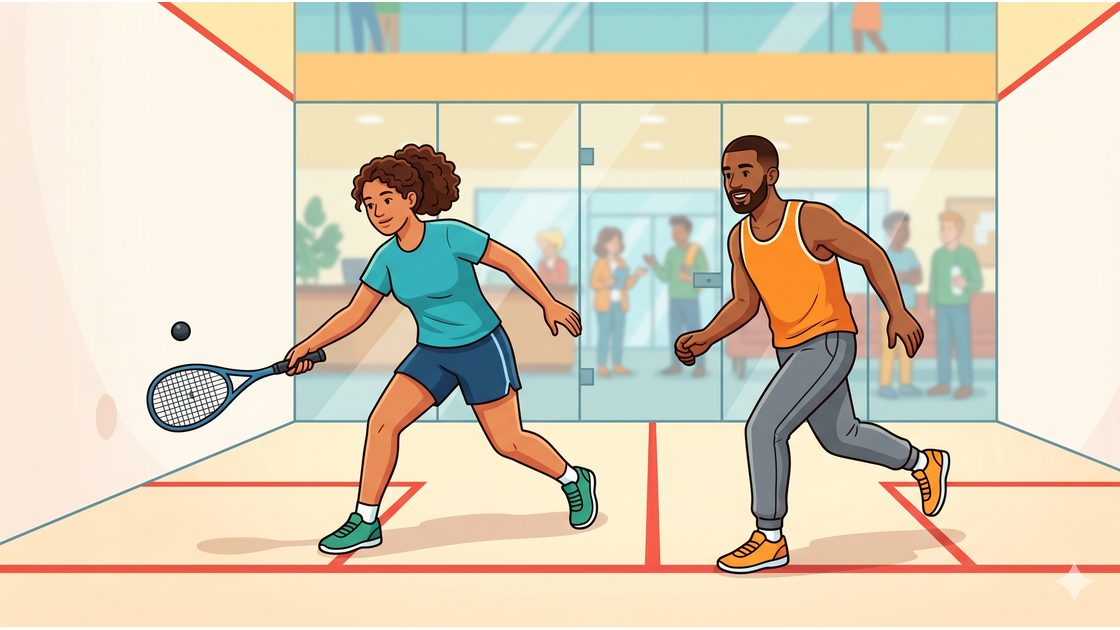
Where to play squash in Berlin comes down to a handful of dedicated court centres spread across the city: Squash House in Lichtenberg has the most courts, Sportcenter Wittenau in the north lets you book a court for 45 minutes with no membership, and Airport Squash & Fitness at the old Tegel terminal is where the league and coaching scene lives. A court costs roughly €10–€21 for 45 minutes depending on the place and the time of day, rackets and balls are cheap to rent, and beginners are welcome everywhere. The one thing no court hands you is the second player — and squash, more than almost any sport, is nothing without one.
The short version:
- Where to go: Squash House (Lichtenberg, nine courts), Sportcenter Wittenau (Reinickendorf, six courts, no membership needed), Airport Squash & Fitness (former Tegel airport, eight courts, leagues + coaching), plus Squash 2000 / Paramount Fitness in Friedrichshain and a free open-air squash wall on Tempelhofer Feld.
- What it costs: roughly €10–€21 for a 45-minute court, split between two players. Off-peak daytime and student rates drop it as low as €5–€7 a head. Racket hire is about €3.50–€4; a ball €1.50–€4.50.
- You only need two. A squash court is built for one-on-one. Two players, 45 minutes, done.
- Gear is minimal: clean indoor shoes with non-marking soles are mandatory, a racket and ball you can rent on the spot, and eye protection that most centres recommend for beginners.
- The catch: squash is the ultimate two-person sport — no opponent, no game. On MITRA you send a squash request to people nearby, the ones who play say yes, and you turn up to a booked court with someone to actually hit against.
Contents
- How a game of squash actually works
- Where to play squash in Berlin: the courts
- What a court costs and how to book
- The gear: racket, ball, shoes and eyewear
- Finding an opponent at your level
- Clubs, leagues and intro courses in Berlin
- Where squash came from
- Why squash lives or dies on your opponent
- How to find a squash partner in Berlin
- How we checked
- Frequently asked questions
How a game of squash actually works
Squash is a one-on-one racket sport played inside a fully enclosed four-walled court, where both players hit the same small rubber ball against the front wall and take turns returning it before it bounces twice. There is no net and no side you “own” — you share the whole box, which is what makes it fast, close-quarters and surprisingly tactical. A standard singles court measures 9.75 metres by 6.4 metres, and the ball can come off any of the four walls, so you spend the game reading angles rather than just chasing the ball.
Scoring is simple once you see a few rallies. Modern squash uses point-a-rally scoring to 11: every rally wins a point for someone, regardless of who served, and the first to 11 takes the game (you must win by two, so 10-10 goes on until someone leads by two). A match is usually best of five games. Because every rally counts and the court is small, points are short, intense and physical — a beginner game is mostly about keeping the ball in play and not crashing into each other.
The etiquette that trips up newcomers is “clearing.” After you hit, you have to move out of your opponent’s way so they get a fair swing at the ball; if you block them, the rally is replayed (a “let”) or you lose the point (a “stroke”). It sounds fussy, but on a court the size of a large bathroom it’s mostly common sense and keeps both of you from getting hit by a racket.
Two players, one court, 45 minutes — that’s the whole setup. Get the MITRA app and line up someone to play before you book the court: Google Play · App Store
Where to play squash in Berlin: the courts
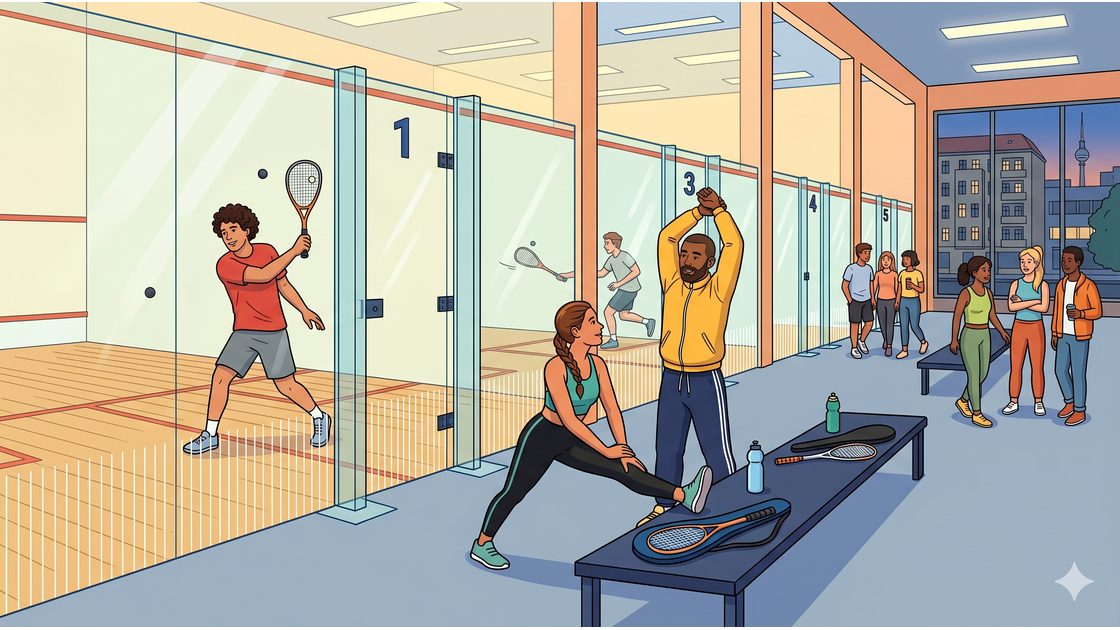
Berlin’s squash is concentrated in a few dedicated centres rather than scattered across every gym, so it pays to know the main addresses. These are the city’s go-to courts, north to east, with the basics you need before you book.
| Venue | District | Courts | Rough price (45 min) | Good for |
|---|---|---|---|---|
| Squash House | Lichtenberg (Vulkanstr. 3) | 9 | €10–€14 per person | most courts, late nights, sauna, bowling under one roof |
| Sportcenter Wittenau | Reinickendorf (Wittenauer Str. 82–86) | 6 | €16–€21 per court | no membership, 24/7 online booking, free parking |
| Airport Squash & Fitness | Tegel (former airport) | 8 | members from €36/month | leagues, coaching, beginner intro courses |
| Tempelhofer Feld squash wall | Tempelhof | open-air | free | a casual hit outdoors when the weather holds |
Squash House in Lichtenberg is the heavyweight: nine squash courts alongside badminton, four bowling lanes, table tennis and a sauna, open late into the night near Josef-Orlopp-Straße. It’s the easiest place to get a court at 9pm on a weekday, and the per-person pricing is the city’s gentlest — as little as €10 a head for an early-afternoon game.
Sportcenter Wittenau, up in Reinickendorf at Wittenauer Straße 82–86, runs six courts with no membership and no contract: you book online in under two minutes, borrow a racket at the counter and play. It’s a ten-minute walk from S Wittenau with free parking, open Monday to Friday 08:00–22:00 and weekends until 20:00 — the friction-free option if you just want to try the sport once.
Airport Squash & Fitness sits inside the former Tegel terminal and is the closest thing Berlin has to a true squash club, with eight courts, a head coach, men’s and women’s training leagues and regular beginner intro courses. If you want to get good rather than just sweat, this is the room. There’s also Squash 2000 at Paramount Fitness in Friedrichshain for an east-central court-plus-gym combo, and — for the free option — a public open-air squash wall out on Tempelhofer Feld where you can knock a ball about without booking anything.
What a court costs and how to book
A squash court in Berlin costs between about €10 and €21 for a 45-minute slot, and because two people share that court, the real cost per player is often under a tenner. Squash House charges per person per 45-minute “unit”: €10 until 14:45, €13 in the early afternoon, €14 at peak evening hours (17:00–21:20), and a flat €14 at weekends, with ten-unit cards bringing the peak rate down to €13. Students pay just €7 a unit on weekday daytimes, and a third or fourth player joining a knock-around pays €5.
Sportcenter Wittenau prices by the court rather than the head: €16 for 45 minutes (or €28 for 90) on weekday mornings, €21 (€38 for 90) in the busy evening window, and €19 at weekends and on holidays — up to two players included, each extra person €4. Airport Squash leans on membership, with a single membership around €36 a month giving you a 90-minute booking slot per day, plus pay-as-you-go training sessions at about €12 a head.
Booking everywhere is online and quick. The golden rule is the same as for badminton in Berlin and public tennis courts: weekday evenings (roughly 18:00–21:00) are when courts fill, so reserve a day or two ahead for those, while weekday mornings and early afternoons are wide open and cheaper. Cancellation is usually free up to 24 hours before; cancel later and you may owe half the court fee if they can’t re-let it.
Sorted on a court but short a player? That’s the easy half to fix. Find someone nearby to hit with on MITRA: Google Play · App Store
The gear: racket, ball, shoes and eyewear
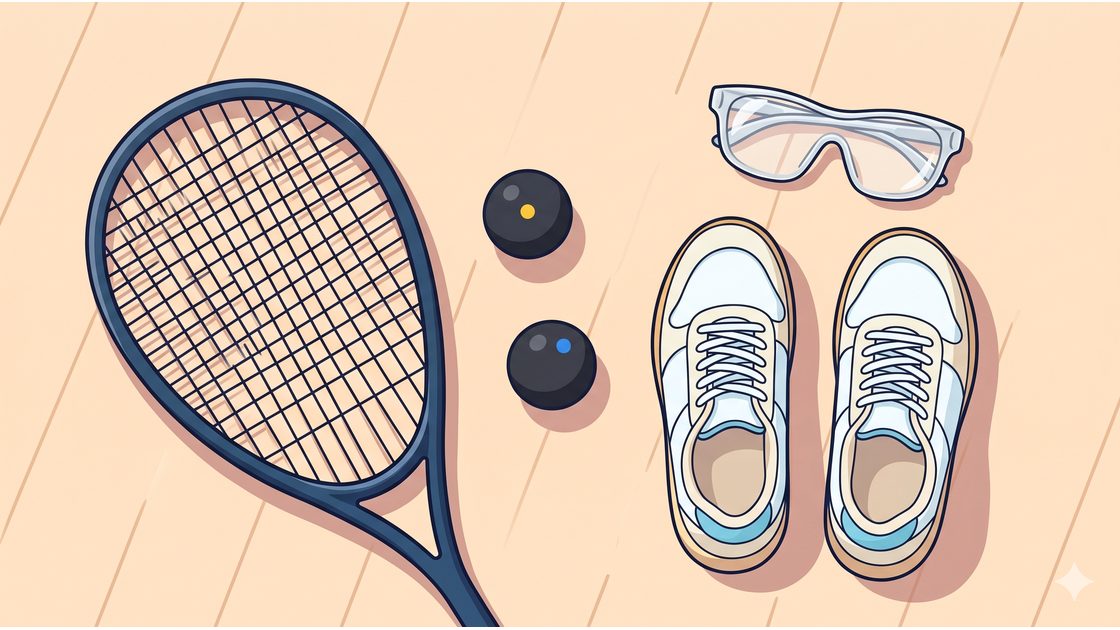
You need almost nothing to start squash, and every centre rents the two things that matter. A racket hires for roughly €3.50–€4, and a ball costs €1.50–€4.50 to borrow or buy, so your first session can cost only the court fee plus a couple of euros.
The one piece of kit you must bring is a clean pair of indoor shoes with non-marking soles — light-coloured gum soles that don’t streak the floor. This isn’t fussiness: every venue enforces it for hygiene, floor care and grip, and Sportcenter Wittenau is blunt that street shoes, joggers or anything worn outside are not allowed on court. Bring a second pair and change at the door.
Balls are colour-coded by speed, and beginners get this wrong constantly. The dots on the ball tell you how lively it is: a double-yellow dot is the slowest, lowest-bouncing ball used by advanced players, while a blue dot is the fastest and bounciest — the one you actually want when you’re learning, because it stays up long enough to hit. Start blue, work toward yellow as your swing improves. Eye protection isn’t mandatory for adults, but most centres recommend it for beginners and juniors, since a squash ball is small, hard and quick, and eye injuries are the sport’s most common mishap. A pair of squash goggles costs €20–€30 at any sports shop.
Finding an opponent at your level
Squash punishes a mismatch more than most sports, so finding someone near your level matters more than finding a court. Because the court is shared and rallies are continuous, a big gap in ability turns into a frustrating game for both people: the stronger player jogs through it while the weaker one sprints and still loses 11-2. A roughly even match, by contrast, is where squash becomes addictive — long rallies, real tactics, both of you genuinely tired afterwards.
The good news is that levels are easy to describe honestly. A true beginner is happy just keeping the ball alive and learning to clear out of the way; an intermediate can serve, volley and aim for the back corners; an advanced player controls the “T” in the middle of the court and moves you around at will. When you arrange a game, say where you sit — “total beginner, played twice” or “club-level, looking for a hard run” — and you’ll both have a far better hour.
This is exactly why a tool that lets you state your activity and your level beats hoping a friend happens to play. The same logic runs through finding a tennis partner or a table tennis partner in Berlin: the sport is only as good as the person on the other side of it. Squash just makes that truth louder, because there’s no team to hide in and no net to keep a safe distance.
Clubs, leagues and intro courses in Berlin
If you want to improve quickly or meet a stream of new opponents, a club beats casual court-hire. Airport Squash & Fitness at Tegel runs the most visible programme: a men’s training league on Monday evenings, a women’s league on Saturday mornings, two-week beginner intro courses, a junior academy and a Bundesliga team, all under a head coach. Sessions run around €12 a head and you don’t need to already be good — the intro courses exist precisely for people who’ve never picked up a racket.
Squash in Germany sits under the Deutscher Squash Verband (DSQV), founded in 1973 in Hamburg and now headquartered in Bocholt, which oversees twelve regional associations and the national league system. Berlin’s centres feed players into that pyramid, but you never have to touch it: most Berliners who play squash just book a court with a friend and never join anything formal. Clubs are there if you want structure, coaching and a ladder to climb; they’re optional if you just want a sweaty 45 minutes after work — the same low-commitment spirit as grabbing a gym session with a buddy and then unwinding in one of the city’s saunas, which several squash centres conveniently have on site.
Where squash came from
Squash was born by accident at Harrow School in England around 1830, when pupils playing the older game of rackets noticed that a ball with a puncture in it — one that “squashed” against the wall instead of bouncing back hard — made for a slower, more varied, more interesting game. That squashy ball gave the sport its name and its whole character: control and placement over raw power. From a school courtyard it spread through Britain and its trade networks into a global indoor game.
The sport is now run internationally by the World Squash Federation, founded in 1967 as the International Squash Rackets Federation and renamed the WSF in 1992, which standardises the rules, the court and that colour-coded ball system. Squash has chased Olympic recognition for decades and finally got it: the sport will make its Olympic debut at Los Angeles 2028, with men’s and women’s singles draws of sixteen players each, staged on the Universal Studios backlot. Nearly two centuries after a punctured ball in a Harrow yard, squash is heading to the Games — and you can play the same game on a Tuesday night in Lichtenberg.
Why squash lives or dies on your opponent
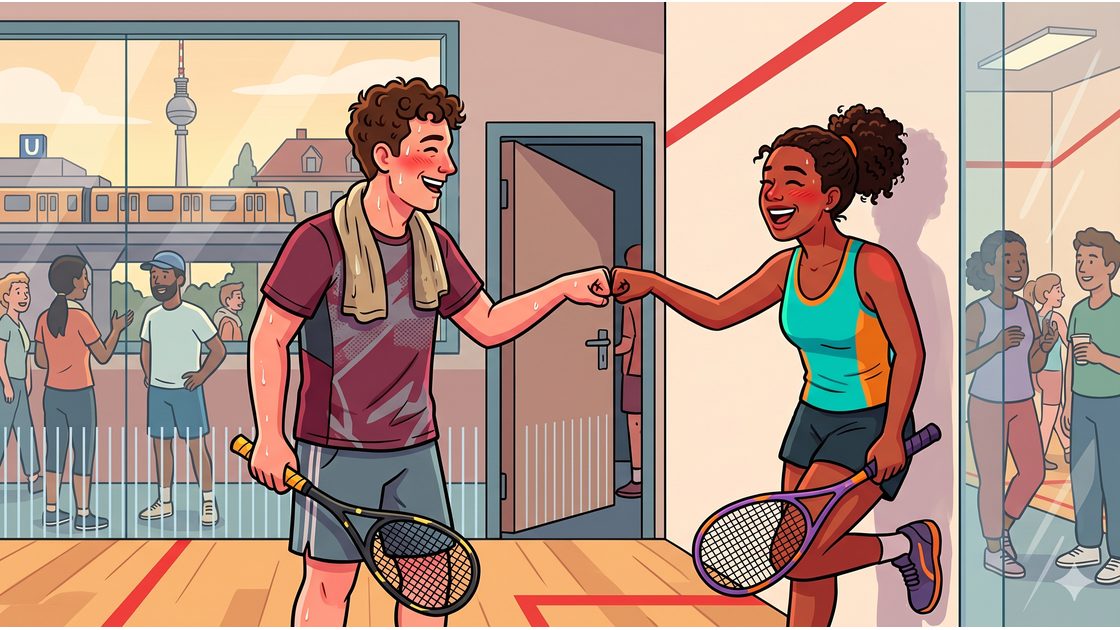
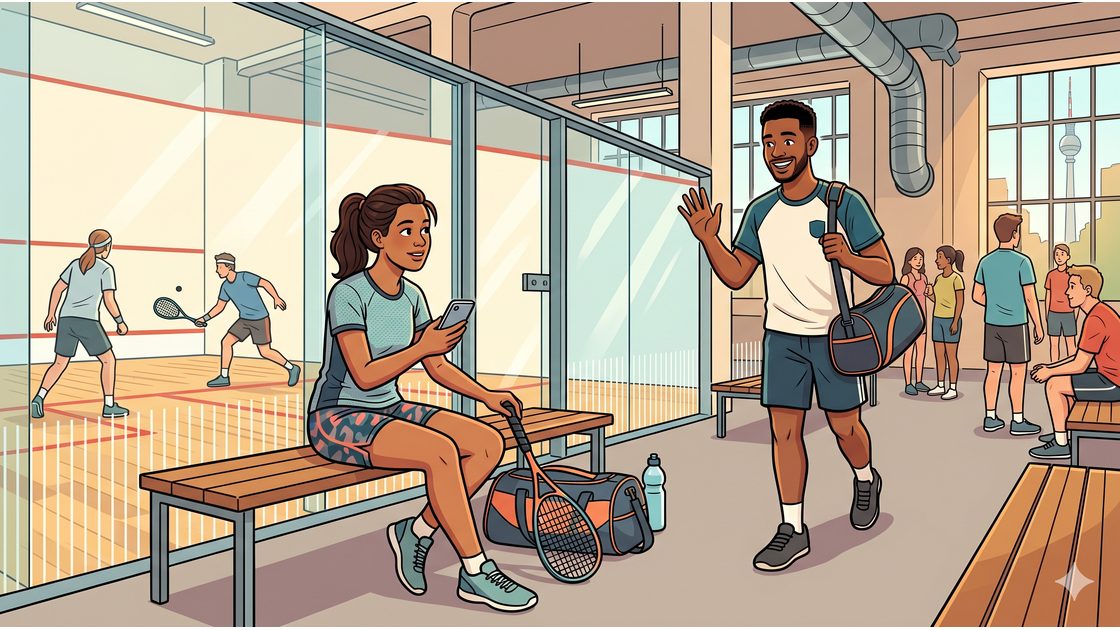
More than any sport in this series, squash is defined by the person across the court, because there literally is no game without them. You can run alone, swim alone, cycle alone, even practise squash alone by hitting against the front wall — but a game of squash needs exactly one other person who shows up, plays near your level and is up for it again next week. The court is cheap and always there; the reliable opponent is the rare part.
That’s also what makes it such a good way to build a connection. Forty-five minutes of fast, close, slightly silly rallies, both of you gasping and laughing by the end, is a fast track from stranger to regular. A lot of people in Berlin arrived without an established circle and find that a recurring Tuesday squash slot does more for their week than any amount of scrolling — it’s an appointment with a real person, in a real room, with a clear point to it. The hard part was never the squash. It was finding the someone.
How to find a squash partner in Berlin
The simplest way to find a squash partner in Berlin is MITRA: you open the app, send a squash request to people near you, and whoever’s up for a game accepts — then you pick a court and a time together. MITRA doesn’t pair you off automatically or decide who you play; you choose who to reach out to, and they choose whether to say yes. It’s built around activities exactly like this one, where the sport is ready and waiting and the only missing piece is a second person.
That fits squash perfectly. You’re not looking for a crowd or a team — you need one person, roughly your level, free for 45 minutes this week. State that you want to play squash, say whether you’re a first-timer or a club-level player, and arrange a court at Squash House, Wittenau or wherever’s closest to you both. The ones who say yes are the ones who actually want to play, which is the whole point.
Stop waiting for a friend who happens to play. Send a squash request to people near you on MITRA and book the court once someone says yes: Google Play · App Store
If squash isn’t quite your thing, the same approach works across the city — from an escape room with a small group to a game of badminton. Pick the activity; the person is the part MITRA helps with.
How we checked
We checked the current court counts, opening hours and 2026 prices on each venue’s own website in June 2026 (Squash House, Sportcenter Wittenau and Airport Squash & Fitness), and cross-referenced the rules, history and equipment facts against the World Squash Federation, England Squash, the Deutscher Squash Verband and Olympics.com. Prices and schedules change — always confirm on the venue’s booking page before you go.
Where can I play squash in Berlin?
The main dedicated squash venues are Squash House in Lichtenberg (nine courts), Sportcenter Wittenau in Reinickendorf (six courts, no membership), and Airport Squash & Fitness in the former Tegel terminal (eight courts, with leagues and coaching). There’s also Squash 2000 at Paramount Fitness in Friedrichshain and a free open-air squash wall on Tempelhofer Feld. Most let you book a court online and rent a racket on arrival, so you can turn up and play the same day.
How much does a squash court cost in Berlin?
Expect roughly €10–€21 for a 45-minute court, shared between two players. Squash House charges per person per unit (€10 in early afternoon up to €14 at peak), with student rates of €7 on weekday daytimes. Sportcenter Wittenau prices by the court: €16 in the morning, €21 in the evening, €19 at weekends, for up to two players. Racket hire adds about €3.50–€4 and a ball €1.50–€4.50.
Is squash good for beginners?
Yes. Squash looks faster than it is at first, and the basics — grip, where to stand, and clearing out of your opponent’s way — come quickly in the first session. Centre staff will point you to the right racket and ball, and several venues run beginner intro courses. Start with a blue-dot ball, which bounces more and stays in play longer than the pro double-yellow, so rallies last and you actually learn.
Do I need my own racket and gear?
No. Every squash centre in Berlin rents rackets (about €3.50–€4) and sells or lends balls (€1.50–€4.50), so you can start with nothing of your own. The one thing you must bring is a clean pair of indoor sports shoes with non-marking soles, changed at the door — street shoes are not allowed on the courts anywhere.
Do I need eye protection to play squash?
It isn’t legally required for adults, but most Berlin centres recommend it for beginners and juniors. A squash ball is small, hard and travels fast, and eye injuries are the most common squash injury, so protective goggles are a sensible buy. They cost around €20–€30 at any sports shop. For children and teenagers, eyewear is strongly advised.
How long does a game of squash take?
You typically book a court for 45 or 90 minutes, and the court is yours for exactly that window. A best-of-five match between evenly matched players runs roughly 30–50 minutes, but as a beginner you’ll spend most of a 45-minute slot rallying, practising serves and catching your breath. Allow about ten extra minutes to change and check in.
Can I play squash on my own?
You can book a court alone and practise by hitting against the front wall, which is a genuinely useful way to groove your swing in your first weeks. But squash is a one-on-one game, so for an actual match you need one other player. Apps like MITRA let you send a squash request to people nearby and arrange a game with someone at a similar level.
What’s the scoring in squash?
Modern squash uses point-a-rally scoring to 11: every rally awards a point to someone regardless of who served, and you win a game by reaching 11 with a two-point lead (so 10-10 continues until someone leads by two). Matches are usually best of five games. It’s quick to pick up — after a few rallies the counting feels natural.
Do I need a membership to play squash in Berlin?
Not at most venues. Sportcenter Wittenau and Squash House let you book a court pay-as-you-go with no membership or contract. Airport Squash & Fitness is more club-oriented and offers monthly memberships from around €36, which suit regular players who want league play and coaching. For an occasional game, simple court hire is cheaper and has no commitment.
Is squash a good workout?
Yes — squash is one of the most intense racket sports there is, combining short sprints, quick changes of direction and constant rallies in a small space. Even a beginner game gets your heart rate up fast, which is part of why a 45-minute slot feels like plenty. Pace yourself early, stay hydrated, and stop if you feel dizzy; the intensity sneaks up on first-timers.
Sources
- England Squash — History of squash (origins at Harrow School, c. 1830, from the game of rackets and the “squashed” ball): https://www.englandsquash.com/about-us/history-of-squash
- Olympics.com (IOC) — Squash: rules, players, origins and Squash arrives at the Olympics (point-a-rally scoring to 11, best of five; Olympic debut at Los Angeles 2028, men’s & women’s singles, Universal Studios lot): https://www.olympics.com/en/news/squash-rules-players-origins-things-to-know
- World Squash Federation — Ball specification (colour-dot speed system; double-yellow slowest, blue fastest) and court standard (9.75 m × 6.4 m): https://www.worldsquash.sport/ball-specification/
- German Squash Association (Deutscher Squash Verband, DSQV) — Wikipedia, citing DSQV (founded 1973 in Hamburg; headquartered in Bocholt; twelve regional associations; renamed from DSRV in 2006): https://en.wikipedia.org/wiki/German_Squash_Association
- Squash House Berlin — official prices page (squash unit rates, student €7, rental fees; nine courts; Vulkanstr. 3, 10367 Berlin), checked June 2026: https://www.squash-house.de/en/preise/
- Sportcenter Wittenau — official squash page (six courts, €16–€21 per 45 min, no membership, indoor-shoe rule, blue vs yellow ball advice; Wittenauer Str. 82–86, 13435 Berlin), checked June 2026: https://sportcenter-wittenau.de/en/squash/
- Airport Squash & Fitness — official site (eight courts at former Tegel airport; men’s/women’s leagues, intro courses, junior academy, head coach; membership from €36/month), checked June 2026: https://www.airportsquash.de/
Want to keep reading?
- Where to play badminton in Berlin
- How to find a tennis partner in Berlin
- How to find a table tennis partner in Berlin
- How to find a gym buddy in Berlin
- The best saunas in Berlin
One more game? MITRA is how Berliners find someone to actually play with — send an activity request, and the people who are up for it say yes. Google Play · App Store
Follow MITRA on Instagram @mitra.social for more ways to meet people through what you love to do. Berlin first. Bucharest and more EU cities coming soon.