Locked in for 60 minutes: escape rooms in Berlin
Escape rooms in Berlin, from Mitte prisons to Friedrichshain ghost ships: the best rooms, English games, prices and how many people you need.
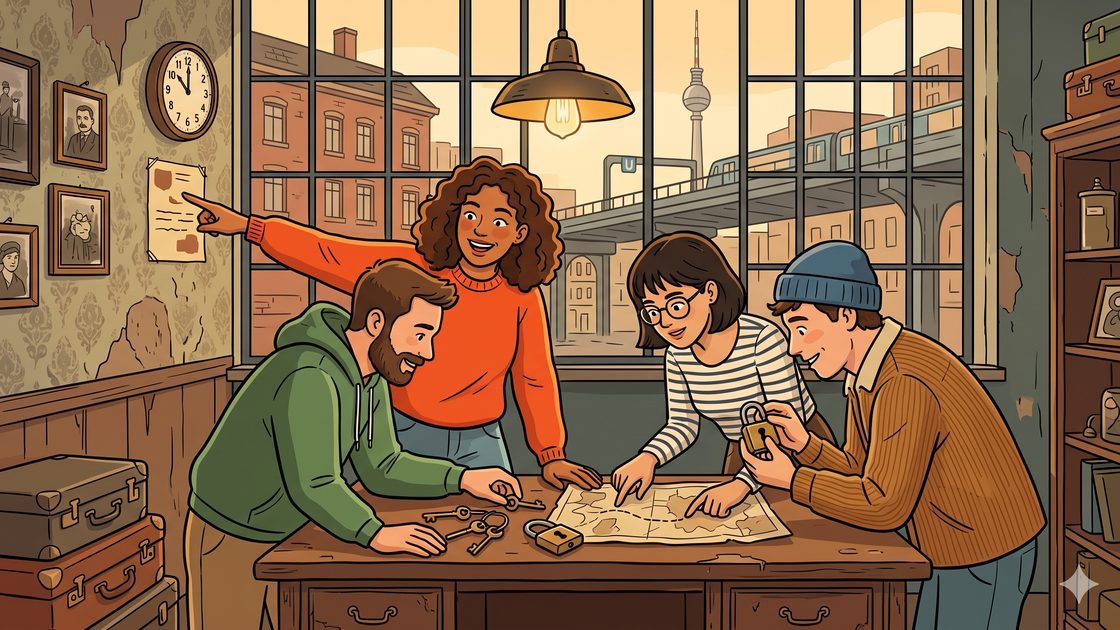
Escape rooms in Berlin are themed, timed puzzle games where a small team is shut into a designed set — a steampunk prison, a ghost ship, a 1920s speakeasy — and has 60 minutes to find the clues, crack the codes and open the door before the clock runs out. The city has dozens of them, clustered in Mitte, Friedrichshain, Charlottenburg and Kreuzberg, most playable in English as well as German, and most built for two to six players. The puzzles are the easy part to find. The harder part is rounding up the three or four people you actually want to be locked in a room with.
The short version:
- What it is: a 60-minute live game where your team searches a themed room for clues, solves linked puzzles, and unlocks the exit. No experience needed; most rooms welcome total beginners.
- Where to go: EXIT Escape Room Games (Mitte, under the Admiralspalast), Final Escape (Prenzlauer Berg), TeamEscape and Mission Accepted (Europa-Center, Charlottenburg), Make a Break and Smartroom (Friedrichshain), Exitroom (Mitte), and the bar-set Prohibition Berlin at Sally Bowles (Schöneberg).
- Language: the major venues run every room in English and German — confirm when you book.
- Group size: rooms are usually designed for 2–6; four is the sweet spot. Two can feel thin; eight gets crowded.
- Price: expect roughly €25–€45 per person, cheaper per head the bigger your group. Final Escape, for example, charges €90 for two and €190 for six.
- The catch: you need a team. On MITRA you send an activity request to people nearby, the ones who fancy it say yes, and you turn up to a full room instead of cancelling for lack of a fourth.
Always wanted to try one but never had the four people? Sort the team, then book the room. MITRA is a free app for finding someone nearby to do an activity with — a 60-minute scramble through a themed room very much included. You send a request to people near you, and meet the ones who say yes.
Contents
- How an escape room in Berlin actually works
- The best escape rooms in Berlin right now
- Escape rooms you can play in English
- How many people you actually need
- Easy, hard or terrifying: picking a room by difficulty
- What an escape room in Berlin costs
- Booking, timing and what to expect on the day
- Where the escape room came from
- Why escape rooms work best with the right small group
- How to find people to do an escape room with in Berlin
- How we checked
- Frequently asked questions
- Sources
How an escape room in Berlin actually works
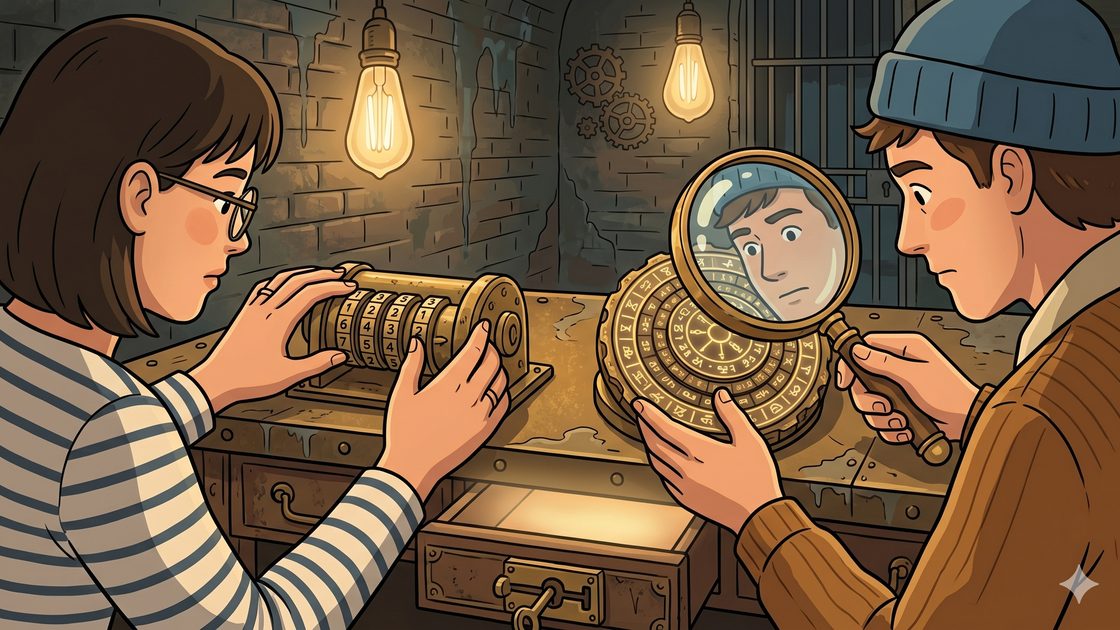
An escape room is a physical game, not a maze or a haunted house: you are not chased, and you are not really locked in against your will — the door can always be opened in an emergency. You and your team enter a themed set, a games master starts a 60-minute countdown, and you work the room. You search for hidden objects, spot patterns, combine clues, and feed answers into locks, keypads and increasingly into hidden electronics that trigger the next reveal. Solve the chain in time and the final door opens; run out of clock and the games master walks you through what you missed.
The “story” is what separates a good Berlin room from a flat one. The strongest local sets — Make a Break’s lifelike reconstruction of the Berlin Wall in Friedrichshain, EXIT’s old-sanatorium and Babylon-Berlin missions in Mitte — put the puzzles inside a world rather than scattering padlocks on a table. A games master watches on camera the whole time and drips hints through a screen or speaker when you stall, so a beginner team rarely gets truly stuck for long.
One honest expectation: your first room can feel chaotic. Sixty minutes goes fast, everyone talks at once, and the first ten minutes are usually just learning how to search properly. That is normal, and it is most of the fun.
The best escape rooms in Berlin right now
Berlin’s escape rooms spread right across the city, so the practical question is less “which is best” and more “which is near me, in my language, at my difficulty.” Here is a working shortlist of established venues, what they are known for, and where to find them.
EXIT Escape Room Games — Friedrichstraße 101, Mitte (directly beneath the Admiralspalast). One of the biggest operators in the city, with rooms running from a secret prison and a steampunk alley to an old sanatorium and a Babylon-Berlin set, plus a two-team “battle mode.” A reliable, high-production first stop if you are central.
Final Escape — Prenzlauer Allee 23, Prenzlauer Berg. Six story-driven rooms — a prison break, a ghost ship, “The Puppeteer,” “Robot Paranoia” — with difficulty clearly labelled and a minimum age of 16. Known for detailed, atmospheric sets for people who want to be properly spooked.
TeamEscape Berlin — Europa-Center, Tauentzienstraße 9–12, Charlottenburg. Five rooms in the Europa-Center basement, every one playable in English and German, briefing included. Central, beginner-friendly, easy to reach from Zoologischer Garten.
Make a Break — Müggelstraße 8, Friedrichshain. The most “Berlin” of the lot: tear down the Wall, take down a local crime boss, or survive a zombie outbreak, with VR used in some rooms and a striking physical Wall reconstruction.
Exitroom Berlin — An der Kolonnade 4 and Wilhelmstraße 92, Mitte. Around ten rooms across two locations, from a bunker escape to film-flavoured fantasy worlds and a zombie mission — and a restaurant attached for the post-game debrief.
Prohibition Berlin at Sally Bowles — Eisenacher Straße 2, Schöneberg. An escape game built into a working 1920s-style bar near Nollendorfplatz: a police raid hits the speakeasy and you have to vanish underground. Play first, drink after, same address.
| Venue | District | Known for | Languages |
|---|---|---|---|
| EXIT Escape Room Games | Mitte | Big, polished sets; battle mode | DE / EN |
| Final Escape | Prenzlauer Berg | Atmospheric, scarier rooms (16+) | DE / EN |
| TeamEscape | Charlottenburg | Central, beginner-friendly | DE / EN |
| Make a Break | Friedrichshain | Berlin-themed, some VR | DE / EN |
| Exitroom | Mitte | Ten rooms, two sites, restaurant | DE / EN |
| Prohibition Berlin | Schöneberg | Escape game inside a 1920s bar | DE / EN |
Found a room you like but no one to book it with? That is the usual order of events — the room is easy, the team is the bit that stalls. MITRA lets you send an activity request to people near you and gather a group for a specific plan, so the booking actually gets made.
Escape rooms you can play in English
Most of Berlin’s larger escape rooms run every game in both English and German, which makes them one of the easiest group activities in the city for a mixed or international group. TeamEscape states that both the briefing and the in-room puzzles work in either language; EXIT, Final Escape, Exitroom and Make a Break all advertise English play. Smaller or more text-heavy rooms — anything built around German wordplay or local history — can lose a little in translation, so it is worth a one-line check when you book: “Is this room fully playable in English, puzzles included?”
This is also why an escape room is a good fit if you have just arrived and your German is still landing. It is a shared task with a clear goal, it does not depend on small talk, and it gives a new group something to do with their hands and heads for an hour. If you are mixing languages on purpose, pair it with a language exchange in Berlin and let the room do the ice-breaking.
How many people you actually need
Most Berlin rooms are designed for two to six players, and four is the number most games masters quietly recommend. With four, every puzzle has someone on it, no one stands around, and the room rarely feels crowded. Two people can absolutely play — it is more intense and you will feel every gap in your knowledge — but a tricky 60-minute room is genuinely hard for a pair. Five or six is lively and forgiving for beginners, though once you pass six in a standard room, people start tripping over each other and a chunk of the group ends up spectating.
If you have a bigger crowd, look for venues built for it: Mission Accepted at the Europa-Center runs city rallies for very large groups, and several operators let you book two rooms in parallel and race team against team. For a casual first try, though, gather four and pick one room. It is the cleanest version of the experience.
Easy, hard or terrifying: picking a room by difficulty
Berlin venues usually rate their rooms on two separate scales — puzzle difficulty and scare/intensity — and they are not the same thing. A room can be gentle on the brain but heavy on atmosphere, or a fiendish logic box with no jump-scares at all. Final Escape labels difficulty on each room precisely because a ghost-ship horror set and a beginner mystery are very different evenings.
For a first room, aim for a labelled “beginner” or mid-difficulty mystery, adventure or heist theme rather than a flagship “expert” room — you want to actually finish, and a 60-minute success is far more fun than a heroic failure. Save the horror rooms (and the 16+ or 18+ sets, like some at Final Escape) for when at least one person in the group knows the ropes. If anyone is claustrophobic or anxious, say so when booking: staff can recommend a brighter, roomier set and explain the in-room panic button, which every legitimate Berlin venue has.
What an escape room in Berlin costs
Expect to pay roughly €25–€45 per person for a standard 60-minute room, and crucially, the price per head drops the more of you there are — most venues price per room, then scale by group size. Final Escape’s published pricing is a clear example: €90 for two players, €115 for three, €140 for four, €165 for five and €190 for six. That is €45 each for a pair but closer to €32 each for a group of six, which is part of why bringing a full team is both more fun and better value.
Outdoor and mobile formats sit lower: EXIT Game’s “Spy and Escape at the Berlin Wall” outdoor mission runs about €19.50 per person, and city-rally style games can start under €15. VR escape rooms tend to run a little higher than classic ones. Whatever the format, book online in advance — walk-up availability is unreliable, especially on Friday and Saturday evenings.
Booking, timing and what to expect on the day
Book your slot online a few days ahead, arrive about 15 minutes early, and plan for the whole visit to take around 90 minutes rather than just the 60 inside the room. You will get a short safety and story briefing, lock your phones and bags away (most rooms ban photos inside to protect the puzzles), then play your hour, then spend ten minutes on the games master’s debrief and the inevitable group photo with a “we escaped” sign.
A few practicalities worth knowing: wear comfortable clothes and flat shoes, because you will be crouching, reaching and occasionally crawling. Don’t force or break anything — if a clue needs a key or code, it is never behind brute strength. Use your hints; a good team treats the three free clues as a tool, not a failure. And eat first or after, not during, since most rooms have no break. Pair the evening with something nearby afterwards — a board game over drinks in the same spirit as playing chess in Berlin, or a proper unwind at one of the best saunas in Berlin the next day.
Where the escape room came from
The physical escape room is barely fifteen years old, which surprises most first-timers. The format was born from video games: in 2007 the Japanese company SCRAP, led by Takao Kato, staged the first “Real Escape Game” in Kyoto, turning the logic of point-and-click “room escape” computer games — themselves popularised by Toshimitsu Takagi’s 2004 Flash game Crimson Room — into a real space with a real ticking clock. The first escape room in Europe followed in 2011, when Attila Gyurkovics opened ParaPark in Budapest, designed less as a tourist attraction than as a kind of experiment in teamwork and problem-solving under pressure.
From there it spread fast. Scott Nicholson’s 2015 academic survey of 175 facilities worldwide documented how quickly the idea jumped from Japan and Hungary to London, New York and on into Germany, where Berlin became one of the densest escape-room cities in Europe. The Berlin twist, fittingly, is history: a striking share of the city’s rooms — Wall escapes, Cold War bunkers, 1920s speakeasies — turn the place’s own past into the puzzle.
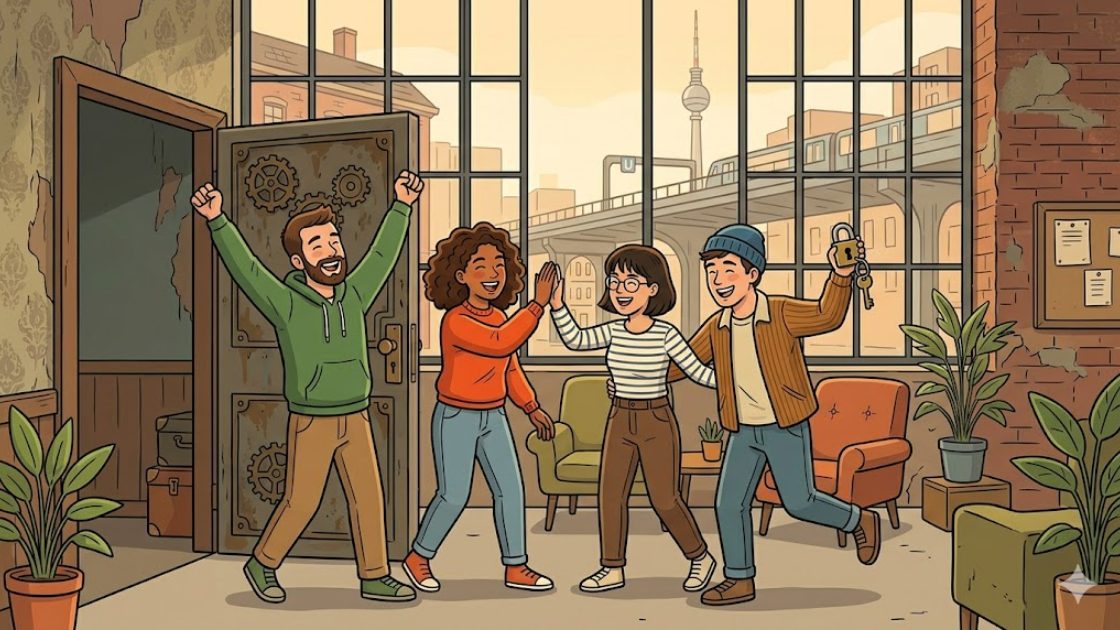
Why escape rooms work best with the right small group
An escape room is one of the few activities that is structurally impossible to do well alone, and that is precisely its social value. The format forces a small group to talk constantly, split tasks, hand off half-solved puzzles, and trust whoever shouts “I’ve got a four-digit lock here.” An hour of that does more for a new friendship than an evening of polite drinks, because you see how people actually think and cooperate under a mild, friendly pressure. People leave a room knowing each other better than they did 60 minutes earlier — that is the real product, not the padlocks.
It is also a low-stakes way to meet people if you have moved to Berlin recently and your social circle is still thin. There is a clear shared goal, you are too busy to feel awkward, and “want to try an escape room?” is a much easier ask than “want to hang out?” The only missing ingredient is usually the other three people — which is the one part Berlin’s venues can’t supply.
You bring the curiosity; we’ll help with the other three players. MITRA is a free app for meeting people nearby around a real activity. Send an escape-room request to people near you, see who says yes, and book the room for a night that’s actually in the calendar.
How to find people to do an escape room with in Berlin
The simplest way to get a team together is to make the plan first and find the people second, and that is exactly what MITRA is built for. Instead of waiting for a free evening to line up across an existing friend group, you open the app, send an activity request to people near you who are also up for an escape room, and the ones who want to go accept. You agree a venue and a slot together, and you turn up as a group of four to a room you would never have booked alone.
It works well for escape rooms specifically because the activity has a built-in shape: a clear plan, a fixed time, a small group, a public venue, and a shared goal that carries the conversation. If the room becomes a regular thing, the same approach gets you to the next plan — a bowling night in Berlin, a casual badminton session, or whatever the group lands on next. The room is the excuse; the people are the point.
How we checked
We cross-checked venue locations, room counts, themes and language options against each operator’s own listings and Berlin’s official city tourism guide (visitBerlin) in June 2026, and used Final Escape’s published price list and EXIT’s stated group recommendations for the pricing and group-size figures. Details like room line-ups and exact prices change — confirm directly with the venue when you book.
Frequently asked questions
What is an escape room in Berlin?
An escape room in Berlin is a live, themed puzzle game where a small team is shut into a designed set and has 60 minutes to find clues, solve linked puzzles and unlock the exit before time runs out. The door can always be opened in an emergency, and a games master watches throughout to give hints. Rooms range from light mysteries to atmospheric horror, and most welcome complete beginners with no experience needed.
How much does an escape room cost in Berlin?
A standard 60-minute room costs roughly €25–€45 per person, and the price per head falls the larger your group, because venues price per room and scale by team size. Final Escape, for instance, charges €90 for two players up to €190 for six — about €45 each as a pair but closer to €32 each in a group of six. Outdoor and city-rally formats can start under €15 per person.
Can you play escape rooms in Berlin in English?
Yes. Most of the larger venues — TeamEscape, EXIT, Final Escape, Exitroom and Make a Break — run every room in both English and German, including the briefing and the in-room puzzles. Smaller rooms built around German wordplay or local history can lose a little in translation, so it is worth asking “Is this room fully playable in English?” when you book. Berlin is one of the easiest cities for an international group on this front.
How many people do you need for an escape room?
Most Berlin rooms are designed for two to six players, and four is the number most games masters recommend. With four, every puzzle has someone working it and nobody stands idle. Two can play but it is intense and harder to finish a tricky room; five or six is lively and forgiving for beginners. Beyond six in a standard room it gets crowded, so larger crowds should book parallel rooms or a city-rally format.
Are Berlin escape rooms scary?
Some are, many are not. Venues usually rate puzzle difficulty and scare level separately, so you can choose a gentle mystery, a heist or an adventure with no horror at all, or a deliberately frightening set like Final Escape’s ghost ship. Horror rooms often carry a 16+ or 18+ age limit. If anyone is anxious or claustrophobic, tell the staff when booking — they can suggest a brighter, roomier room and point out the panic button every legitimate venue provides.
Do you need experience to try an escape room?
No. The large majority of Berlin rooms are built for first-timers, and the games master gives you a full briefing plus hints during the game, so a beginner team rarely gets badly stuck. For a first visit, choose a room labelled beginner or mid-difficulty rather than a flagship “expert” set — finishing in time is far more satisfying than narrowly failing. Your first ten minutes will feel chaotic; that is normal and part of the fun.
Where are the best escape rooms in Berlin?
Strong, established options include EXIT Escape Room Games in Mitte (under the Admiralspalast), Final Escape in Prenzlauer Berg, TeamEscape at the Europa-Center in Charlottenburg, Make a Break in Friedrichshain for Berlin-themed rooms, Exitroom in Mitte across two sites, and the bar-set Prohibition Berlin at Sally Bowles in Schöneberg. “Best” depends on your location, language and the difficulty you want, so pick by district and theme rather than reputation alone.
How long does an escape room take?
The game itself is 60 minutes, but plan for the whole visit to take around 90. You arrive about 15 minutes early for a safety and story briefing, lock away phones and bags, play your hour, then spend roughly ten minutes on the games master’s debrief and a group photo. Booking online a few days ahead is wise, especially for Friday and Saturday evenings, which sell out fastest.
Can two people do an escape room in Berlin?
Yes, many rooms allow two players, but it is the hardest way to play — a pair has to cover every puzzle with no backup, and a tough 60-minute room can be a stretch. If it is your first time, a group of three or four is much more forgiving and usually the same total price split further. If you only have one other person, ask the venue which of their rooms suits a duo; some are tuned for smaller teams.
Is an escape room a good way to meet people in Berlin?
It is one of the better ones. The format forces a small group to talk, divide tasks and cooperate under friendly pressure for a full hour, so you learn how people actually think — which builds a connection faster than drinks. It suits newcomers because there is a clear shared goal and little room for awkwardness. The usual obstacle is simply assembling a team, which is where an app like MITRA helps: send a request, gather four,&�ok the room.
Sources
- visitBerlin (official Berlin city tourism), “Top 11 escape rooms in Berlin” — venue list, locations, themes and ages. https://www.visitberlin.de/en/blog/top-11-escape-rooms-berlin
- Final Escape Berlin, “Prices & Booking” — per-group pricing (2–6 players). https://final-escape.com/berlin/en/prices-booking/
- TeamEscape Berlin — rooms, English/German play, Europa-Center location. https://teamescape.com/en/berlin/escape-rooms/
- EXIT Game Berlin — group-size recommendation and outdoor “Spy and Escape at the Berlin Wall” pricing. https://www.exit-game.de/en/buchen
- Scott Nicholson (2015), “Peeking Behind the Locked Door: A Survey of Escape Room Facilities” (white paper, survey of 175 facilities) — origins (SCRAP, Japan, 2007; ParaPark, Budapest, 2011) and global spread. https://scottnicholson.com/pubs/erfacwhite.pdf
- Atlas Obscura, “Inside the Budapest Escape Room That Started the Worldwide Craze” — ParaPark and Attila Gyurkovics, 2011. https://www.atlasobscura.com/articles/inside-the-budapest-escape-room-that-started-the-worldwide-craze
Berlin first. Bucharest and more EU cities coming soon. Follow MITRA on Instagram @mitra.app for the activities people are actually meeting up for this week.
Stop waiting for the stars to align with your existing friends. MITRA is a free app for finding people nearby to do real things with — escape rooms, bowling, a Sunday hike. Send an activity request, meet the ones who say yes, and get the plan into the calendar.
If a shared challenge in the dark appeals, our guide to laser tag in Berlin lists seven arenas by price and age.