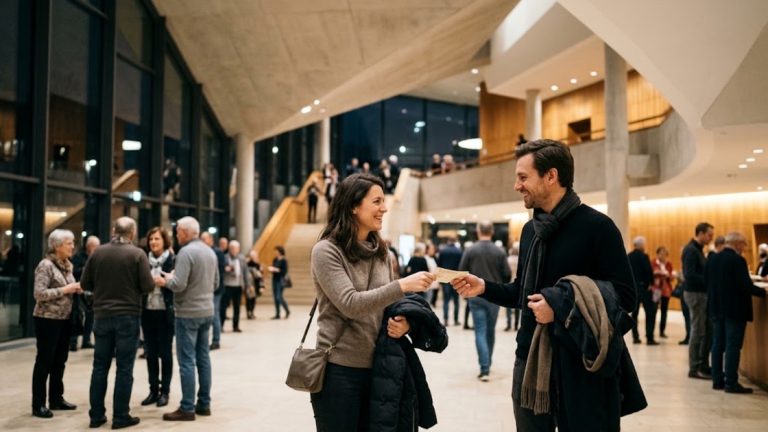
Tenpin lanes and basement Kegelbahnen: bowling in Berlin
Bowling in Berlin, from modern tenpin centres like Lane7 to vintage basement Kegelbahnen — prices, cosmic nights and how to fill a lane with people.
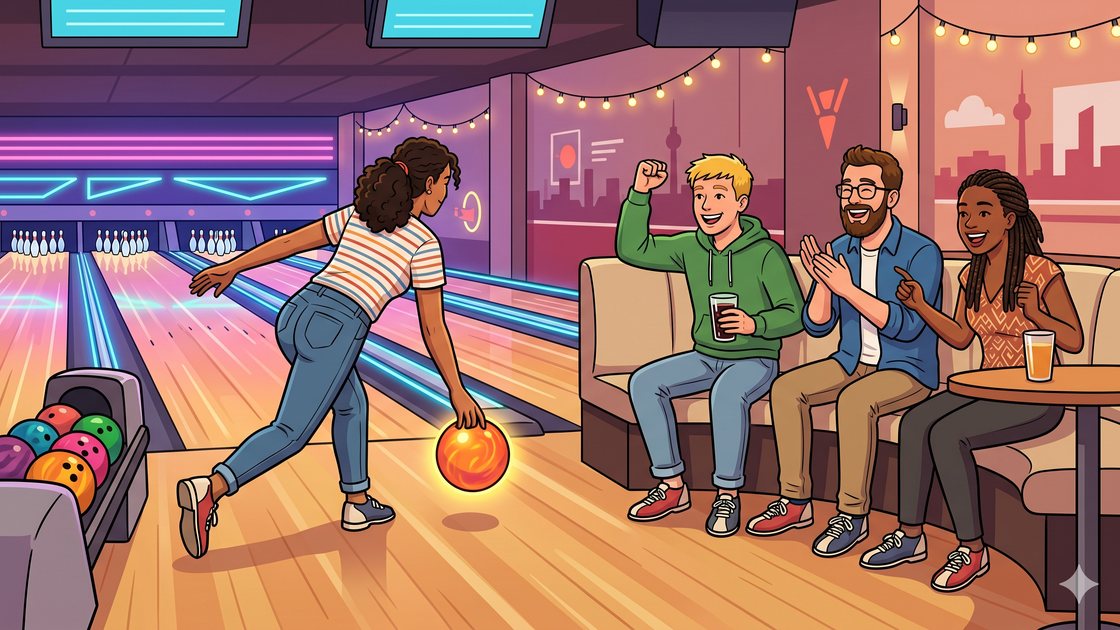
Bowling in Berlin comes in two very different shapes: the big, modern tenpin centres with glow-in-the-dark lanes and a bar — like Lane7 on Potsdamer Platz, Bowling World in Friedrichshain or BowlHouse in Prenzlauer Berg — and the city’s quieter secret, vintage nine-pin Kegelbahnen tucked into the basements of old pubs. You can roll a casual game for a couple of euros, book a full lane for a group, or go down some creaky stairs to a 1970s skittle alley and set the pins by hand. Either way, the lane is the easy part. The thing worth sorting first is who you’re going with.
The short version:
- Two kinds of bowling exist here. Modern tenpin centres (Lane7 at Potsdamer Platz, Bowling World in Friedrichshain, BowlHouse near Storkower Straße, the Bowling Center at Alexanderplatz) and old-school Kegelbahnen — German nine-pin lanes hidden under bars.
- Two ways to pay. Either per lane, per hour (Bowling World runs roughly €36–46 a lane; Alexanderplatz from €11.40–15.60) or per game, per player (BowlHouse from about €1.60 on a Sunday to €3.80 at peak) — the second is far cheaper for two people.
- Shoes are always extra (about €2–3) and you should reserve for Friday and Saturday nights, which sell out.
- Berlin’s real charm is the Kegelbahn. Bars like Tante Lisbeth in Kreuzberg and the 1911 Bornholmer Hütte in Prenzlauer Berg keep antique nine-pin lanes alive in their cellars.
- Bowling is a group game. On MITRA you send a bowling request to people nearby, and the ones who fancy it say yes — so you turn up to a full lane, not an empty one.
Been meaning to organise a bowling night that never quite happens? Stop organising, start asking. MITRA is a free app for finding someone nearby to do an activity with — a lane of clattering pins very much included. You send an activity request to people near you, and meet the ones who say yes.
Contents
- Where to go bowling in Berlin: the big tenpin centres
- What bowling in Berlin actually costs
- Cosmic bowling and late-night lanes
- Berlin’s other lane: the basement Kegelbahnen
- Bowling or Kegeln: what’s the difference?
- How to get a lane: booking, shoes and groups
- Where bowling came from
- Why bowling is better with a few people
- How to find people to go bowling with in Berlin
- Frequently asked questions
- Sources
Where to go bowling in Berlin: the big tenpin centres
The best-known places to bowl in Berlin are the modern tenpin centres, where automatic pinsetters, on-screen scoring and a bar are all under one roof. Four cover most of the city. Lane7 sits right on Potsdamer Platz and is less a bowling alley than a games bar — bowling alongside mini golf, darts, karaoke, shuffleboard and beer pong, built for a night out rather than a serious league. Bowling World Berlin, over at Über Platz in Friedrichshain near Ostbahnhof, is a big classic centre with a lounge, a grill, pool tables and league nights. BowlHouse on Storkower Straße in Prenzlauer Berg is the no-frills, pay-per-game local. And the long-running Bowling Center at Alexanderplatz keeps things central and family-friendly, with a special children’s lane that has bumper cushions in the gutters.
Each leans a different way, so it’s worth matching the venue to the evening. Lane7 is the pick for a birthday or a mixed group who’ll wander between games; Bowling World suits a bigger crew that wants food, drinks and a proper centre; BowlHouse is where you go to actually bowl a few cheap games without a clock ticking on a whole lane; and Alexanderplatz is the easy, central choice if you’ve got kids or you’re meeting people coming from all over town. If you like the “book a slot and play” rhythm, it’s the same one you’d use to play badminton in Berlin — reserve ahead, bring flat-soled shoes, show up on time.
| Venue | District | How you pay | Good for |
|---|---|---|---|
| Lane7 | Potsdamer Platz (Mitte) | Per person, packages from €14.50 | Groups, birthdays, a games-bar night |
| Bowling World | Friedrichshain (Über Platz) | Per lane/hour, ~€36–46 | Big crews, food + drinks, leagues |
| BowlHouse | Prenzlauer Berg (Storkower Str.) | Per game/player, from €1.60 | Cheap casual games, no time pressure |
| Bowling Center Alexanderplatz | Mitte (Alexanderplatz) | Per lane/hour, from €11.40 | Central meet-ups, families, kids |
| Tante Lisbeth / Bornholmer Hütte | Kreuzberg / Prenzlauer Berg | Per hour, ask at the bar | Old-school nine-pin Kegeln, atmosphere |
The practical takeaway is that “bowling in Berlin” isn’t one experience but several, and the cheapest, most central and most atmospheric options are rarely the same place. Decide whether you want a slick night out, a budget game or a slice of old Berlin first — then pick the lane to match.
What bowling in Berlin actually costs
Bowling in Berlin is priced one of two ways, and which one you meet decides whether an evening is cheap or pricey. The traditional centres charge per lane, per hour, with up to six people sharing that lane: Bowling World, for example, lists roughly €36 for a daytime weekday hour, rising to about €46 on a Friday or Saturday night, with one-off shoe hire at €3. The Bowling Center at Alexanderplatz works the same way but lower, from €11.40 an hour midweek to €15.60 at the weekend, with shoes at €1.90. Split between a full lane of friends, the per-hour model is good value; for just two people it’s an expensive way to bowl, because you’re paying for four empty seats.
The other model is per game, per player, and it’s the budget route. BowlHouse charges by the individual game: as little as €1.60 all day Sunday, €2.50 for a daytime game midweek, and €2.80–3.80 in the busy evening slots, with shoe rental €2 and socks €1 if you forgot them. Seniors over 55 and children under 14 bowl for €2 a game in the daytime. For a pair who want three or four games, paying per game rather than renting a whole lane by the hour can roughly halve the bill. It is, frankly, one of the cheaper nights out in the city — closer to the price of a sweaty hour over the net at one of Berlin’s table-tennis spots than to a big organised outing.
Two small costs catch people out. Bowling shoes are compulsory and always rented — the flat, non-marking soles protect the approach — so budget a couple of euros per person on top. And the headline price almost never includes food and drink, which is where a centre quietly makes its money; a round of drinks can outweigh the bowling itself. None of it is expensive by Berlin standards, but check whether you’re booking a lane or buying games before you turn up, because the two add up very differently.
Got a number in your head but no one to fill the lane? That’s exactly the gap MITRA closes. Send a bowling request to a few people near you, and the ones who are up for it say yes — six seats filled, cost split, no group-chat wrangling.
Cosmic bowling and late-night lanes
If you want bowling with the lights down, look for “cosmic” or “disco” bowling — lanes lit by UV blacklight, with louder music and a club-ish feel, usually on Friday and Saturday nights. BowlHouse runs its cosmic bowling from 21:00 on Fridays and Saturdays, with the pins and balls glowing under the ultraviolet light and the music turned up, at €3.80 a game. The bigger centres lean into the same idea at the weekend, and Lane7’s whole format — neon, cocktails, a DJ-ish energy across bowling, darts and karaoke — is essentially cosmic bowling stretched into a full night out.
The reason to know the difference is that cosmic sessions change who’s there and what it feels like. Daytime and early-evening bowling is relaxed, family-friendly and easy to talk over; the late UV slots are louder, busier and more of a party, and they’re the ones that sell out first. If you’re after a calm catch-up, go before 18:00; if you want the night to roll on, the glow-in-the-dark weekend slots are made for it — and the same after-dark, lights-down energy you’d find at one of Berlin’s late-night saunas and spas, just with more clatter.
Berlin’s other lane: the basement Kegelbahnen
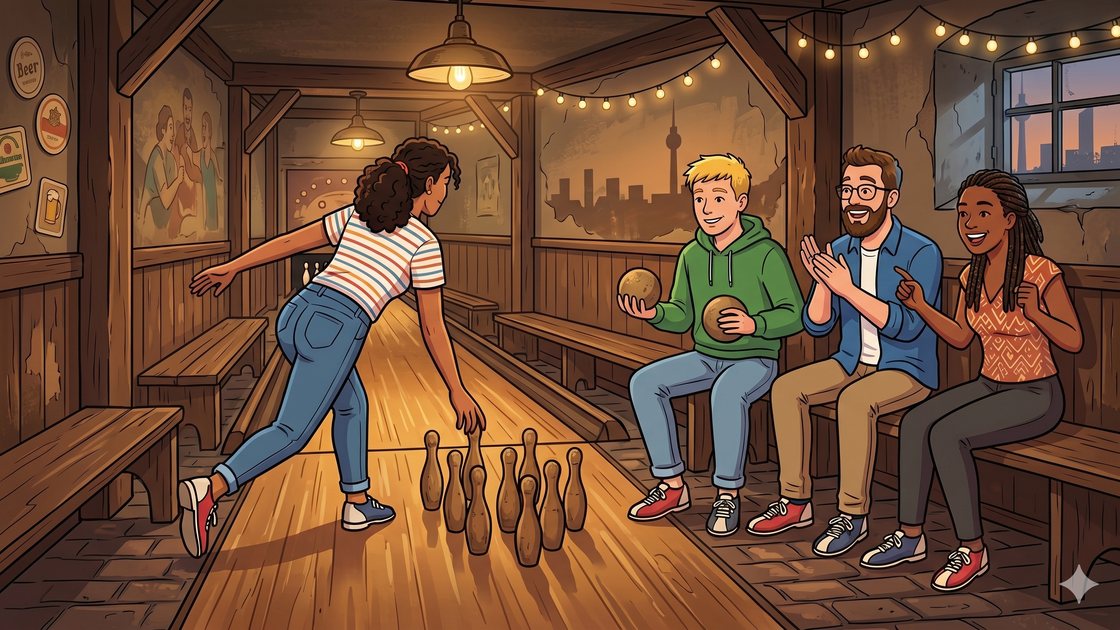
Berlin’s most charming bowling isn’t in a centre at all — it’s down a narrow staircase under an old pub, on a vintage Kegelbahn, the German nine-pin lane that predates tenpin by centuries. These are not slick: you’ll often find two lanes of worn, polished wood in a low cellar, smaller balls with no finger holes, and in the oldest places, pins you set back up by hand because there’s no machine. What they have instead is atmosphere — wood panelling, dim light, a bar at the top of the stairs and the sense that people have been rolling balls down this exact strip of timber for generations.
A handful are Berlin institutions. Tante Lisbeth on Muskauer Straße in Kreuzberg hides a 1970s Kegelbahn in its basement, all wood panels and neon, with play ending around 22:00 so the neighbours stay friendly. Bornholmer Hütte on Bornholmer Straße in Prenzlauer Berg claims the oldest lane in the city, dating to 1911 — old enough that you reset the skittles yourself after every throw. Over in Wedding, Kugelbar on Grüntaler Straße keeps the rough-edged, old-Berlin spirit alive, and Figl in Kreuzberg pairs one of the city’s better pizzas with a genuine old Kegelbahn out the back. You generally book the lane by the hour through the bar, gather a small group, and make an evening of it.
Going Kegeln rather than bowling is one of those small things that makes you feel like you actually live in Berlin rather than just visiting it. It’s cheap, deeply local, and gloriously analogue — no screens keeping score, just chalk, a notepad and an argument about whose turn it is. For a newcomer it’s also a brilliant icebreaker, the kind of only-here experience that’s far easier to share than to do alone — much like puzzling out a board over coffee at one of the city’s chess cafés.
Bowling or Kegeln: what’s the difference?
The simplest answer is that bowling has ten pins and Kegeln has nine, but the two games feel quite different on the lane. Tenpin bowling is the American import: ten pins in a triangle, heavier balls drilled with three finger holes, wide synthetic lanes with automatic pinsetters and a screen totting up your score. Kegeln is the older German game: nine pins set in a diamond, a smaller, hole-less ball you cradle in your palm, and narrower wooden lanes — sometimes with a string-and-pulley pinsetter, sometimes nothing but your own hands. Germany even keeps three regional Kegeln variants (Classic, Schere and Bohle) alive alongside tenpin, all under one national federation.
For a casual night, the differences that matter are practical. Kegeln balls are lighter and have no holes, so they suit anyone who finds a heavy tenpin ball awkward; the lanes are tighter and the scoring is simpler; and the settings are usually older, cosier and cheaper. Tenpin is the one to choose if you want the full modern experience — bumpers for beginners, a glowing scoreboard, shoe hire and a cocktail menu. Neither is “better”; they’re two flavours of the same simple pleasure of knocking things down, and trying both is half the fun of a city that does each well.
| Tenpin bowling | Kegeln (nine-pin) | |
|---|---|---|
| Pins | 10, in a triangle | 9, in a diamond |
| Ball | Heavier, three finger holes | Smaller, no holes |
| Lane | Wide, synthetic, auto pinsetter | Narrow wood, often manual |
| Where in Berlin | Modern centres (Lane7, Bowling World) | Basement bars (Tante Lisbeth, Bornholmer Hütte) |
| Feel | Bright, modern, party | Old, cosy, local |
How to get a lane: booking, shoes and groups
Getting a lane in Berlin comes down to three things: book ahead for weekends, bring socks, and know whether you’re paying for the lane or the game. Reservations matter most on Friday and Saturday evenings, when the centres fill up and walk-ins can wait an hour or more; every venue takes bookings by phone, and most have an online form. Midweek and daytime you can usually just turn up. For the basement Kegelbahnen, always call or message ahead — there are only one or two lanes and they go to whoever booked first.
A few practical notes save the evening. Wear or bring socks, because you can’t rent shoes to bare feet and most places charge a euro for emergency ones. Shoes are rented at the counter against your street shoes — flat, smooth soles only, which is why your own trainers won’t do on the approach. Lanes hold up to six people, so a tenpin lane is most economical with a full group; a pair is usually better off at a per-game venue like BowlHouse. And if anyone’s nervous, ask for bumpers — the Alexanderplatz centre’s children’s lane has permanent ones, and most places will raise them on request, which turns a frustrating first go into a laughing one.
The one thing no booking system solves is the group itself. A lane sits six, but assembling six people on a given Thursday is the genuinely hard part — far harder than reserving the lane. That’s the bit worth sorting first, and the bit a low-effort way to meet people for activities is built for.
Sorted the lane in your head — now fill it. Open MITRA, send a bowling request to a few people nearby, and let the ones who are keen tap yes. You bring the strikes; the app brings the company.
Where bowling came from
Bowling is one of humanity’s oldest games, and Germany sits close to its roots. The British archaeologist Sir Flinders Petrie reported finding objects resembling balls and pins in an Egyptian child’s grave he dated to around 3200 BC — an interpretation that’s debated, but a sign of how ancient the impulse to roll something at a target really is. The thread most relevant to Berlin runs through medieval Germany, where the modern game’s ancestor took shape. Historians often trace nine-pin bowling to a German religious rite: parishioners would set up a Kegel — a club they carried for protection — and roll a stone at it, a knockdown supposedly proving a clean soul. From church courtyards it spread to taverns, and covered lanes, the original Kegelbahnen, were built so people could play in any weather.
Tradition even credits Martin Luther with fixing the number of pins at nine. Centuries later the game crossed the Atlantic with German and Dutch settlers, and when several US states banned nine-pin lanes in the 1840s over heavy gambling, players are said to have added a tenth pin to slip the law — the birth of tenpin. The American Bowling Congress standardised the modern rules in New York City in 1895, and international competition was eventually coordinated by the Fédération Internationale des Quilleurs, founded in 1952 in Hamburg — fittingly, back on German soil. Germany’s own governing body, the Deutscher Kegler- und Bowlingbund, traces its roots to a central association of Kegeln clubs founded in Dresden in 1885, and only formally added tenpin bowling as a discipline in 1929. So when you roll a ball down a Berlin lane, you’re joining a line that runs from a medieval churchyard through Luther to the present day — which is a lot of history for a Tuesday night.
Why bowling is better with a few people
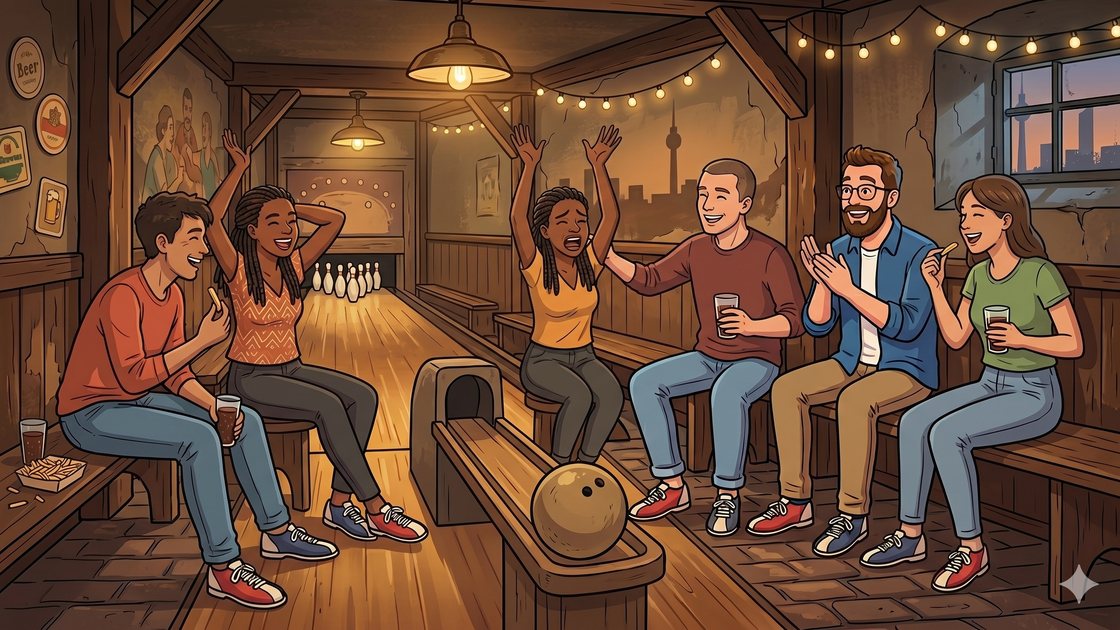
Bowling is built for company in a way few activities are: the game pauses between every throw, so it’s really a conversation with a sport happening in the gaps. You can’t bowl seriously alone — a single player on a lane is a slightly melancholy sight — but with two or six it becomes a string of small moments: the cheering, the gentle mockery, the bad form everyone forgives, the running scoreboard that gives shy people something to talk about. Nobody has to be good. Half the fun is being collectively terrible, and a gutter ball gets a bigger laugh than a strike.
That low bar is exactly why it’s such a good way to meet people. Berlin is full of arrivals rebuilding a social life from scratch — new in the city, between friend groups, fresh out of a long stretch of working from a laptop — and a bowling lane asks almost nothing of a group of near-strangers. You’re side by side, not face to face; there are natural breaks and an automatic shared focus; and the whole thing has a built-in ending when the games run out. It demands far less than a sit-down dinner and gives back more laughter, the same easy, shoulder-to-shoulder way a casual lap of Tempelhofer Feld on skates turns strangers into a standing plan. The lane does the social work; you just have to fill it.
How to find people to go bowling with in Berlin
The easiest way to find people to bowl with in Berlin is an app built around meeting through an activity, which is exactly what MITRA is. The mechanic is simple and worth being clear about, because it isn’t an algorithm that pairs you off: you make a quick profile, you see people nearby who are up for doing things, and you send an activity request — “anyone fancy a few games at BowlHouse on Friday?” The other person accepts if they’re keen. Nobody is auto-matched and nobody is obliged; both sides choose. When two or three people say yes, you’ve gone from an empty lane to a full one and a plan for the weekend.
It works especially well for bowling because the activity carries the evening. You don’t need a clever opening line or a shared history — you need a lane, a couple of hours and people willing to be cheerfully bad at knocking down pins. That makes it an easy first meet for anyone new to Berlin, anyone rebuilding a circle after a move, or anyone who finds “do you want to come bowling?” simpler to send than to say. Make a whole night of it: line up a few games, then carry the group on to a casual game or a drink elsewhere in the city. The hard part was never the bowling — it was the people, and that’s the part MITRA takes care of.
One good bowling night beats a hundred “we should go sometime”s. Download MITRA free, send a bowling request to someone nearby, and turn a vague idea into a booked lane this week.
Come say hi on Instagram @mitra.app for Berlin activity ideas and nights out. Berlin first. Bucharest and more EU cities coming soon.
How we checked
We checked the venues, prices and opening details named here against each centre’s own website and Berlin’s official tourism listing in June 2026 — Bowling World and BowlHouse for their current price lists, Lane7 for its packages, and visitBerlin for the Bowling Center at Alexanderplatz — and confirmed the historic Kegelbahn bars against the venues’ own pages and Berlin city-magazine guides. Prices, opening hours and lane availability change, so treat the figures as a guide and confirm before you go.
Frequently asked questions
Where is the best place to go bowling in Berlin?
There’s no single best place — it depends on the night. For a games-bar atmosphere with cocktails and a group, Lane7 on Potsdamer Platz is the standout. For a big traditional centre with food and league lanes, Bowling World in Friedrichshain works well. For cheap, casual games with no time pressure, BowlHouse in Prenzlauer Berg is the value pick, and the Bowling Center at Alexanderplatz is the most central and family-friendly. For atmosphere, the old basement Kegelbahnen beat them all.
How much does bowling cost in Berlin?
It depends on how you pay. Traditional centres charge per lane per hour — roughly €36–46 at Bowling World, or from €11.40 to €15.60 at the Bowling Center Alexanderplatz — with a lane holding up to six people. Per-game venues like BowlHouse charge each player per game instead, from about €1.60 on a Sunday to €3.80 in a peak evening slot. Bowling shoes are always rented separately, usually €2–3. For two people, paying per game is much cheaper than renting a whole lane.
Do I have to rent bowling shoes?
Yes. Bowling shoes are compulsory at every centre, because their flat, non-marking soles protect the lane’s approach and stop you slipping. You hand over your street shoes and rent a pair at the counter for around €2–3. You can’t bowl in bare feet or socks alone, and most places sell socks for about €1 if you forgot yours. Some serious bowlers bring their own approved shoes, which venues generally allow.
What is Kegeln, and how is it different from bowling?
Kegeln is the older German game of nine-pin bowling. It uses nine pins set in a diamond rather than ten in a triangle, a smaller ball with no finger holes, and narrower wooden lanes — often in the basement of an old bar. Tenpin bowling is the modern American version with heavier drilled balls, wide synthetic lanes and automatic pinsetters. Kegeln tends to be cheaper, cosier and more local; tenpin is brighter, bigger and more of a night out.
Where can I play traditional Kegeln in Berlin?
Several old Berlin bars keep vintage Kegelbahnen in their cellars. Tante Lisbeth on Muskauer Straße in Kreuzberg has a 1970s nine-pin lane, with play ending around 22:00. Bornholmer Hütte on Bornholmer Straße in Prenzlauer Berg has a lane dating to 1911 where you reset the pins by hand. Kugelbar in Wedding and Figl in Kreuzberg also keep old lanes alive. You usually book the lane by the hour through the bar, so call ahead.
Do I need to book a bowling lane in advance?
For weekend evenings, yes. Friday and Saturday nights are the busiest, and without a reservation you can wait a long time or miss out entirely. Every centre takes bookings by phone, and most have an online form. Midweek and during the day you can often just walk in. For the small basement Kegelbahnen, always reserve, because there are only one or two lanes and they book up with single groups.
Is bowling in Berlin good for beginners?
Very. Bowling needs no skill or fitness to enjoy, and being bad at it is half the fun. If you’re nervous about gutter balls, ask for bumpers — the raised rails that stop the ball falling into the gutter. The Bowling Center at Alexanderplatz has a permanent bumper lane for children, and most venues will put bumpers up on request. A lighter ball and a few practice rolls are all it takes to have a good evening.
When is cosmic or disco bowling in Berlin?
Cosmic bowling — lanes under UV blacklight with louder music and a party feel — usually runs on Friday and Saturday nights. BowlHouse holds its cosmic sessions from 21:00 on Fridays and Saturdays at €3.80 a game, and the bigger centres lean into the same after-dark format at weekends. These late slots are the busiest and sell out first, so book ahead. For a calmer, easier-to-talk-over game, bowl before 18:00 instead.
Is bowling a good activity for a group or to meet people?
Yes — it’s one of the best. Bowling pauses between every throw, so it’s really a social game with sport in the gaps, and nobody needs to be good at it. A lane holds up to six, there are natural breaks for chatting, and you stand side by side rather than face to face, which takes the pressure off. That makes it an easy, low-stakes way to meet people or cement a new group, especially if you’re new to the city.
How do I find people to go bowling with in Berlin?
Use MITRA. You make a short profile, see people nearby who are up for activities, and send a bowling request; they accept if they’re keen. Nobody is auto-matched — both people choose — so it’s a relaxed way to line up a lane of company for the weekend. It’s especially useful if you’re new to Berlin and building a social circle from scratch, because the activity does the talking and you just have to show up and rent the shoes.
Sources
- visitBerlin (official Berlin tourism) — Bowling Center at Alexanderplatz: ten-pin centre with a special children’s lane on bumper cushions; lane hire from €11.40 per hour midweek and from €15.60 at weekends; bowling shoes €1.90 to borrow.
- Bowling World Berlin (official) — Preise / prices: open-bowling lane rates per lane/hour (€36 weekday daytime up to €46 Fri/Sat evening; €40 all Sunday), max six per lane; one-off shoe hire €3; address Über Platz, 10243 Berlin; valid from 1 November 2025.
- BowlHouse Berlin (official) — Preise & Zeiten: per-game-per-player pricing (€1.60 all-day Sunday, €2.50 daytime, €2.80–3.80 evenings); shoe rental €2, socks €1; cosmic bowling Fri/Sat from 21:00 at €3.80; Storkower Str. 105–107, 10407 Berlin.
- Lane7 Berlin (official) — lane7.de: activity bar on Potsdamer Platz with bowling, mini golf, darts, karaoke, shuffleboard and beer pong; “All In” unlimited-play packages from €14.50 per person.
- Secret City Travel — Berlin’s vintage Kegelbahnen hidden in bar basements: Tante Lisbeth (Muskauer Str. 49, Kreuzberg, 1970s lane); Bornholmer Hütte (Bornholmer Str. 89, Prenzlauer Berg, lane dating to 1911, manual pin reset); Kugelbar (Wedding); Figl (Kreuzberg).
- Encyclopædia Britannica — Bowling: Sir Flinders Petrie’s reported Egyptian grave find (~3200 BC); German nine-pin religious origins; Martin Luther tradition; nine-pin bans and the move to tenpin; American Bowling Congress standardisation, New York City, 1895.
- Encyclopedia.com — Bowling: nine-pin banned in Connecticut in 1841; American Bowling Congress founded 1895; Fédération Internationale des Quilleurs founded 1952 in Hamburg; IOC recognition as world governing body in 1979.
- Deutscher Kegler- und Bowlingbund (DKB, official) — kegelnundbowling.de and German Wikipedia: German national federation for Kegeln and bowling; predecessor founded in Dresden in 1885 to standardise rules; tenpin bowling added as a discipline in 1929; member of the DOSB and the Fédération Internationale des Quilleurs.
If the lanes are booked out, or you would rather stand around a table than swap shoes, Berlin’s pool halls charge €5–€16 an hour and most of them take walk-ins.
If you would rather throw something than roll it, axe throwing in Berlin runs at two venues and costs €12–€33 a head for an hour.
Want to keep reading?
- Play chess in Berlin — another indoor, low-key way to meet people over a game.
- Where to play badminton in Berlin — the same book-a-lane rhythm, indoors year-round.
- How to find a table tennis partner in Berlin — cheap, casual and endlessly social.
- Best saunas in Berlin — a warm, lights-down option for a rainy Berlin evening.
- Inline skating in Berlin — take the meet-people momentum back outdoors when the weather turns.