Calm lakes and the Spree: paddleboarding in Berlin
Paddleboarding in Berlin, made simple: the calmest beginner lakes, SUP rental prices, which canals you can paddle, plus SUP yoga and tours.
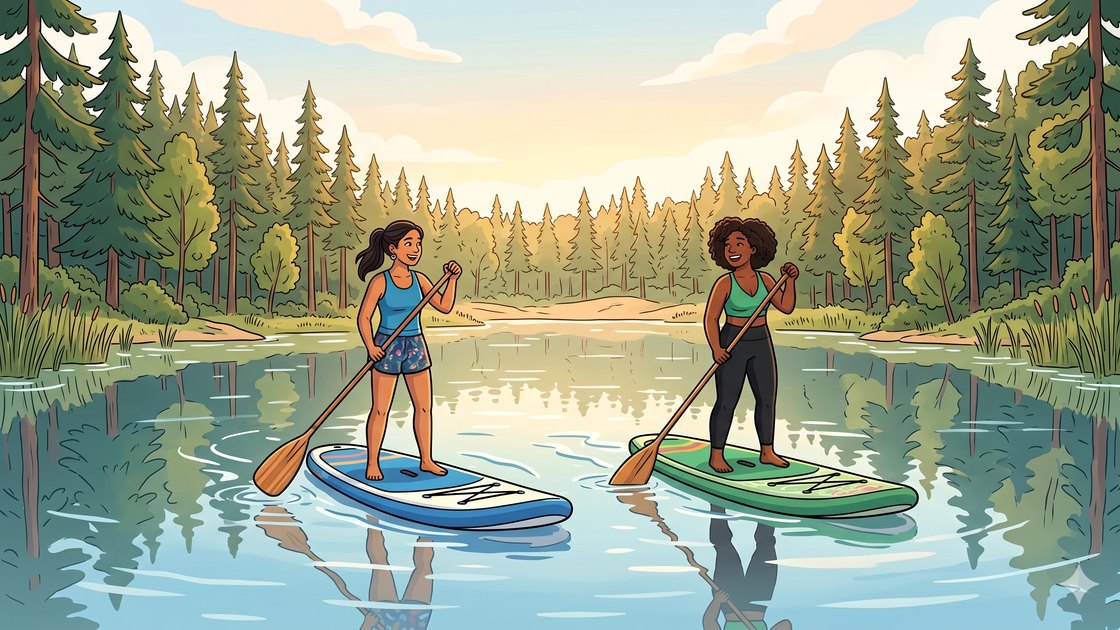
Paddleboarding in Berlin means one of three kinds of water: the calm forest lakes in the south-west like the Schlachtensee and Krumme Lanke, the big open lakes like the Wannsee and the Müggelsee where rentals cluster, and the eastern stretches of the Spree around the Funkhaus and Rummelsburg. You can rent a board by the hour at most of them for roughly €12–€18, no licence and no experience needed — just the ability to swim. The one thing the rental shop hands you that nobody talks about is balance, and the one thing it can’t hand you is the friend who actually makes you drive out to the lake on a warm Thursday evening.
The short version:
- Easiest first water: the Schlachtensee in Zehlendorf — no motorboats, clear water, ringed by the Grunewald, and a board rental (Steh-Paddler) right there. The Krumme Lanke next door is just as calm.
- Where the rentals are: the Wannsee (Standup Wannsee and the Wassersport Center by the lido), the Müggelsee in the east (Nalani, Wasserläufer), the Funkhaus on the Spree (Kolula, StandUpClub), and Spandau’s Havel (WhatSUPBerlin). A board is roughly €12–€18 per hour.
- One rule that catches people out: the central Spree between the Oberbaumbrücke and the Kanzleramt is closed to paddlers all year — too many tour boats. Paddle the eastern Spree and the lakes instead.
- Ways in beyond renting: SUP yoga on the Müggelsee and Wannsee, sunrise paddles, and beginner courses if you’ve never stood on a board.
- The catch: it’s a lot more fun, and a lot more likely to actually happen, with someone. On MITRA you send a paddle request to someone nearby who’s also up for it, they accept if they’re in, and your Saturday on the water has a person in it.
Been meaning to try it all summer? Stop meaning to. MITRA is a free app for finding someone nearby to do an activity with — a first time on a paddleboard absolutely included. You send an activity request to people near you, and meet the ones who say yes.
Contents
- Where to go paddleboarding in Berlin: lakes, the Spree and the canals
- The calmest lakes for your first time on a board
- Where to rent a SUP in Berlin, and what it costs
- Which canals and Spree stretches you can actually paddle
- SUP yoga, sunrise paddles and guided tours
- Before you go: leash, water temperature and a buddy
- Where stand-up paddleboarding came from
- Why paddleboarding is better with someone
- How to find someone to paddle with in Berlin
- Frequently asked questions
- Sources
Where to go paddleboarding in Berlin: lakes, the Spree and the canals
Berlin gives you three very different paddleboarding environments, and which one you pick matters far more as a beginner than which board you rent. The forest lakes in the south-west — the Schlachtensee, Krumme Lanke, Grunewaldsee — are small, sheltered and motor-free, which makes them the steadiest water in the city to stand up on for the first time. The big lakes — the Großer Wannsee in the west, the Müggelsee in the east, the Tegeler See in the north — are where most of the rental shops sit, with proper beaches and long routes, but they’re wide enough to pick up wind and boat wash by midday. And then there’s the Spree and the Havel, the moving water that lets you paddle through the actual city, prettiest from the Funkhaus in the east or out on Spandau’s Havel.
Berlin is genuinely built for this: it’s one of the most water-rich capitals in Europe, threaded with lakes and rivers, and a huge share of them are paddleable. The practical takeaway is simple. Learn on a calm forest lake, graduate to the big lakes once your balance is there, and save the Spree for when standing up no longer takes all your concentration. If open water in general is your thing, the same lakes are the heart of Berlin’s open-water swimming scene — a board and a swim make a natural pairing on a hot day.
The calmest lakes for your first time on a board
The single best lake to learn on in Berlin is the Schlachtensee in Zehlendorf, because motorboats are banned, the water is clean and clear, and the whole lake is wrapped in the Grunewald forest so there’s almost no wash to wobble you. There’s a board rental on the shore (Steh-Paddler), an S-Bahn station a few minutes’ walk away, and the Fischerhütte beer garden for afterwards. It is, by common agreement, the gentlest introduction to standing on a board in the city.
Right beside it, the Krumme Lanke is its quieter twin — a forest-ringed lake you can enter at almost any point along the shore, calm enough that a first wobble feels low-stakes. Both sit at the edge of the Grunewald, so a paddle pairs neatly with a walk in the woods; if that’s your speed, our guide to hiking near Berlin covers the trails that start right there.
When you’ve found your balance, step up to the bigger water. The Großer Wannsee is the classic — huge, with a sandy lido, board rentals on the shore, and a postcard route out around the Pfaueninsel and Schwanenwerder. The Müggelsee, Berlin’s largest lake, does the same job in the east, with rentals at Friedrichshagen and Köpenick. The Tegeler See in the north is the third of the big three. The trade-off is honest: more space and better routes, but also more wind and more boat traffic once the afternoon gets going, so beginners do best launching early.
No board, no buddy, no problem. MITRA is built for exactly the “I’d go if someone came” moment. Send a paddleboarding request to people near you and meet the one who says yes — then split a double rental and learn together.
Where to rent a SUP in Berlin, and what it costs
You can rent a stand-up paddleboard by the hour at most of Berlin’s main lakes and a couple of Spree spots, typically for around €12–€18 an hour, with paddle and a buoyancy aid included and a deposit plus photo ID held against the board. Prices are per board, not per person, so a two-person outing on two boards is the unit to budget for — or you split a double board and share. Here are the established spots, by water.
| Rental | Where (water) | Roughly | Good for |
|---|---|---|---|
| Standup Wannsee | Am Großen Wannsee 58B (Wannsee) | €12/hr Mon–Thu, €15/hr Fri–Sun | Big-lake routes to the Pfaueninsel; SUP yoga |
| Wassersport Center Berlin | Badeweg 7A, by Strandbad Wannsee | from ~€15/hr (Fri–Sun) | Easiest start, right next to the lido; courses |
| Steh-Paddler | Schlachtensee (Zehlendorf) | from ~€18/hr | The calmest beginner water in the Grunewald |
| Kolula SUP | Funkhaus, Nalepastraße 18 + Lindwerder | hourly + day hire | A sheltered Spree backwater in the east |
| Nalani / Wasserläufer | Müggelsee (Friedrichshagen / Köpenick) | hourly | Berlin’s largest lake; SUP yoga at Nalani |
| WhatSUPBerlin | Scharfe Lanke 109 (Spandau, Havel) | hourly + courses | Havel paddling, big team boards, lessons |
| SUPRIDE Berlin | delivered to your lake | multi-day inflatable hire | When there’s no rental at your favourite lake |
A few things worth knowing before you turn up. Most shops only open at weekends early and late in the season and go daily through high summer, so check the day’s hours before you travel. Several — Standup Wannsee, the Wassersport Center, WhatSUPBerlin — run beginner courses and guided tours alongside straight rentals, which is the smarter first booking if you’ve genuinely never stood on a board. And if your nearest lake has no rental at all, SUPRIDE Berlin will deliver an inflatable board for a few days, which also solves the “I want to try it more than once” problem without buying. Prefer to sit down on the water? Berlin’s kayak and canoe rentals cover the same lakes and canals from a lower, drier centre of gravity.
Which canals and Spree stretches you can actually paddle
The most important rule in Berlin paddling is that the central Spree is closed to muscle-powered boats — including paddleboards — all year round. The closed section runs through the middle of the city from the Kanzleramtssteg (km 14.1) to the Oberbaumbrücke (km 20.7), and it includes the Spreekanal. The reason is traffic, not bureaucracy: that stretch is packed with passenger tour boats, has high steel embankments that throw back wash, and forces vessels to squeeze past each other at narrow bridges — genuinely dangerous on a board. So the dream of paddling past Museum Island is off the table, and rightly so.
What you can paddle is plenty. The eastern Spree — around Treptow, the Rummelsburger Bucht, the Insel der Jugend and the Funkhaus at Oberschöneweide — is calm, scenic and where the city-side rentals launch from. To the west and south, the Landwehrkanal is open to paddlers, but treat it as a one-way street: it flows downstream from Kreuzberg toward Charlottenburg, carries a 6 km/h limit, and has a lock (the Oberschleuse) you’ll need to plan around. Out on the lakes there are far fewer restrictions — the forest lakes are motor-free and the big lakes are wide-open — which is another reason beginners are better off starting on still water and saving the moving water for later. When in doubt, the Deutscher Kanu-Verband publishes the current rules for Berlin’s waters, and the rental shops will tell you exactly where their boards are allowed to go.
Turn “we should paddle the Spree sometime” into a date on the calendar. Find someone nearby on MITRA who’s up for a Funkhaus paddle, agree a Saturday, and actually go.
SUP yoga, sunrise paddles and guided tours
If just renting a board feels like too blank a page, Berlin has gentler and more sociable ways onto the water. SUP yoga — a slow flow practised on an anchored board — has a real foothold here: Standup Wannsee runs sessions on the Wannsee, Nalani offers it at the Seebad Friedrichshagen on the Müggelsee, and Pura Vida teaches SUP basics, SUP fitness and SUP yoga from the Rummelsburger Bucht. It’s a surprisingly good first experience, because the focus on balance and breath turns the wobble into the point rather than the problem. If it’s the yoga side that pulls you, our roundup of yoga classes in Berlin covers the studios and outdoor sessions on dry land too.
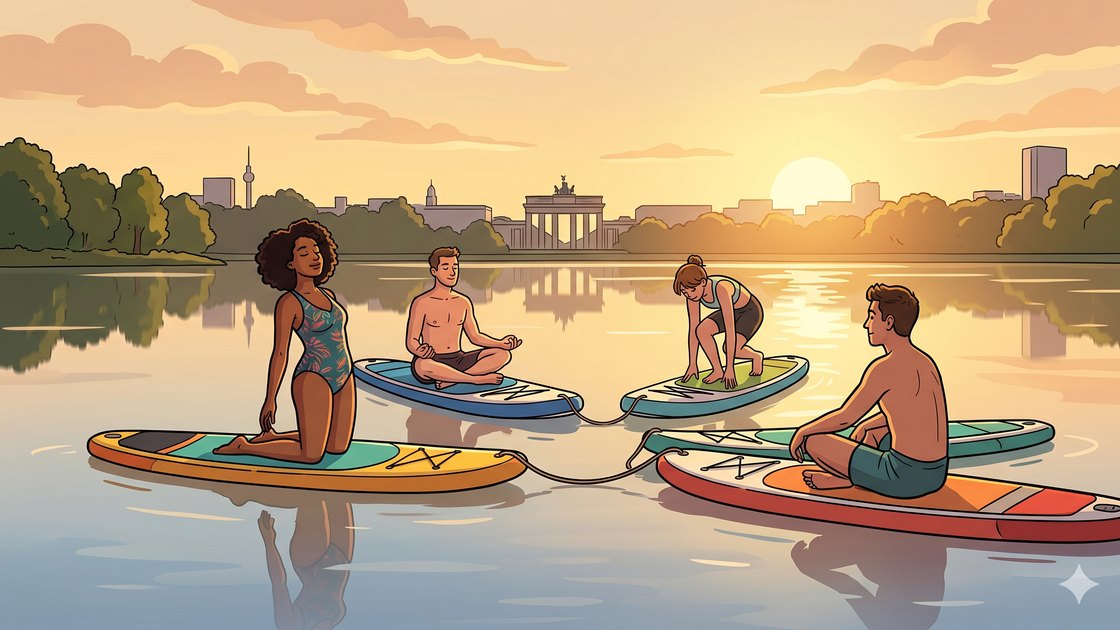
Beyond yoga, most of the bigger rentals run guided tours and beginner courses. The StandUpClub launches city tours from the Funkhaus toward the Plänterwald, the Rummelsburger Bucht and the Insel der Jugend, where there’s a beer garden to stop at. WhatSUPBerlin runs Havel tours from Spandau out to Klein Venedig and the island of Lindwerder, and even rents big multi-person team boards for a group that wants to share one platform and laugh a lot. A guided sunrise or sunset paddle, when the lakes go glassy and gold, is the version of this people remember — and it’s far less daunting with an instructor and a small group than going it alone with a rental and a vague plan.
Before you go: leash, water temperature and a buddy
Three things keep a Berlin paddle safe and pleasant: a leash, an honest read of the water temperature, and ideally not being alone. The leash — the cord that tethers your ankle to the board — matters because your board is your biggest flotation device; if you fall, it stays with you instead of drifting off in the wind. Rentals include one and a buoyancy aid; wear both. You don’t need a licence to paddle under your own muscle power on Berlin’s lakes, but you do need to be able to swim, because you will fall in, especially the first few times. That’s part of the fun, not a failure.
Water temperature is the quieter factor. Berlin’s lakes are lovely and warm from June through September, but in spring and autumn the water is cold enough that a fall is a shock rather than a laugh, which is when a neoprene suit (some shops include one in bad weather) and company matter most. The city monitors bathing-water quality at its official Badestellen through the season, so the swimming-grade lakes are a known quantity. The last piece is simply this: open water rewards a buddy. Two people spot each other, share a board if one tires, and turn a slightly daunting first outing into an easy afternoon. It’s the same logic behind every “never swim alone” sign on the lakes — and it’s the natural bridge to how MITRA fits.
Where stand-up paddleboarding came from
Stand-up paddleboarding looks like a 2010s fitness trend, but its modern form was born on Waikiki Beach in Hawaii in the mid-20th century. The story usually credited is that of the Waikiki Beach Boys — the surf instructors who taught visitors to surf — and in particular John Ah Choy, who, as he aged, stayed on his board and paddled out standing with a canoe paddle; his sons Leroy and Bobby, along with the legendary waterman Duke Kahanamoku, did the same, partly because standing gave them a better view of their groups and the incoming waves. The style was known for decades as “beach boy surfing.” It was revived as a distinct sport around the turn of the 2000s by surfers including Laird Hamilton and Dave Kalama, and from there it spread worldwide.
Who governs it has been less settled than who invented it. For years the International Canoe Federation and the International Surfing Association disputed the sport, until the Court of Arbitration for Sport ruled in 2020 that the ISA should govern SUP at Olympic level, while allowing both bodies to keep running events. In Germany, the sport sits under the Deutscher Kanu-Verband, the national canoe federation, which is also the body that publishes the waterway rules you’ll follow on the Spree and the canals. None of that history is on your mind when you’re wobbling upright on the Schlachtensee — but it’s a nice thing to know you’re doing something Hawaiian watermen worked out a century ago.
Why paddleboarding is better with someone
Paddleboarding is one of those activities that technically works solo but quietly wants a second person. There’s the practical layer: someone to split a double board or a deposit with, to mind the bags while you launch, to spot you if a gust pushes you out, and to laugh with the first ten times you fall in rather than feeling self-conscious about it. A first lesson lands much softer when there are two of you being beginners together.
And there’s the deeper reason, the one that has nothing to do with boards. A lot of people in Berlin arrived from somewhere else and are quietly rebuilding a social life from scratch — the city is full of newcomers in exactly that position, and a shared, low-pressure activity outdoors is one of the easiest ways to turn a stranger into a familiar face. A paddle on the Wannsee is a genuinely good first hang: you’re side by side, doing something a little silly, with natural pauses to talk and a beer garden at the end. It asks far less of two people than a face-to-face coffee and gives back more. That’s the gap MITRA is built to close.
How to find someone to paddle with in Berlin
The simplest way to find a paddleboarding partner in Berlin is to use an app built for meeting people around an activity, which is exactly what MITRA does. Here’s the honest mechanic, because it’s not an algorithm that pairs you off: you set up a quick profile, you see people near you who are up for activities, and you send an activity request — “fancy renting boards on the Schlachtensee this Saturday?” The other person accepts if they’re up for it. Nobody is auto-matched and nobody is obliged; both sides choose. When two people say yes, you’ve got a plan and a paddling partner for the weekend.
It works well for paddleboarding specifically because the activity does the heavy lifting. You don’t need to be witty over text — you need two people, two boards and a free afternoon, and the lake handles the rest. It’s an easy first meet for newcomers, for anyone rebuilding a circle after a move, or for people who simply find it easier to click “I’m in” than to organise a group chat. If you’d rather arrive by bike and make a day of it, grab a cycling buddy too and ride out to the Grunewald lakes together.
Your first time on a board shouldn’t be your last. Download MITRA free, send a paddle request to someone nearby, and turn one good Saturday on the Wannsee into a regular thing.
Come say hi on Instagram @mitra.app for Berlin activity ideas and lake days. Berlin first. Bucharest and more EU cities coming soon.
How we checked
We checked the rental locations, opening pattern and price ranges of the SUP providers named here against their own websites and the official visitBerlin water-sports listings in June 2026, and the waterway rules against the Deutscher Kanu-Verband’s Berlin guidance. Prices and seasonal hours shift year to year, so treat the figures as a guide and confirm with the shop before you travel.
Frequently asked questions
Do you need a licence to paddleboard in Berlin?
No. Stand-up paddleboarding under your own muscle power needs no boat licence on Berlin’s lakes and most of its canals — you just rent a board and go. What you do need is the ability to swim, because you will fall in, particularly at first. The only real legal restriction is geographic: the central Spree between the Oberbaumbrücke and the Kanzleramt is closed to paddlers year-round, so plan your route around it.
How much does it cost to rent a SUP in Berlin?
Expect roughly €12–€18 per hour for a board, with a paddle and buoyancy aid included and a deposit plus photo ID held while you’re out. Standup Wannsee, for example, runs around €12 an hour midweek and €15 at weekends. Day and multi-day hire is cheaper per hour, and the price is per board, so two people on two boards is the unit to budget for.
Where is the best place to learn paddleboarding in Berlin?
The Schlachtensee in Zehlendorf is the gentlest place to start: it bans motorboats, the water is calm and clean, and there’s a board rental on the shore. The neighbouring Krumme Lanke is just as sheltered. Both beat the big lakes for a first attempt, because the Wannsee and Müggelsee pick up wind and boat wash once the afternoon gets busy.
Can you paddleboard on the Spree in central Berlin?
Not in the middle of the city. The Spree is closed to paddleboards and other muscle-powered boats year-round between the Kanzleramtssteg and the Oberbaumbrücke, because of heavy tour-boat traffic and dangerous wash. You can paddle the eastern Spree around Treptow, the Rummelsburger Bucht and the Funkhaus, and the Landwehrkanal as a one-way downstream route from Kreuzberg.
When is the paddleboarding season in Berlin?
Roughly May to September, with high summer the easiest and warmest time. Many rentals open only at weekends early and late in the season and switch to daily hours through July and August, so check the day’s opening times before you travel. In spring and autumn the water is cold enough that a fall is a shock, so a wetsuit and company matter more.
Is SUP yoga a good way to start?
For some people, yes. SUP yoga is practised slowly on an anchored board, so the balance challenge becomes the focus instead of a source of stress, and you’re in a small guided group rather than alone with a rental. Standup Wannsee, Nalani on the Müggelsee and Pura Vida in the Rummelsburger Bucht all offer it. If you like the yoga part most, plenty of dry-land studios in Berlin teach in English too.
Do I need my own board, or can I just turn up?
You can just turn up at most lakes and rent by the hour — no need to own anything. If your nearest lake has no rental, SUPRIDE Berlin will deliver an inflatable board for a few days. Buying only makes sense once you’re paddling regularly; an inflatable board that packs into a rucksack is the usual first purchase because it’s easy to store and carry on the S-Bahn.
Is paddleboarding hard for a complete beginner?
Less than it looks. Most people can kneel and paddle within minutes and stand up within the first session, especially on calm water like the Schlachtensee. Falling in is normal and harmless when you can swim and you’re wearing the leash and buoyancy aid the rental provides. Starting on a still forest lake rather than windy open water makes the learning curve dramatically gentler.
How do I find someone to paddleboard with in Berlin?
Use MITRA. You make a short profile, see people nearby who are up for activities, and send a paddleboarding request; they accept if they’re keen. Nobody is auto-matched — both people choose — so it’s a low-pressure way to line up a partner for a Saturday on the lake. It’s especially handy if you’re new to the city and building a social circle from scratch.
Sources
- visitBerlin (official Berlin tourism) — Stand-Up-Paddling (SUP) in Berlin: named SUP rentals and lake/Spree launch points (Kolula at the Funkhaus, StandUpClub, Pura Vida, WhatSUPBerlin in Spandau, Wassersport Center and Standup Wannsee at the Wannsee, Steh-Paddler at the Schlachtensee, Nalani and Wasserläufer at the Müggelsee, SUPRIDE delivery).
- Standup Wannsee (official, prices checked June 2026) — standup-wannsee.de: board hire ~€12/hr Mon–Thu and ~€15/hr Fri–Sun at Am Großen Wannsee 58B; neoprene included in bad weather; SUP yoga.
- Wassersport Center Berlin (official, checked June 2026) — wassersportcenter-berlin.de: SUP board ~€15/hr (Fri–Sun) at Badeweg 7A, beside Strandbad Wannsee; online booking.
- Deutscher Kanu-Verband (DKV, official) — Wasser-Verkehrsregeln Berlin · Mitte & Landwehrkanal: inner-city Spree closed to muscle-powered craft year-round (Kanzleramtssteg km 14.1 – Oberbaumbrücke km 20.7, incl. Spreekanal); Landwehrkanal one-way downstream, 6 km/h limit.
- Standup paddleboarding — Wikipedia (encyclopedia reference): modern SUP traced to the Waikiki Beach Boys (John Ah Choy, sons Leroy and Bobby, Duke Kahanamoku); “beach boy surfing”; revival around 2000 by surfers including Laird Hamilton and Dave Kalama.
- International Surfing Association (2020, official) — ISA awarded governance of SUP at Olympic level by CAS, and International Canoe Federation — ICF cleared to keep running SUP events: the 2020 Court of Arbitration for Sport ruling on SUP governance.
Want to keep reading?
- How to find a swimming partner in Berlin — the same lakes, for open-water swimming.
- Kayaking in Berlin — prefer to sit? The paddle sport with a lower centre of gravity.
- Yoga classes in Berlin — if SUP yoga is your way in, here’s the dry-land scene too.
- How to find a cycling partner in Berlin — ride out to the Grunewald lakes together.
- How to find a hiking partner in Berlin — pair a paddle with a walk in the woods around the Schlachtensee.