
Wind and wide lakes: sailing in Berlin
Sailing in Berlin is easier to start than you’d think. The best lakes, the licence you need, schools, costs, and how to find someone to crew with.

Sailing in Berlin is easier to start than most newcomers expect, because the city sits on a chain of big, open lakes — the Wannsee, the Müggelsee, the Tegeler See — all reachable by S-Bahn and all dotted with sailing schools, clubs and boat rentals. You can take a beginner course over a single weekend, join a club for a season, or rent a small dinghy for an afternoon once you have the right certificate. The season runs roughly April to October, and on a warm, breezy summer day the water fills with white sails within sight of the U-Bahn.
The short version: Berlin’s sailing season runs about April to October. The three main areas are the Großer Wannsee (the classic sailing lake, home to historic clubs and most of the schools), the Müggelsee in Köpenick (Berlin’s largest lake, 7.4 km², where sailing is allowed everywhere), and the Tegeler See in the north-west. To sail your own boat on Berlin’s waters you generally need the Sportbootführerschein Binnen (Segeln) — the inland sailing licence — required from a sail area of 6 m². A weekend beginner course starts around €350–450. It’s an activity that almost demands a second pair of hands, which makes it perfect for meeting people.
Contents
- What sailing in Berlin actually looks like
- When the season runs and what the wind is like
- Where to sail: Berlin’s best lakes for getting on the water
- Do you need a licence to sail in Berlin?
- Learning to sail: schools and courses around the Wannsee
- Renting a boat versus joining a club
- What your first day on the water actually feels like
- Why sailing is so much better with a partner
- Frequently asked questions
What sailing in Berlin actually looks like
Sailing in Berlin means getting out on the city’s interconnected lakes and rivers — the Havel, the Spree, and the broad lakes they widen into — under sail rather than engine. Unlike a coastal city, Berlin offers sheltered, flat freshwater sailing: no tides, no swell, and shorelines you can usually see across, which is exactly why it’s such a forgiving place to learn. The water is genuinely woven into the city; Berlin and surrounding Brandenburg form one of the largest connected inland waterway networks in Europe, and you can sail for days between lakes without touching the sea.
For most people, “sailing in Berlin” starts on one of three lakes. The Großer Wannsee in the south-west is the historic heart of the scene, lined with yacht clubs and sailing schools and an easy S1/S7 ride from the centre. The Müggelsee in Köpenick is the city’s biggest open expanse of water. The Tegeler See in the north-west, with its seven little islands, is the quieter, family-friendly option. You don’t need to own anything to begin — a course or a club gets you on the water with borrowed boats.
Want someone to learn to sail with this summer? MITRA helps you find people near you for the activities you actually want to do. Download it free and send a “let’s book a sailing taster” request today.
When the season runs and what the wind is like
The Berlin sailing season runs roughly from April to October, with the schools and rental fleets opening when the water warms and closing as autumn sets in. Wassersportcenter Berlin, one of the long-running schools at the Wannsee, states its season plainly as April to October — and that is the window most clubs and rentals work to. High summer, June through August, is the sweet spot for beginners: long daylight, warm water if you capsize, and lighter, steadier breezes than the gusty shoulder seasons.
The wind on Berlin’s lakes is moderate and shifty rather than strong, which is both the charm and the challenge. Because the lakes are ringed by trees and buildings, the breeze swings direction and comes in patches, so you learn to read the water — the dark ruffled patches are gusts arriving — and to trim constantly. It’s an excellent classroom: enough wind to actually sail and feel the boat respond, rarely enough to frighten a first-timer. A still, glassy day means little sailing and a lot of drifting; a fresh, blustery one is where the lessons stick.
Like the rest of Berlin’s summer water culture, sailing rewards flexibility. Keep an eye on the forecast, and when a warm afternoon with a steady 3–4 Beaufort lands midweek, that’s the day to be on the Wannsee rather than at your desk.
Where to sail: Berlin’s best lakes for getting on the water
Berlin’s sailing splits across three main lakes, each with a different character — pick the one that matches how you want to spend the day. All three are reachable on public transport, so you can sail without a car.
Großer Wannsee (Steglitz-Zehlendorf). The classic Berlin sailing lake and the densest cluster of clubs, schools and moorings in the city, on the Unterhavel in the south-west. This is where most beginner courses run and where the prestigious old yacht clubs sit. It connects straight into the wider Havel, so once you have skills you can range far beyond the lake itself. Reach it on the S1 or S7 to Wannsee station, then a short walk to the water.
Müggelsee (Treptow-Köpenick). Berlin’s largest lake at 7.4 square kilometres, in the city’s south-east, and the most open water you’ll find inside the city limits. Sailing and surfing are permitted across the whole lake (motorboats are restricted to marked fairways), and the marina on the Müggelseedamm has well over 100 berths plus its own sailing school and crane. It’s the place for uninterrupted, big-water sailing without the club density of the Wannsee. The old town of Köpenick, beside the Schloss, is the gateway.
Tegeler See (Reinickendorf). The quieter north-western option, scattered with seven small islands and an easy, idyllic feel that suits families and relaxed afternoons. There’s boat rental on the shore, and the lake connects to the Havel for longer trips. It’s less of a hardcore racing scene than the Wannsee and more of a gentle-day-out lake — good for a first proper sail once you’re licensed.
Here’s how the three compare at a glance. We checked the lakes’ size, location and water-sport rules on Berlin’s official city portal and the schools’ own sites in June 2026; club membership and course availability change through the season, so confirm before you go.
| Lake | District | Character | Good for |
|---|---|---|---|
| Großer Wannsee | Steglitz-Zehlendorf | Club and school hub on the Havel | Learning, courses, joining a club |
| Müggelsee | Treptow-Köpenick | Berlin’s largest lake, open water | Big-water sailing, surfing too |
| Tegeler See | Reinickendorf | Quiet, seven islands | Relaxed family-friendly days |
Do you need a licence to sail in Berlin?
For most sailing boats on Berlin’s waters, yes — you need the Sportbootführerschein Binnen (Segeln), the German inland sailing licence. Under the state rules for Berlin waters, the sailing licence becomes mandatory once a sailboat’s sail area reaches 6 m², which covers essentially every boat bigger than a tiny dinghy. The same Sportbootführerschein Binnen, in its motor version, is federally required for powered craft above 15 PS (about 11.03 kW), so a licence is the norm rather than the exception here.
The certificate is not hard to get. A typical course covers boat handling, right-of-way and inland-waterway rules, basic navigation and safety, then a practical sailing element on Berlin’s own lakes, followed by a theory test and a practical exam. Schools run intensive weekend formats and spread-out evening formats, and many bundle the sailing and motor versions together since the theory overlaps heavily. You can be licensed within a few weekends if you commit.
A crucial caveat: there are licence-free routes onto the water too. Within a sailing school or a club, you sail under the school’s or instructor’s authorisation, so a taster session or a supervised course day needs no certificate of your own — you only need the licence to take a boat out independently. That’s why a beginner course is the simplest first step: you get on the water immediately and earn the paper as you go.
Thinking about a course but don’t want to do it solo? That’s exactly what MITRA is for. You send an activity request to people nearby who are also keen to learn, they accept if they’re up for it, and you book the course together.
Download MITRA on Google Play · Download MITRA on the App Store
Learning to sail: schools and courses around the Wannsee
The fastest way into sailing in Berlin is a beginner course at one of the Wannsee sailing schools, where prices for the inland sailing licence start around €350–450. The Wannsee shore has several established schools, and a couple of well-known options elsewhere are worth knowing too.
Segelschule Große Freiheit (Großer Wannsee). Running since 1995, this school offers everything from beginner sailing certificates to advanced certifications, with SBF Binnen (Segeln) courses advertised from around €350 and flexible booking dates through the season. It’s one of the most visible English-friendly schools on the lake.
Wassersportcenter Berlin / Segelschule am Wannsee. A long-running Wannsee operation whose season runs April to October, offering the full ladder from basic sailing up to the Sportbootführerschein Binnen (Segeln). Good for people who want a structured progression rather than a one-off taster.
Segelschule Robert Kettler (Am Großen Wannsee 10, 14109 Berlin). A classic Wannsee boating school at a prime address on the lake, covering the standard licences with both sailing and motor training.
FU Berlin Hochschulsport — Wassersportzentrum. If you’re a student or affiliated with a Berlin university, the Freie Universität’s water-sports centre runs licence courses and sailing on the Spree and lakes at reduced rates — usually the cheapest legitimate route to a certificate in the city.
Beyond the Wannsee, the Müggelsee marina on the Müggelseedamm has its own sailing school, which makes sense if you live out east in Köpenick and want to learn on the city’s biggest lake rather than commuting across town.
No sailing buddy yet? Find one before you book. MITRA shows you people nearby who are up for the same thing — you reach out, they say yes if they’re keen, and suddenly the course is a plan with a person, not a solo errand.
Renting a boat versus joining a club
Once you’re licensed, the two routes onto the water regularly are renting per outing or joining a sailing club for the season — and they suit very different rhythms. Renting is pay-as-you-go freedom; a club is cheaper over a full summer and far more social, but it’s a commitment.
Renting suits the occasional sailor. Around the Wannsee, Müggelsee and Tegeler See you can hire small sailboats and dinghies by the hour or day once you can show the right certificate, and rental platforms list everything from little day-sailers to larger yachts (some skippered, so you don’t even need a licence). It’s the no-strings option: turn up on a good-wind day, sail, hand the boat back.
A club is the better long game, and Berlin has some of the most storied sailing clubs in the country. The Verein Seglerhaus am Wannsee (VSaW), founded in October 1867, is one of Germany’s oldest and most prestigious yacht clubs — it began with fourteen members and eight boats, moved to its present Wannsee site in 1877, and its Tudor-style 1910 clubhouse is now a protected monument. Clubs like this offer moorings, training, boats and, above all, a built-in community of people who sail every weekend. For anyone who wants sailing to become a regular part of their life in Berlin — rather than a one-off — a club is how you find a crew.
That community point matters more than it first appears, and it’s the same reason people seek out a regular swimming spot or a kayaking group: the water is the hook, but the people are what bring you back.

What your first day on the water actually feels like
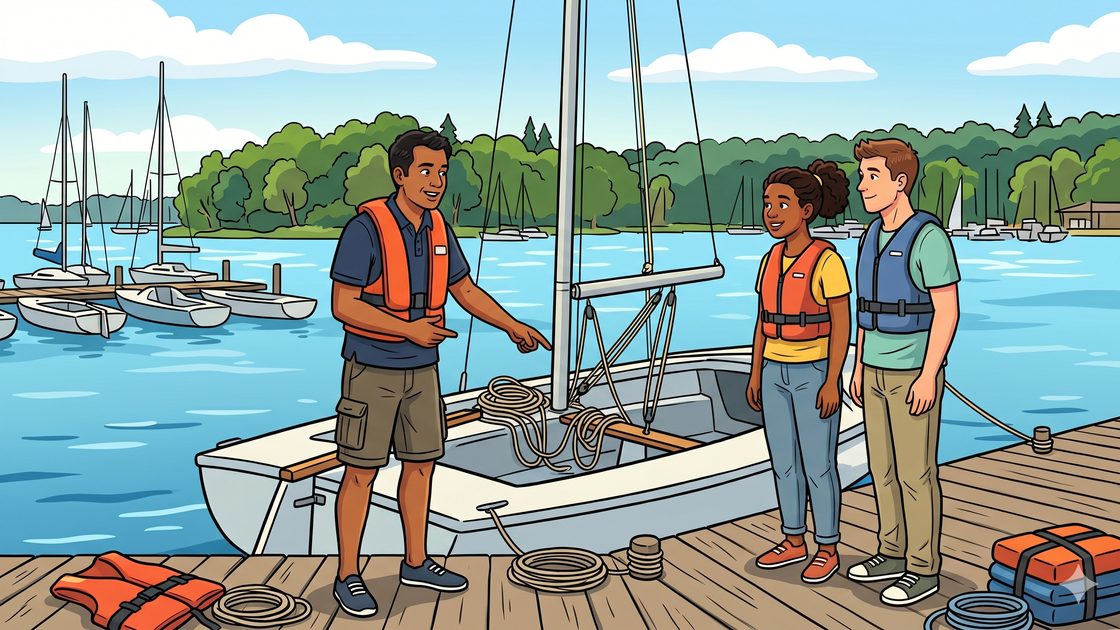
Your first day sailing in Berlin is mostly about learning to relax into a boat that’s doing several things at once. Picture Lena, 29, who moved to Berlin from Lisbon and booked a Saturday beginner session on the Großer Wannsee at 10 am. The first half hour is on the pontoon: names of the parts, how the sail catches wind, which way to push the tiller (the opposite way to where you want to go, which feels wrong for an hour and then suddenly doesn’t).
Then you’re off the dock, and the boat heels — leans — as the sail fills, and your instinct is that you’re about to capsize. You’re not; that lean is the boat working. By late morning you’re taking turns on the tiller and the sail, tacking back and forth across the lake, ducking under the boom as it swings, learning to spot the dark gust-patches creeping across the water. There’s a lot of laughing at near-misses and the occasional flat, windless pause where you just sit and drift and look back at the shore.
Two things tend to stick from a first day. One, sailing is a two-person sport in practice — someone steers, someone handles the sail, and you’re constantly talking. Two, three hours pass like one. You come off the water sunburnt, slightly waterlogged, and already checking the forecast for next weekend. It is, by design, an activity you immediately want to repeat with the person you did it with.
Why sailing is so much better with a partner
Sailing is one of the few activities that’s genuinely hard to do alone and effortless with one other person, which makes it an unusually good way to meet someone in a new city. A small dinghy is built for a crew of two: one on the helm, one on the sheet, both reading the wind together. The shared problem-solving — and the shared adrenaline when a gust hits — builds the kind of easy rapport that’s difficult to manufacture over a coffee. Many people who move to Berlin find the real challenge isn’t the city but arriving without a ready-made crew to do these things with.
That’s the gap MITRA is built to close. It’s an activity-first app for meeting people in real life: you tell it what you want to do — book a Saturday sailing course on the Wannsee, say, or crew for someone on the Müggelsee — and it shows you people nearby who might be up for it. You send them an activity request, and the ones who are interested accept. Nothing happens automatically and nobody is paired off for you; you choose who to reach out to, and they choose whether to say yes. It turns “I’ve always wanted to learn to sail” into a real plan with a real person.
The same approach works for the rest of a Berlin summer on the water and off it — from a stand-up paddleboarding afternoon to the things worth doing when you’re new and on your own. The activity is the easy excuse; the company is what makes the city start to feel like yours.
Make this the summer you finally learned to sail. Download MITRA, find someone nearby who wants to get on the water, and send the request — the worst that happens is they say not this weekend.
Get MITRA free on Google Play · Get MITRA free on the App Store
Frequently asked questions
Do you need a licence to go sailing in Berlin?
To take a sailing boat out independently on Berlin’s waters you generally need the Sportbootführerschein Binnen (Segeln), the inland sailing licence, which becomes mandatory from a sail area of 6 m². However, you can sail without your own licence inside a sailing school or club, where you’re covered by the instructor’s authorisation — so a beginner course or taster session lets you start on the water immediately and earn the certificate as you go.
When is the sailing season in Berlin?
Berlin’s sailing season runs roughly from April to October, when the schools and rental fleets are open. High summer — June through August — is the best window for beginners: long daylight, warm water if you capsize, and lighter, steadier breezes than the gustier spring and autumn months. Most clubs and schools close their on-water programmes once the colder weather arrives in late autumn.
Where can you go sailing in Berlin?
The three main sailing lakes are the Großer Wannsee in the south-west (the club-and-school hub on the Havel), the Müggelsee in Köpenick (Berlin’s largest lake at 7.4 km², where sailing is allowed everywhere), and the Tegeler See in the north-west (quieter, with seven small islands). All three are reachable by S-Bahn, so you can sail without owning a car or a boat.
How much does it cost to learn to sail in Berlin?
A beginner course for the inland sailing licence (SBF Binnen Segeln) at a Wannsee school typically starts around €350–450, depending on the school and the format. Intensive weekend courses and spread-out evening courses are both common, and many schools bundle the sailing and motor licences together since the theory overlaps. Students affiliated with a Berlin university can usually get the cheapest courses through the FU Berlin Hochschulsport water-sports centre.
Can you sail in Berlin as a complete beginner?
Yes — Berlin is one of the easier places to learn, because the lakes are flat, sheltered freshwater with no tides or swell and shorelines you can usually see across. A beginner course starts you on the pontoon with the basics, then gets you sailing the same day under instruction. The moderate, shifty lake wind is enough to actually sail and feel the boat respond, but rarely strong enough to frighten a first-timer.
Is it better to rent a boat or join a sailing club in Berlin?
Renting suits occasional sailors: once licensed, you can hire small sailboats and dinghies by the hour or day on the Wannsee, Müggelsee or Tegeler See and sail with no strings. A club is cheaper over a full season and far more social — it gives you moorings, boats, training and a built-in community of weekend sailors. If you want sailing to become a regular part of your life in Berlin, a club is how you find a steady crew.
What are the oldest sailing clubs in Berlin?
The Verein Seglerhaus am Wannsee (VSaW), founded in October 1867, is one of Germany’s oldest and most prestigious yacht clubs. It began with fourteen members and eight boats, moved to its present Wannsee site in 1877, and its Tudor-style clubhouse, completed in 1910, is now a protected historic monument. The Wannsee shoreline hosts several such storied clubs, making it the historic heart of Berlin sailing.
Can you sail on the Müggelsee?
Yes. The Müggelsee in Treptow-Köpenick is Berlin’s largest lake at 7.4 square kilometres, and sailing and surfing are permitted across the whole lake, with motorboats restricted to marked fairways. The marina on the Müggelseedamm has well over 100 berths plus its own sailing school and crane, so you can learn, moor and sail on the city’s biggest open water without crossing town to the Wannsee.
Do you need your own boat to sail in Berlin?
No. Most people start without owning anything: a beginner course or a sailing club provides borrowed boats, and rental services around the Wannsee, Müggelsee and Tegeler See hire out dinghies and day-sailers once you can show the right certificate. Some rental platforms even offer skippered boats, where a licensed skipper handles the sailing — so you can get on the water before you have any licence of your own.
Want to keep reading?
- Kayaking in Berlin: where to paddle
- Paddleboarding in Berlin
- How to find a swimming partner in Berlin
- The best picnic spots in Berlin
- Things to do alone in Berlin
Sources
- Berlin.de (official city portal), Müggelsee — Berlin’s largest lake at 7.4 km² in Treptow-Köpenick; sailing and surfing permitted across the lake, motorboats restricted to marked fairways; marina on the Müggelseedamm with 100+ berths, sailing school and crane. berlin.de
- Sportbootführerschein Binnen (German inland boating-licence rules) — sailing licence mandatory for Berlin waters from a 6 m² sail area; motor version required above 15 PS (≈11.03 kW). Sportbootführerschein Binnen
- Verein Seglerhaus am Wannsee (VSaW), official club history — founded October 1867 with fourteen members and eight boats; moved to the Wannsee in 1877; Tudor-style 1910 clubhouse is a protected monument; one of Germany’s oldest yacht clubs. vsaw.de
- Segelschule Große Freiheit (official) — operating at the Großer Wannsee since 1995; SBF Binnen (Segeln) beginner courses from around €350. segelschule-grosse-freiheit.de
- Wassersportcenter Berlin / Segelschule am Wannsee (official) — Wannsee sailing school; season runs April to October; courses from basic sailing to Sportbootführerschein Binnen (Segeln). wassersportcenter-berlin.de
Your first sail is closer than you think. MITRA is free — find someone nearby who wants to get on the Wannsee or the Müggelsee this season and send them a request. Berlin’s summer is short; spend it on the water in good company.
Ready to get on the water? MITRA helps you find people near you for the activities you love — sailing, lake swims, weekend paddles. Send an activity request, meet whoever says yes. Follow us on Instagram @mitra.app for more Berlin ideas. Berlin first. Bucharest and more EU cities coming soon.