
Wraps on, gloves up: boxing classes in Berlin
Beginner boxing classes in Berlin made simple: which gyms welcome first-timers, what a first session is really like, the cost, and who to train with.

Boxing classes in Berlin are easy to start and far less intimidating than they look from outside the gym. A beginner session is almost all technique and fitness — footwork, shadowboxing, pad work and bag rounds — with no one swinging at your head on day one. This guide covers the gyms that genuinely welcome first-timers, the different styles you’ll run into, what a first class actually feels like, what it costs, and how to find someone to train with so you actually keep going.
Contents
- The short version
- What a beginner boxing class in Berlin is actually like
- The kinds of boxing you’ll find in Berlin
- Where to take boxing classes in Berlin: the gyms
- Women’s and FLINTA boxing in Berlin
- A quick comparison of beginner boxing options
- What it costs: drop-ins, class cards and memberships
- What to wear and bring to your first session
- What actually happens in your first hour
- Will you get hit? Sparring and safety for beginners
- Why boxing is easier to keep up with a training partner
- How to find someone to train with in Berlin
- Want to keep reading?
- Frequently asked questions
- Sources
The short version
You can take a beginner boxing class in Berlin this week for the price of a couple of drinks, and your first session will be technique and conditioning, not a fight. Small studios like Sportsfreund in Prenzlauer Berg cap classes at eight people and coach in English; Box Studio Berlin in Friedrichshain runs explicit beginner nights; Boxgirls and The Dopamine Studio hold FLINTA-only sessions; and a multi-gym pass like Urban Sports Club opens dozens of boxing spots from around €33 a month. Most places offer a free or cheap taster. The single biggest predictor of whether you stick with it isn’t the gym — it’s having one person who expects you on the mat next to them.
What a beginner boxing class in Berlin is actually like
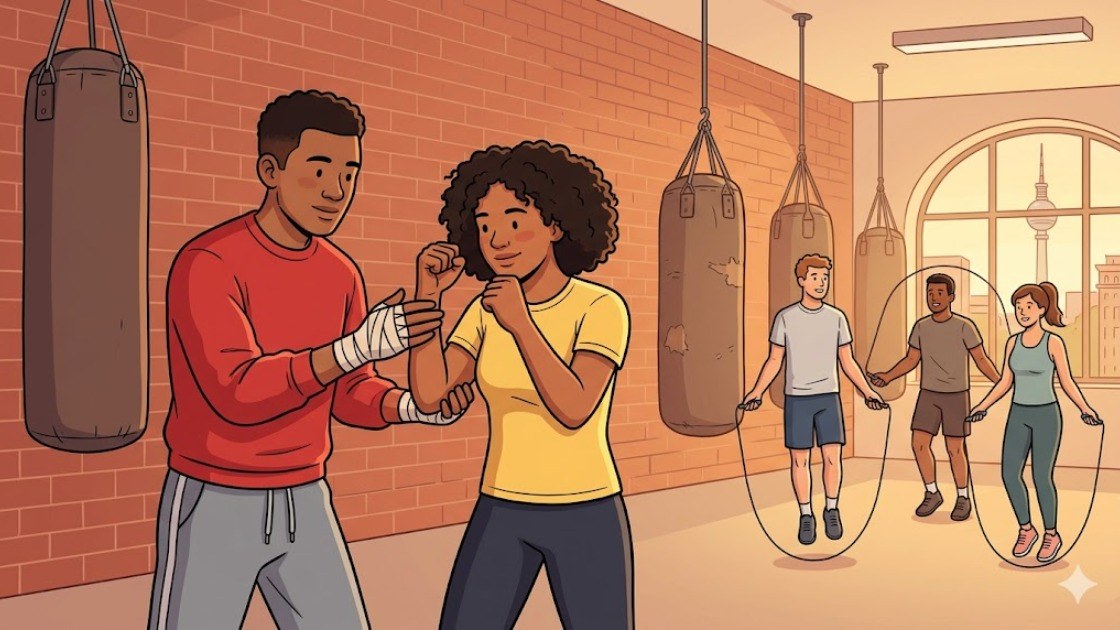
A first boxing class in Berlin is mostly skipping rope, shadowboxing, hitting pads and bags, and core work — the punching you imagine is real, but it lands on equipment and mitts, not on people. Beginner sessions are built around learning a stance, the basic punches numbered one to six (jab, cross, hooks and uppercuts), how to move your feet, and how to keep your hands up to defend. Coaches break each piece down slowly, because bad technique is both useless and the fastest route to a sore wrist.
The atmosphere surprises most newcomers. Boxing gyms have a reputation for being intimidating, but the beginner-facing studios in Berlin lean welcoming and unpretentious, full of people who started exactly where you are. You will sweat hard — boxing is a genuine cardio workout — but nobody expects you to be good in week one. The point of a first class is to leave knowing how to throw a clean jab and wanting to come back.
New to Berlin and want someone to start with? MITRA is built for exactly this: tell it the activity you’re up for, send a request to people training near you, and meet the ones who say yes. Get it on Google Play or download it on the App Store.
The kinds of boxing you’ll find in Berlin
“Boxing” in Berlin covers several different sports, and knowing which is which saves you from booking the wrong class. English boxing — hands only — is the classic discipline and the easiest entry point, with the most beginner courses in the city. If you want to use your legs too, kickboxing and Thai boxing (Muay Thai) add kicks, knees and shin conditioning, and plenty of Berlin gyms teach all three under one roof.
Then there’s fitness boxing, sometimes called boxercise or fit-boxing: technique-based, equipment-only classes built purely for cardio and strength, with no contact at all. These are the gentlest on-ramp if you mainly want the workout. And Berlin offers one genuinely local oddity — chessboxing, which alternates rounds of speed chess and boxing and was effectively invented as a competitive sport here. For most beginners, plain English boxing or a no-contact fitness-boxing class is the right first booking; you can branch into kickboxing or the stranger formats once you have the basics.
Where to take boxing classes in Berlin: the best gyms
The best beginner boxing gyms in Berlin are the small studios that run dedicated entry-level classes rather than expecting you to join an experienced group. A handful are reliable first stops, spread across the eastern and central districts where most newcomers live.
Sportsfreund Berlin sits at Jablonskistraße 27 in Prenzlauer Berg and is about as gentle a landing as boxing gets. Classes are capped at eight participants, beginners are explicitly welcome alongside regulars, the trainers can coach in English, and there’s a free trial class — ideal if you’re nervous or new to the city and want a small room rather than a crowd.
Box Studio Berlin in Friedrichshain runs structured beginner boxing, with sessions built around striking technique and footwork for people getting fit from scratch. Friedrichshain is something of a boxing hub: it’s also home to K4 Athletics on Holzmarktstraße, which pairs boxing with strength and fitness training, and to a cluster of clubs reachable on a single class pass.
Berlin Gym has a Kreuzberg location near Am Tempelhofer Berg that teaches boxing and mixed martial arts, including outdoor boxing sessions in warmer months — a good fit if you’d rather hit pads in the open air than in a basement. For a proper curriculum, KINE runs an eight-week beginner boxing course of two sessions a week, which suits people who want to learn properly in sequence instead of dropping into mixed-level classes.
Women’s and FLINTA boxing in Berlin
Berlin has a strong, well-established scene of women-only and FLINTA boxing, so you don’t have to be the only woman in a room full of men if you’d rather not be. Boxgirls Berlin e.V. is the anchor: a non-profit at Weserstraße 38 in Neukölln that has run boxing, Thai boxing, kickboxing and self-defence for girls and women, intersex, non-binary, trans and agender people for years, including beginner courses and dedicated BIPoC FLINTA sessions. Its coaches work in German, English, French and some Turkish, which makes it unusually accessible for internationals.
The Dopamine Studio runs boxing built exclusively for the FLINTA community, teaching beginners the real foundations — stance, the one-to-six punches, defence and footwork — from coaches who actually box; hand wraps are required and can be bought there, and gloves are free to rent, so you can show up with nothing. Boxing Sisters adds another women-focused beginner option in the city. The shared thread is a room where the basics are taught patiently and you’re never the odd one out, which for a lot of people is the difference between trying boxing once and actually sticking with it.
Plenty of gyms, one missing piece — a person to go with. On MITRA you find someone nearby who’s into the same activity and arrange it together; there’s no algorithm pairing you off, just a request and a yes. Get MITRA on Google Play or on the App Store.
A quick comparison of beginner boxing options
Here’s a side-by-side look at the main entry points so you can match a gym to your budget, your language and how you like to learn. Prices and schedules shift, so treat this as a starting point and confirm the specific class before you go.
| Gym / route | Area | Style | Best for | Rough entry |
|---|---|---|---|---|
| Sportsfreund Berlin | Prenzlauer Berg | Boxing, kickboxing, fitness | Nervous beginners, English speakers, small classes | Free trial; then class/membership pricing |
| Box Studio Berlin | Friedrichshain | English boxing | Structured beginner technique nights | Taster around €15; 10-class card around €125 |
| Boxgirls Berlin e.V. | Neukölln | Boxing, Thai, kickboxing, self-defence | Women / FLINTA, multilingual, community focus | Non-profit course fees; check current term |
| Berlin Gym (Kreuzberg) | Kreuzberg | Boxing + MMA, outdoor option | Outdoor pad work, all-rounders | Via Urban Sports Club, from ~€33/month |
| KINE | Berlin | English boxing | Learning in sequence over 8 weeks | Fixed beginner-course fee, 2×/week |
| Urban Sports Club pass | City-wide | Many boxing gyms | Trying several gyms before committing | From ~€33/month, multi-venue |
How we chose: we focused on gyms that run genuine beginner-facing classes for an international audience, cross-checked their districts, styles and beginner offerings against each venue’s own website and the major class-pass platforms, and confirmed prices where they were published in June 2026. We left out pure personal-training listings and one-off pop-ups.
What it costs: drop-ins, class cards and memberships
Boxing in Berlin is cheap to try and flexible to continue, with three common ways to pay. The cheapest route in is the taster or trial: many studios, including Sportsfreund, offer a free or low-cost first class, and a single taster elsewhere often runs around €15. If you want to keep going without a contract, class cards are the usual middle option — a ten-class card around €125 at a studio like Box Studio Berlin works out near €12–13 a session and never expires as fast as a monthly membership.
For regular training, a multi-gym pass is often the best value. Urban Sports Club starts from roughly €33 a month and unlocks boxing at dozens of Berlin venues, which is ideal while you’re still figuring out which gym suits you; ClassPass and Eversports cover similar ground class by class. Private one-to-one coaching is the priciest tier, averaging in the region of €50 an hour, and is worth it mainly if you want intensive technique correction. Whichever you pick, start with a taster before you commit any real money — the right gym is the one you’ll actually return to.
What to wear and bring to your first session
For a first boxing class in Berlin you need almost nothing: workout clothes, indoor trainers and a water bottle will get you through. Most beginner studios lend gloves for your first sessions, so you don’t have to buy a pair before you know you’ll keep going — The Dopamine Studio, for example, rents gloves for free. The one item worth picking up early is a pair of hand wraps, the long cloth bands that protect the small bones and tendons in your hand; some studios require them and will sell you a set on the spot for a few euros.
Once you’re hooked, the natural order of buying your own kit is wraps first, then gloves (a 12oz or 14oz pair covers most beginners), and a mouthguard only when you start any light contact. Boxing shoes and headgear come much later, if ever. If a gym’s beginner page lists specific requirements — the chessboxing club, for instance, asks newcomers to bring bandages and a mouthguard for tryouts — follow that list, but for a standard fitness-boxing or technique class, comfortable clothes and clean indoor shoes are plenty.
Sorting the plan is easier with someone already in. Find people near you who want to train too, send an activity request, and meet the ones who accept — you choose who to reach out to, and they choose whether to say yes. Download on Google Play or on the App Store.
What actually happens in your first hour
A typical beginner boxing hour in Berlin follows a predictable, reassuring shape. It opens with a warm-up — skipping rope, mobility, some light cardio — to get your shoulders and hips loose. Then the coach teaches or reviews stance and footwork, because everything in boxing is built on where your feet are. From there you’ll shadowbox, throwing punches into the air in front of a mirror so the coach can correct your form before any impact.
The middle of the class is the part people come for: pad work with a partner or coach holding mitts, and rounds on the heavy bag, usually in timed intervals of two to three minutes with short rests, the same rhythm as a real bout. You’ll finish with core and conditioning work, then a stretch. The first time, expect to feel clumsy and to gas out faster than you’d like — that’s universal, and it passes quickly. What stays with most people is how absorbing it is: an hour of focusing on a jab leaves no room to think about your inbox.
Will you get hit? Sparring and safety for beginners
No — you will not get punched in a beginner boxing class, and you won’t spar until you choose to, often months in. Reputable Berlin gyms treat sparring as an advanced, opt-in step that only happens once you have solid defence, with headgear, a mouthguard and a coach controlling the intensity. Plenty of people train boxing for years purely for fitness and technique and never spar at all, and the fitness-boxing classes are entirely no-contact by design.
This matters because fear of getting hurt is the single most common reason people talk themselves out of trying. The reality is that boxing is among the more controlled ways to get fit: you set the pace, the contact is optional and gradual, and the conditioning benefits arrive long before any sparring would. The wider case for it is well established — the World Health Organization notes that adults who meet its activity guidelines of 150–300 minutes of moderate or 75–150 minutes of vigorous exercise a week see real reductions in anxiety and depression symptoms, and a couple of hard boxing classes a week clear that bar comfortably while teaching you something genuinely new.

Why boxing is easier to keep up with a training partner
Boxing rewards consistency more than almost any other beginner sport, and consistency is far easier with someone expecting you. Pad work is literally a two-person activity — one holds, one hits, then you swap — so a partner makes drilling outside class possible and turns a solitary slog on the bag into something social. More importantly, a partner closes the gap between signing up and still showing up six weeks later, when the novelty has worn off and the U-Bahn home looks tempting.
There’s a Berlin-specific reason this lands. A large share of the city’s twenty- and thirty-somethings moved here without an existing circle, and Germany’s first national loneliness barometer found young adults among the groups most affected, with the strain peaking sharply during the pandemic years before easing. A standing training appointment with one other person is a quietly powerful antidote: it’s a reason to leave the flat, a shared difficult thing that builds an easy bond, and a friendship that forms around doing rather than small talk. Unlike a one-off night out, a standing weekly training slot gives you a recurring reason to see the same person again and again, which is how acquaintances quietly turn into friends. You don’t need a whole crew — one reliable partner who’s also learning is enough.
That one reliable partner is the whole idea behind MITRA. Find someone near you who’s keen to start boxing too, send a request, and meet the ones who say yes. Get MITRA on Google Play or on the App Store.
How to find someone to train with in Berlin
The simplest way to find a boxing partner in Berlin is to make the plan concrete first and the company second. Pick a specific class — a free trial at Sportsfreund on a Tuesday, a beginner night at Box Studio Berlin — then look for one other person who wants in. A precise plan (“Tuesday, 7pm, beginner boxing in Prenzlauer Berg”) is far easier for someone to say yes to than a vague “we should work out sometime.”
That’s what MITRA is for. You set the activity and where you are, send activity requests to people nearby, and meet the ones who accept — you decide who to reach out to, and they decide whether to join. There’s no automatic matching and nothing to swipe through; it’s just a quick, consent-based way to turn a class you already want to try into a class with someone beside you. If you’d rather build a wider circle, beginner classes themselves are friendly places — you’re all clumsy together in week one — and gyms like Boxgirls are explicitly built around community. The same logic applies to any starter sport: it’s the reason people pair up to find a gym buddy in Berlin, to start bouldering as beginners, or to find a running partner for the conditioning that boxing demands.
Want to keep reading?
If you’re building a routine of active, social things to do in Berlin, these guides pair well with boxing:
- How to find a gym buddy in Berlin — the accountability partner who makes strength work stick.
- Bouldering in Berlin for beginners — another beginner-friendly, technique-first sport that’s better with someone.
- How to find a running partner in Berlin — easy conditioning that doubles your boxing fitness.
- Where to play football in Berlin — a team sport for the days you want a crowd, not a partner.
- How to find a table tennis partner in Berlin — fast, low-cost and sharpens the same reflexes.
Frequently asked questions
Are there beginner boxing classes in Berlin?
Yes — Berlin has plenty of boxing classes built specifically for beginners. Small studios like Sportsfreund Berlin in Prenzlauer Berg cap classes at eight and welcome first-timers, Box Studio Berlin in Friedrichshain runs structured beginner technique nights, and KINE offers an eight-week beginner course. Most start you on stance, footwork and the basic punches with no contact, so you can show up with zero experience and learn the fundamentals safely in your first session.
How much do boxing classes in Berlin cost?
A trial or taster class is often free or around €15, which is the cheapest way to test a gym. Class cards are the common middle option — roughly €125 for ten classes at a studio like Box Studio Berlin, about €12–13 a session. For regular training, a multi-gym pass such as Urban Sports Club starts from around €33 a month and unlocks boxing at many venues. Private one-to-one coaching is pricier, averaging near €50 an hour.
Do I need to speak German to take a boxing class in Berlin?
No. Several Berlin boxing studios coach in English, including Sportsfreund Berlin, and Boxgirls Berlin runs sessions in German, English, French and some Turkish. Boxing is also a very physical, demonstration-led activity — coaches show a movement and you copy it — so even in a mostly German class you can follow along easily. For internationals who want to be sure, it’s worth messaging a gym in advance to confirm the class you’re booking is English-friendly.
Will I get punched in my first boxing class?
No. Beginner boxing classes are technique and fitness — shadowboxing, pad work and bag rounds — with no one hitting you. Sparring is an advanced, opt-in step that only comes after you’ve built solid defence, and it always uses headgear, a mouthguard and a coach controlling the intensity. Many people train boxing for years for fitness and never spar, and fitness-boxing classes are no-contact by design, so fear of getting hit shouldn’t stop you trying.
What should I wear and bring to a beginner boxing class?
Workout clothes, clean indoor trainers and a water bottle are enough for a first class. Most studios lend gloves to beginners, and some, like The Dopamine Studio, rent them for free. The one thing worth buying early is a pair of hand wraps, which protect your hands and cost a few euros; some gyms require and sell them on site. Buy your own gloves and a mouthguard later, once you know you’ll keep going.
Is there women-only or FLINTA boxing in Berlin?
Yes — Berlin has a well-established women-only and FLINTA boxing scene. Boxgirls Berlin e.V. in Neukölln offers boxing, Thai boxing, kickboxing and self-defence for girls and women, intersex, non-binary, trans and agender people, including BIPoC FLINTA sessions, with multilingual coaches. The Dopamine Studio runs FLINTA-only boxing built around beginner foundations, and Boxing Sisters adds another women-focused option. These rooms teach the basics patiently and make sure you’re never the only woman training.
What kinds of boxing can I learn in Berlin?
Berlin gyms teach several disciplines. English boxing uses hands only and is the easiest beginner entry point. Kickboxing and Thai boxing (Muay Thai) add kicks and knees. Fitness boxing, or boxercise, is no-contact and built purely for cardio and strength. Berlin is also the birthplace of competitive chessboxing, which alternates chess and boxing rounds. For a first class, plain English boxing or a no-contact fitness-boxing session is usually the right choice.
How often should a beginner train boxing?
Two sessions a week is a realistic, effective starting point for a beginner, and it comfortably meets the World Health Organization’s guideline of 150–300 minutes of moderate or 75–150 minutes of vigorous activity per week. Two classes give your technique time to develop while leaving room to recover, since boxing is demanding on the shoulders and core. Structured courses like KINE’s are deliberately built around twice-weekly training. Add bag or pad work with a partner between classes once you’ve learned the basics.
Can I try boxing in Berlin without committing to a membership?
Yes. The easiest no-commitment routes are a free or cheap taster class, a pay-as-you-go class card, or a flexible multi-gym pass like Urban Sports Club that you can cancel monthly. Booking platforms such as Eversports and ClassPass let you reserve single boxing sessions at different studios, so you can sample several gyms before settling on one. Starting with a taster is the smartest move — it costs little and tells you immediately whether a gym’s vibe and coaching suit you.
Sources
- World Health Organization — Physical activity fact sheet (adults: 150–300 min moderate or 75–150 min vigorous activity per week; physical activity reduces symptoms of anxiety and depression): https://www.who.int/news-room/fact-sheets/detail/physical-activity
- Bundesministerium für Familie, Senioren, Frauen und Jugend (BMFSFJ) — Einsamkeitsbarometer 2024 (long-term development of loneliness in Germany; young adults among the most affected, peaking during the pandemic years): https://www.bmbfsfj.bund.de/bmbfsfj/aktuelles/alle-meldungen/erstes-einsamkeitsbarometer-fuer-deutschland-veroeffentlicht-240202
- Sportsfreund Berlin (official) — boxing/kickboxing fitness classes, max 8 participants, beginners welcome, English coaching, free trial, Jablonskistraße 27 Prenzlauer Berg: https://www.sportsfreund-berlin.de/en/fitness-classes/
- Boxgirls Berlin e.V. (official) — FLINTA/MINTA boxing, Thai boxing, kickboxing and self-defence, beginner and BIPoC FLINTA courses, Weserstraße 38 Neukölln, multilingual coaching: https://boxgirls.de/
- The Dopamine Studio (official) — FLINTA-only boxing, beginner foundations (stance, 1–6 punches, defence, footwork), hand wraps required, gloves free to rent: https://thedopaminestudio.com/pages/training
- Box Studio Berlin (official) — beginner boxing programme (Anfänger-Boxen), striking technique and footwork, Friedrichshain: http://www.box-studio-berlin.de/programs/anfaenger-boxen/
- Chess Boxing Club Berlin (official) — world’s first chessboxing club (established 2004), trial training, kit list, Siegfried-Hirschmann-Park 7 Friedrichshain: https://www.chessboxingberlin.com/en/training
- Urban Sports Club (official) — boxing across Berlin venues on a single membership from around €33/month: https://urbansportsclub.com/en/sports/boxing-sports/berlin
Make this the week you actually go. Pick a beginner class, open MITRA, and send a request to someone nearby who wants to start too — you meet the ones who say yes. Get it on Google Play or download it on the App Store.
MITRA is activity-first: you send an activity request to people near you, and you meet the ones who accept. Berlin first. Bucharest and more EU cities coming soon. Follow along on Instagram @mitra.app, and bring someone to your first class.





One Comment