Punchlines in English: stand-up comedy in Berlin
From free open mics in Neukölln to English showcase nights in Prenzlauer Berg: where to find stand-up comedy in Berlin, what it costs, and who to bring.
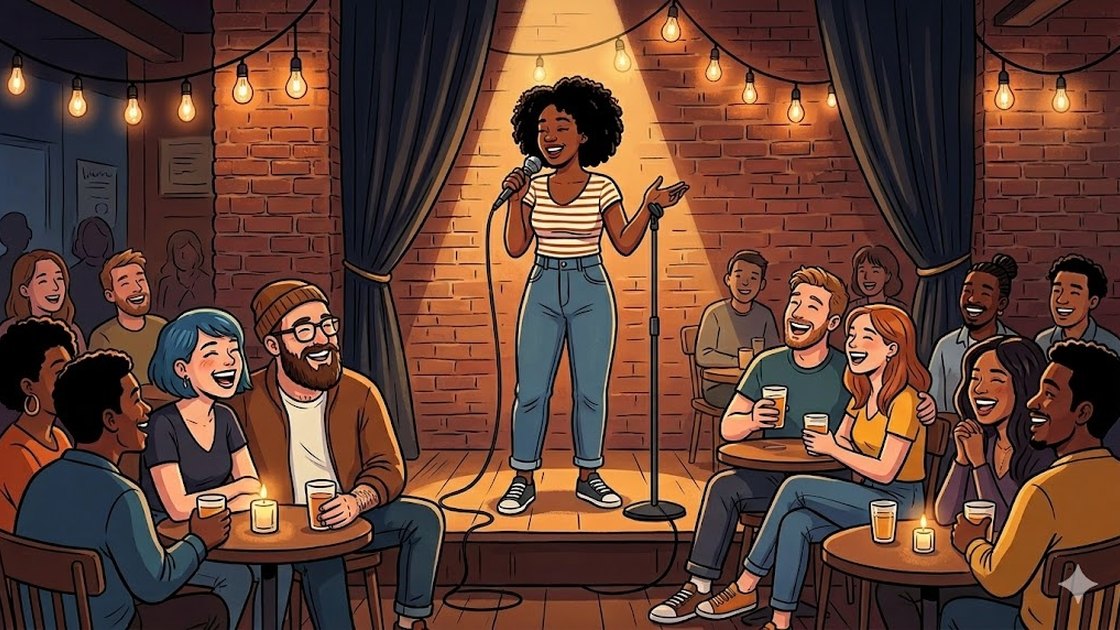
Stand-up comedy in Berlin runs almost every night of the week, and a surprising amount of it is in English. You can watch a polished showcase of touring comedians in Prenzlauer Berg, try five euros’ worth of nervous first-timers at a Neukölln open mic, or sit in the basement of a famous theatre for a German big-room set. This guide covers where to go, what each room is actually like, what it costs, and why a comedy night is one of the easiest ways to spend an evening with someone in this city.
Contents
- The short version
- Where to find stand-up comedy in Berlin
- English-language nights for newcomers
- Free and cheap open mics: the best way in
- The big German rooms: Quatsch and the Kabarett tradition
- Alternative and improv: Comedy Café Berlin
- A quick comparison of Berlin’s comedy venues
- What it costs and how to get a seat
- How stand-up comedy actually started
- Why a comedy night is better with someone
- How to find someone to go with in Berlin
- Want to keep reading?
- Frequently asked questions
- Sources
The short version
Berlin has a dense, year-round comedy scene split across three lanes: English-language clubs and showcases for the international crowd, free or cheap open mics where anyone can watch raw new material, and bigger German-language rooms in the Kabarett and TV-comedy tradition. Start with an English showcase like Cosmic Comedy at Kookaburra (Prenzlauer Berg) or Comedy Café Berlin (Neukölln) if you want a reliable laugh; drop into a Thursday open mic if you want something cheap and unpredictable. Most English nights run €10–€20, often with pizza thrown in. It is a low-effort, low-cost plan that works much better with one other person to laugh and compare notes with.
Where to find stand-up comedy in Berlin
The best stand-up comedy in Berlin clusters in a handful of neighbourhoods and a few reliable venues, so you rarely have to gamble on the night. English-language shows concentrate around Prenzlauer Berg, Mitte, Neukölln and Kreuzberg, while the larger German productions sit in central theatres. Because Berlin is home to a huge international population, English comedy here is not a novelty add-on — it is a full scene with its own regular rooms, touring acts and weekly open mics.
A simple way to think about it: pick your lane first, then pick the night. If you want guaranteed quality, book a curated showcase. If you want cheap and surprising, find an open mic. If you want a proper night out in a big room and your German is up to it, go for one of the established theatres. The rest of this guide walks through each lane with real venues, neighbourhoods and prices.
New in Berlin and want company for a night like this? MITRA is built for exactly that — find someone nearby who is up for the same plan and sort it out together. Get it on Google Play or download it on the App Store.
English-language nights for newcomers
If you have just moved to Berlin and your German is still a work in progress, English-language showcases are the easiest entry point. These rooms book a line-up of professional and semi-professional comedians from across the international scene, so the standard is consistent and you will not need to translate a single punchline.
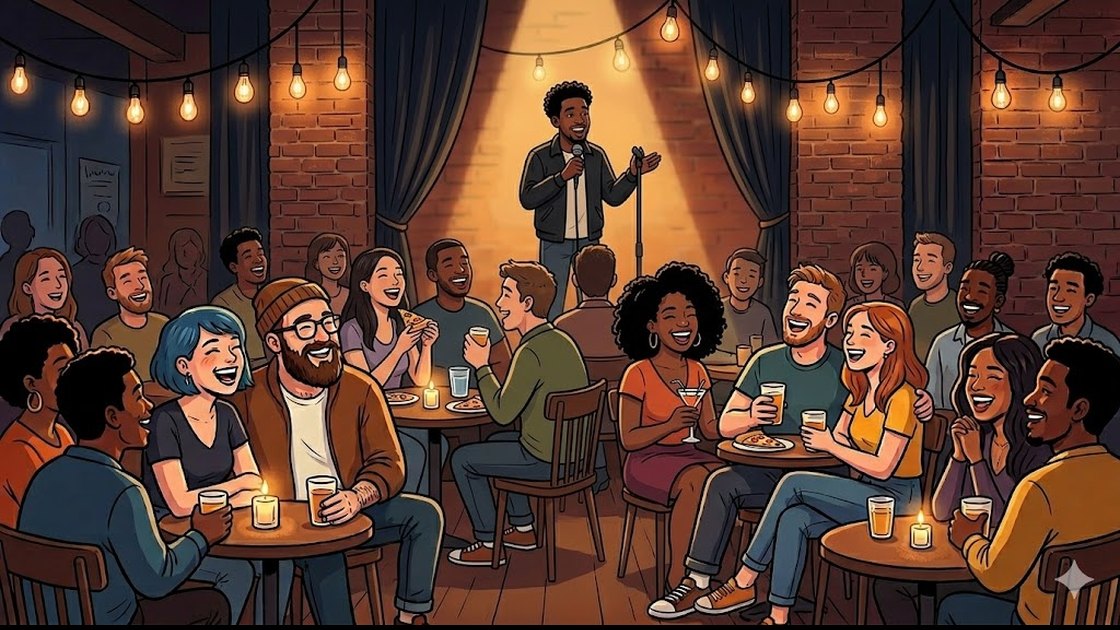
Cosmic Comedy at Comedy Club Kookaburra is the most established English-language room. Kookaburra sits at Schönhauser Allee 184 in Prenzlauer Berg, in a former bank branch it has occupied since 2002, and Cosmic Comedy runs English nights there through the week: a Thursday open mic and a “best of” showcase on Friday and Saturday. Doors are typically at 7pm, pizza comes out around 8:15pm and the main show starts at 9pm, with a complimentary apple shot and a vegetarian and vegan pizza buffet included in the ticket. It is the closest thing Berlin has to a classic comedy-club night, and a safe first booking.
Epic Comedy Berlin runs a weekly English showcase of hand-picked established and up-and-coming comedians, with shows in Mitte and Friedrichshain. It is a good option if you want a tighter, curated line-up rather than the lottery of an open mic, and it moves around enough that there is usually a date that fits your week.
East-West Comedy programmes English-language shows and open mics around the Kreuzberg and Neukölln border, explicitly aimed at expats, travellers and the city’s international community. The vibe is welcoming and unpretentious, which makes it an easy first comedy night if you are nervous about the format or going somewhere new on your own.
Free and cheap open mics: the best way in
Open mics are the cheapest, most unpredictable and arguably most fun way to watch stand-up comedy in Berlin. At an open mic, anyone who signed up gets five to seven minutes to test new jokes, which means you will see a mix of seasoned comedians working out fresh material and complete beginners shaking through their first set. Some of it lands hard, some of it dies, and the gap between the two is half the entertainment.
The Thursday open mic at Cosmic Comedy / Kookaburra is the easiest to recommend because it is in English, runs reliably and still includes the pizza-and-shot deal at a lower price than the weekend showcases. Beyond that, Berlin’s open-mic calendar shifts constantly across bars and small venues in Neukölln, Kreuzberg and Friedrichshain, so the smart move is to check a live listings site in the week you want to go rather than trusting a fixed schedule. Event platforms aimed at Berlin’s English-speaking audience list comedy open mics night by night.
One honest warning: open mics are where the scene experiments, so the quality swings. That is exactly why they are better shared. A set that flops is a great story to lean over and whisper about; a set that kills is more fun when someone next to you gasps too.
Going to an open mic solo can feel like a lot. With MITRA you send an activity request to people near you who are up for the same thing, and you meet the ones who accept — you choose who to reach out to, and they choose whether to say yes. Get MITRA on Google Play or on the App Store.
The big German rooms: Quatsch and the Kabarett tradition
If your German is solid, Berlin’s larger German-language comedy rooms are worth the upgrade in scale and production. The flagship is the Quatsch Comedy Club, which performs in the basement of the Friedrichstadt-Palast in Mitte. Quatsch matters historically as well as practically: Thomas Hermanns opened the first Quatsch Comedy Club in 1992, and it is widely credited with laying the foundation for modern stand-up in Germany. Its weekly “Club Mix” format puts several comedians on one bill, the same TV-style showcase that introduced a generation of German audiences to the form.
Quatsch is also a useful reminder that Germany’s comedy history did not start with stand-up. The older, deeper tradition here is Kabarett — sharp, politically pointed cabaret that long predates the American club format. Plenty of Berlin’s German-language stages still lean on that heritage, blending satire and song with newer stand-up energy. If you want to understand why German comedy feels a little different from the Anglo club scene, Kabarett is the missing context.
These rooms are ticketed and pricier than the English open mics, and most of the material assumes fluent German. But for a special night out — or to see why stand-up took so long to land in Germany and then took off — they are the real thing.
Alternative and improv: Comedy Café Berlin
For something looser than a straight stand-up showcase, Comedy Café Berlin in Neukölln is the city’s home of alternative and improvised comedy. It opened in autumn 2015 at Roseggerstraße 17 as Berlin’s first dedicated international alternative comedy stage, café and bar, and it has a soundproof 60-seat theatre with a full bar attached. The programme mixes English and German stand-up, long-form improv shows and live podcast recordings, so no two nights look alike.
Comedy Café Berlin is also where the scene teaches itself. It runs improv and comedy classes for beginners and advanced students in both English and German, and it co-organises the Berlin Fringe each summer, where international comedians road-test material before heading to the Edinburgh Fringe. If watching comedy makes you wonder whether you could do it — a lot of people have that thought after a good open mic — this is the obvious place to find out, ideally with a friend who will sign up alongside you.
The room’s small size is the whole point. Sixty seats means you feel part of the show rather than a face in a dark hall, which is great for a night out and slightly terrifying if you sit in the front row.
A quick comparison of Berlin’s comedy venues
Here is a side-by-side look at the main rooms so you can match a venue to your night, your language and your budget. Prices and nights move around, so treat this as a starting point and confirm the specific show before you go.
| Venue | Area | Language | Best for | Typical entry |
|---|---|---|---|---|
| Cosmic Comedy at Kookaburra | Prenzlauer Berg | English | Reliable showcases + Thursday open mic, pizza and a shot included | ~€13 open mic / ~€17 showcase |
| Comedy Café Berlin | Neukölln | English & German | Alternative comedy, improv, podcasts, classes | Varies, often around €12+ |
| Quatsch Comedy Club | Mitte (Friedrichstadt-Palast) | German | Big-room, TV-style line-ups | Higher, fully ticketed |
| Epic Comedy Berlin | Mitte & Friedrichshain | English | Curated weekly English showcase | Mid-range ticketed |
| East-West Comedy | Kreuzberg / Neukölln | English | Expat-friendly shows and open mics | Free to low-cost |
How we chose: we focused on the rooms that run regular, findable comedy nights for an international audience, cross-checked their neighbourhoods and formats against official venue and Berlin tourism listings, and confirmed the English-language programming and current price ranges where they were published in mid-2026. We left out one-off pop-ups and pure ticket-reseller listings.
What it costs and how to get a seat
Stand-up comedy in Berlin is cheap by night-out standards, which is a big part of its appeal. English open mics typically run around €10–€13 and frequently bundle in pizza and a welcome drink; weekend showcases at the established clubs sit closer to €15–€20. The big German rooms like Quatsch are the exception — those are full theatre tickets and priced accordingly.
A few practical tips. Book the popular English showcases in advance, because the rooms are small and the good weekend slots sell out, especially in summer when visitors pile in. For open mics you can often just turn up, but arriving when doors open gets you a better seat in a tight room. Bring cash as a backup for the bar even where tickets are online. And check the start time carefully: at clubs like Kookaburra the doors, the pizza and the actual show are staggered across the evening, so “9pm show” really means arrive by 8 if you want food and a decent seat.
Sorting a plan is easier with someone already in. On MITRA you find people nearby who want to do the same activity and arrange it together — no algorithm deciding for you, just a request and a yes. Download on Google Play or on the App Store.
How stand-up comedy actually started
Stand-up in the modern sense — one person talking directly to an audience, as themselves, without props or characters — is a relatively young art form that took shape around the turn of the 20th century. It grew out of American vaudeville and variety traditions, where performers gradually stepped out from behind the sketches and songs to address the crowd directly. That direct, conversational address is the thing that separates stand-up from the variety acts it came from.
Germany came to this format late. The country’s own comic tradition ran for decades through Kabarett rather than the American club circuit, and homegrown stand-up only really took hold in the 1990s and 2000s — accelerated, as noted above, by Thomas Hermanns founding the Quatsch Comedy Club in 1992 after the format had won over younger audiences who had encountered it abroad. That short history is part of why Berlin’s scene feels so layered today: a young German stand-up culture, an older satirical Kabarett heritage, and a large international circuit all sharing the same city on the same nights.

Why a comedy night is better with someone
A comedy night is one of those plans that quietly doubles in value when you bring someone. Laughter is contagious in a literal, well-documented way — we laugh far more in company than alone, and a shared laugh is one of the fastest ways two people feel at ease with each other. A room full of strangers helps, but the person in the seat next to you is what turns a show into a memory.
There is also the after. The best part of an open mic is often the walk to the U-Bahn afterwards, dissecting which comedian was secretly the best, which joke should never have left the house, and whether either of you could survive five minutes on that stage. That conversation needs a second person. Going alone is perfectly fine and Berlin makes it easy, but a comedy night is built for two — low pressure, plenty to talk about, and no need to fill the silences yourself because the show does that for you.
It is also a forgiving first hang with someone you do not know well yet. You are pointed at a stage, not at each other, the jokes carry the evening, and if you click you have an instant plan for next week’s show. That is a far softer landing than a sit-down dinner where the whole night rests on conversation.
That second person is the whole idea behind MITRA. Find someone near you who is into the same night out, send a request, and meet the ones who say yes. Get MITRA on Google Play or on the App Store.
How to find someone to go with in Berlin
The simplest way to find someone to go to a comedy night with in Berlin is to make the plan first and the company second. Pick a specific show — a Thursday open mic at Kookaburra, an English showcase at Comedy Café Berlin — then look for one other person who wants in. A concrete plan (“Thursday, 8pm, English open mic in Prenzlauer Berg”) is far easier for someone to say yes to than a vague “we should hang out sometime.”
That is what MITRA is for. You set what you want to do and where you are, send activity requests to people nearby, and meet the ones who accept — you decide who to reach out to, and they decide whether to join. There is no automatic matching and nothing to swipe through; it is just a quick, consent-based way to turn a plan you already have into a plan with someone in it. For a comedy night, where the show does the heavy lifting, that one extra person is all you need.
If you would rather start from a crowd, the city’s English-comedy rooms and expat-focused nights are friendly places to talk to strangers anyway — small venues, shared laughter and a bar are a good recipe for meeting people. Either path works. The goal is the same: do not let “I had no one to go with” be the reason you skip a good cheap night out.
If watching the professionals makes you want a go yourself, improv classes in Berlin start at nothing — the Comedy Café jam is free — and run to €335 for a nine-week course.
Want to keep reading?
If you are putting together a roster of easy, social things to do in Berlin, these guides pair well with a comedy night:
- Karaoke in Berlin — the natural next-step night out when you want to be on the mic instead of watching it.
- Open air cinema in Berlin — another low-pressure evening plan, this time under the stars.
- Escape rooms in Berlin — a great group activity when you want something more hands-on.
- Things to do alone in Berlin — for the nights you do want to head out solo.
- Mini golf in Berlin — another cheap, no-skill plan that is easy to share.
- Bowling in Berlin — a classic, low-stakes evening with someone new.
Frequently asked questions
Is there English-language stand-up comedy in Berlin?
Yes — Berlin has a large, regular English-language comedy scene, not just occasional shows. Cosmic Comedy at Kookaburra in Prenzlauer Berg, Comedy Café Berlin in Neukölln, Epic Comedy Berlin in Mitte and Friedrichshain, and East-West Comedy around Kreuzberg and Neukölln all programme English nights through the week. Because the city has such a big international population, English stand-up here is a full scene with its own clubs, touring acts and open mics.
How much does a comedy show in Berlin cost?
English open mics usually run around €10–€13 and often include pizza and a welcome drink, while weekend showcases at established clubs sit closer to €15–€20. The big German-language rooms such as the Quatsch Comedy Club are full theatre tickets and cost more. Overall, stand-up is one of the cheaper nights out in Berlin, which is a large part of its appeal for newcomers on a budget.
Where is the best stand-up comedy in Berlin for beginners to the scene?
For a reliable first night, book an English-language showcase rather than an open mic. Cosmic Comedy at Kookaburra (Prenzlauer Berg) and Comedy Café Berlin (Neukölln) both offer consistent quality and a welcoming room. Showcases book professional and semi-professional comedians, so the standard is steadier than an open mic, where the line-up is a lottery of seasoned acts and nervous first-timers testing brand-new material.
What is an open mic and is it worth going to?
An open mic is a show where anyone who signed up gets a short slot, usually five to seven minutes, to try out material. You will see experienced comedians working on new jokes alongside complete beginners doing their first set. The quality swings wildly, which is exactly the appeal — it is cheap, unpredictable and full of moments you could not script. The Thursday open mic at Kookaburra is an easy English-language one to start with.
Do I need to speak German to enjoy comedy in Berlin?
No. A large share of Berlin’s comedy is performed in English specifically for the city’s international audience, so you can fill several nights a week without a word of German. If your German is fluent, the bigger German-language rooms like Quatsch Comedy Club and the city’s Kabarett stages open up a deeper, more local tradition. But fluent German is in no way required to enjoy the scene as a newcomer.
What is the Quatsch Comedy Club?
The Quatsch Comedy Club is Germany’s best-known stand-up venue, performing in the basement of the Friedrichstadt-Palast in Mitte. Thomas Hermanns opened the first Quatsch Comedy Club in 1992, and it is widely credited with establishing modern stand-up in Germany. Its weekly “Club Mix” puts several comedians on one bill in a TV-style showcase. Shows are in German and ticketed like a theatre, so it is a step up in scale and price from the English open mics.
Can I try doing stand-up myself in Berlin?
Yes. Open mics exist precisely so new comedians can test material, and many performers start with a five-minute slot at a small room. Comedy Café Berlin in Neukölln also runs improv and comedy classes for beginners in both English and German, and co-organises the Berlin Fringe each summer for acts road-testing shows. Signing up with a friend makes the first attempt far less intimidating than going it alone.
Where do comedy clubs cluster in Berlin?
English-language stand-up concentrates in Prenzlauer Berg, Mitte, Neukölln and Kreuzberg, while the larger German productions sit in central theatres like the Friedrichstadt-Palast. Kookaburra is on Schönhauser Allee in Prenzlauer Berg, Comedy Café Berlin is on Roseggerstraße in Neukölln, and East-West Comedy runs around the Kreuzberg–Neukölln border. Picking a neighbourhood is an easy way to plan a comedy night around dinner or drinks nearby.
Is a comedy night a good plan to bring someone to?
It is one of the best low-pressure plans in the city. The show carries the evening, so there is no pressure to keep a conversation going, and the post-show walk gives you plenty to talk about. People laugh far more in company than alone, and a shared laugh is a fast way to feel comfortable with someone. For meeting someone new or deepening a new friendship, a cheap comedy night is a softer first hang than a formal dinner.
Sources
- visitBerlin (official Berlin tourism) — Comedy Club Kookaburra venue listing (Prenzlauer Berg; in a former bank branch since 2002): https://www.visitberlin.de/en/comedy-club-kookaburra
- Cosmic Comedy / English Comedy Berlin — show nights, schedule and ticket prices (Thursday open mic, Friday/Saturday showcase; doors 7pm, pizza 8:15pm, show 9pm; apple shot + pizza buffet): https://comedyclubberlin.com/event/comedy-pizza-and-shots-open-mic-thursday/
- Comedy Café Berlin (official) — venue history (opened autumn 2015, Roseggerstraße 17, Neukölln), 60-seat theatre, English/German programme, classes and Berlin Fringe: https://www.comedycafeberlin.com/
- Quatsch Comedy Club (official) — venue at the Friedrichstadt-Palast, Berlin Mitte, weekly Club Mix format: https://quatsch-comedy-club.de/berlin/
- Wikipedia — History of stand-up comedy (modern stand-up emerged around the turn of the 20th century from American vaudeville; performers address the audience directly as themselves): https://en.wikipedia.org/wiki/History_of_stand-up_comedy
- Encyclopædia Britannica — Stand-up comedy (definition and origins of the form): https://www.britannica.com/art/stand-up-comedy
- East-West Comedy (official) — English-language shows and open mics for Berlin’s international community (Kreuzberg/Neukölln): https://eastwestcomedy.com/
Make tonight the night you actually go. Pick a show, open MITRA, and send a request to someone nearby who wants the same plan — you meet the ones who say yes. Get it on Google Play or download it on the App Store.
MITRA is activity-first: you send an activity request to people near you, and you meet the ones who accept. Berlin first. Bucharest and more EU cities coming soon. Follow along on Instagram @mitra.app, and bring a friend to your next show.