
Salsa, tango and swing: find a dance partner in Berlin
Want a dance partner in Berlin? Where to learn salsa, tango and swing, the best socials and milongas, and a faster way to find one to practise with.
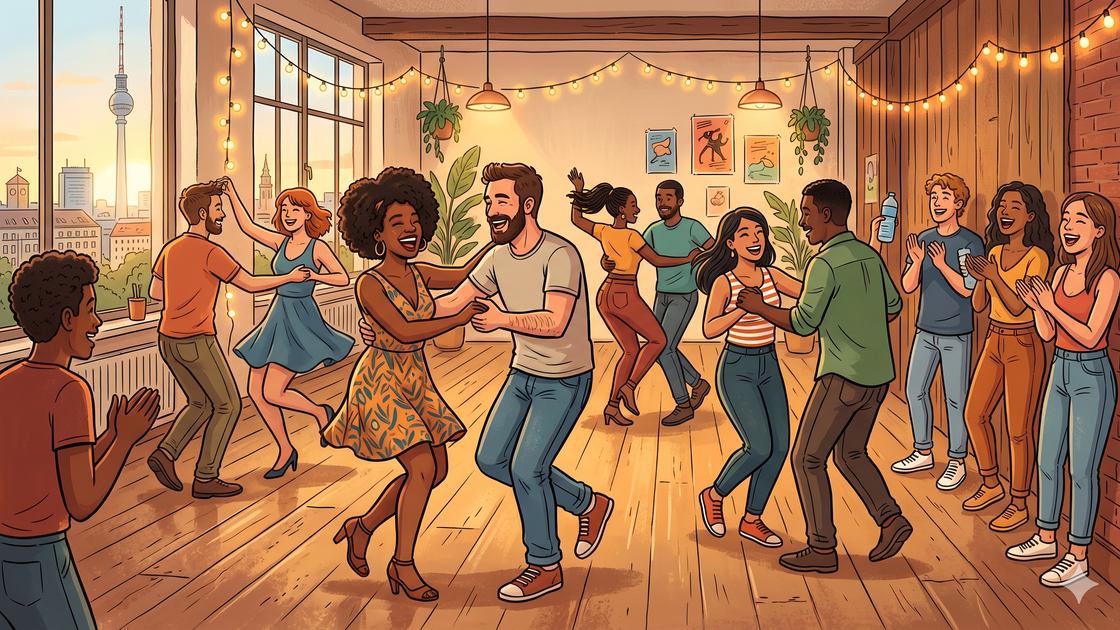
To find a dance partner in Berlin, start by picking one partner dance and joining a beginner course or a weekly social where partners rotate — at places like Clärchens Ballhaus in Mitte, a Lindy hop class in Kreuzberg or a salsa social in Kreuzberg you will be dancing with strangers within the hour. You almost never need to bring your own partner. What is harder to find is a regular person to practise with between classes, and that is where sending a dance request on an activity app to someone nearby helps: you ask, they decide whether to say yes, and you build a standing dance habit together.
The short version:
- You do not need to bring a partner to dance in Berlin. Beginner courses and socials (called milongas in tango) rotate partners on purpose, so you turn up alone and dance all night.
- The fastest way in is one beginner course plus one weekly social in the same style: a 10-week Lindy hop course with Let it Swing (around €120), a drop-in bachata class near Alexanderplatz (around €12), or a Wednesday tango evening in the mirrored hall of Clärchens Ballhaus, a ballroom open since 1913.
- Berlin runs deep on social dance: there is a milonga almost every night of the week, plus open-air tango by the Spree at Monbijoupark all summer.
- The one thing apps solve that classes don’t is the regular practice partner. On MITRA you send a dance request to someone near you; they accept if they want, so it stays low-pressure on both sides.
New to Berlin and want someone to learn the steps with? Find your dance partner on MITRA — free to start. Get MITRA on Google Play or download for iPhone.
Contents
- Do you need to bring a partner to dance in Berlin?
- Which partner dance fits you — and where Berlin does each best
- Where to learn: beginner courses at named Berlin studios
- Where to actually dance: Berlin’s weekly socials and milongas
- Lead, follow, and the etiquette of a Berlin social
- How to find a regular dance partner in Berlin, not just a one-song dance
- How MITRA helps you find a dance partner near you
- Your first month on the floor: a simple way in
- Frequently asked questions
Do you need to bring a partner to dance in Berlin?
No — and this is the single thing that stops most people before they start. Berlin’s partner-dance world is built for people who arrive on their own. Beginner courses rotate partners every few minutes so everyone dances with everyone, and the city’s social evenings work the same way: you walk in solo, you ask people to dance one song at a time, and you leave having danced with a dozen strangers. Swing schools say it plainly on their sign-up pages — you need no special shoes and no partner, because the class rotates.
The rotation is not just logistics; it is how you actually learn. Dancing with many bodies, leads and follows in one evening teaches you to adapt far faster than drilling with one fixed person. So the beginner’s real question is not “who do I bring?” but “which night do I show up, and where?”
There is, though, a genuine gap that rotation doesn’t fill. Once you are past your first month, most people want one or two reliable people to practise with between classes — someone to run through last week’s figures with before the next social, or to go to a milonga with so you are not standing at the edge alone. Berlin makes the first dance easy and the regular partner surprisingly hard. The rest of this guide covers both.
Which partner dance fits you — and where Berlin does each best
Pick the dance by the music and the room you want to be in, not by which is “easiest.” Berlin does several partner dances at a world-class level, and each has its own scene, venues and crowd. Here is an honest map to choose from.
| Dance | What it feels like | Where Berlin does it well | Easiest way in for a beginner |
|---|---|---|---|
| Salsa (Cuban) | Fast, circular, playful, social | Latin schools and socials across Mitte, Kreuzberg and Friedrichshain | A drop-in beginner class before a weekend social |
| Bachata | Slower, smooth, close partner connection | Weeknight classes near Alexanderplatz; sensual-bachata socials | A €12 drop-in class on a Monday or Wednesday |
| Tango Argentino | Deep, improvised, intense embrace | Mitte, Schöneberg, Prenzlauer Berg; a milonga almost every night | A beginner course plus an early-evening práctica |
| Lindy hop / swing | Bouncy, joyful, retro, partnered | Neukölln, Kreuzberg and Prenzlauer Berg swing schools | A 10-week beginner course (partners rotate) |
| Kizomba | Slow, grounded, walking connection | Smaller but warm scene, often shared with bachata nights | A taster night, then a beginner course |
A quick way to decide: if you want fast, loud and friendly, start with salsa. If you want close, musical and intense, try bachata or tango. If you want to laugh, bounce and sweat to jazz, go swing. None of them require a partner to begin, and you can switch later — plenty of Berliners dance two or three.
If your real aim is meeting people while you pick up a skill, dancing sits naturally alongside other social activities — many people who dance also do a weekly language exchange or a regular sport with the same crowd.
Found the dance, missing the person to practise with? MITRA helps you find a dance partner near you — and it’s free. Download on Google Play or get it for iPhone.
Where to learn: beginner courses at named Berlin studios
Start with a structured beginner course, because it gives you a fixed weekly slot, a clear progression, and a built-in group of people at exactly your level. These are real, current options across the main styles. Schedules and prices shift, so treat these as a starting map and confirm the next intake on each school’s own page.
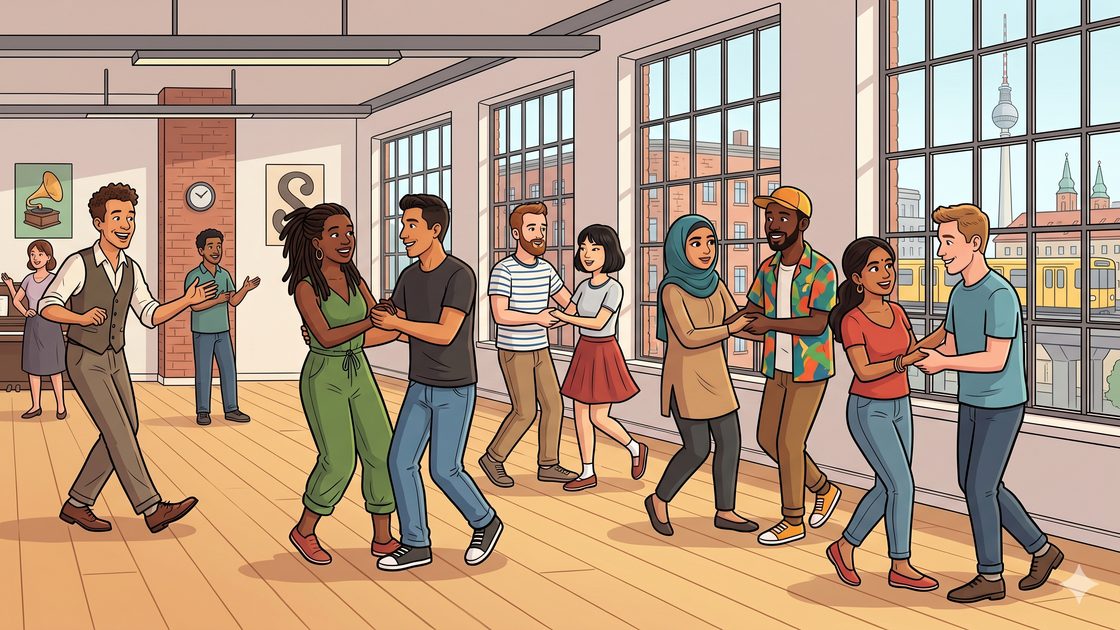
For swing and Lindy hop, Let it Swing runs its beginner “Lindy Hop 1” as a 10-week course — recently Mondays at 18:00 in Neukölln and Wednesdays at 18:00 in Kreuzberg — for around €120 solo (about €220 if you sign up as a pair), taught in English and German. Swing Base in Prenzlauer Berg teaches beginner Lindy hop, Charleston and Balboa in 10-week blocks. If you would rather not commit to a course, Swing Patrol Berlin runs friendly drop-in classes at venues including the Kulturbrauerei, with no sign-up and no partner needed.
For salsa and bachata, a budget-friendly first step is Zapatissimo, a Berlin school teaching Salsa Cubana, Bachata Sensual and Tango Argentino, with trial classes around €5.50. The Bachata Classes Berlin group runs beginner-heavy technique classes near S+U Alexanderplatz on Mondays and Wednesdays at 19:00 for around €12 a class — an easy, low-stakes way to test whether bachata is your thing. Dolce Vita Dance Studio in Mitte offers salsa, bachata and more for mixed levels.
For tango, beginners are well served at Mala Junta on Kolonnenstraße in Schöneberg, where two studios run daily classes with rotating teachers and a monthly open house with free instruction, and at Urquiza on Schönhauser Allee 175 in Prenzlauer Berg, which runs regular courses, themed workshops and private lessons. For sheer atmosphere, Clärchens Ballhaus on Auguststraße in Mitte hosts beginner-friendly tango in its mirrored upstairs hall, followed by open dancing.
Here is the same information at a glance.
| Studio / group | District | Styles | Beginner entry |
|---|---|---|---|
| Let it Swing | Neukölln / Kreuzberg | Lindy hop, swing | 10-week course ~€120 |
| Swing Base | Prenzlauer Berg | Lindy hop, Charleston, Balboa | 10-week beginner block |
| Swing Patrol | Various (incl. Kulturbrauerei) | Swing, Lindy hop | Drop-in, no partner needed |
| Zapatissimo | Berlin | Salsa Cubana, Bachata, Tango | Trial class ~€5.50 |
| Bachata Classes Berlin | Near Alexanderplatz, Mitte | Bachata | Drop-in ~€12, Mon/Wed 19:00 |
| Mala Junta | Schöneberg | Tango Argentino | Daily classes; monthly free taster |
| Clärchens Ballhaus | Mitte | Tango and social dance | Beginner tango + milonga |
How we checked: we read each school’s current beginner timetable, drop-in policy and trial pricing in June 2026. Dance schedules change often — always confirm the next class on the school’s own page before you go.
Where to actually dance: Berlin’s weekly socials and milongas
Once you have a few steps, the social evening is where dancing becomes a habit. A social (in tango, a milonga) is an open dance night where people come to dance with whoever is there — exactly the low-pressure, rotation-based setting beginners need. Berlin has one almost every night of the week.

In tango, the city’s official tourism board notes there are milongas across Berlin on nearly every weekday, with introductions for beginners. The most atmospheric indoor option is the mirrored hall at Clärchens Ballhaus — a ballroom that has been running since 1913 and is the last survivor of the roughly 900 dance halls Berlin once had. In summer, the loveliest free option is the open-air milonga at Monbijoupark, right on the Spree opposite the Bode-Museum, where people of every level dance under the trees on warm evenings.
In salsa and bachata, look for socials that teach a class first and then open the floor, so beginners have a soft landing. SalsOli, held at the Tangoloft in Kreuzberg, runs taught levels from beginner to advanced between 19:00 and 22:00 before open dancing — a good first social because the lesson warms up the room and you already share steps with the people around you. Latin socials rotate through venues across Mitte, Kreuzberg and Friedrichshain, so check a current calendar each week.
In swing, the scene runs regular social nights and the schools above will point you to the next one; because Lindy hop is so partner-rotation friendly, swing socials are among the easiest places in the city to dance all evening as a solo newcomer.
Got a class booked and want company on the floor? Line up a dance partner on MITRA before you go. Get MITRA on Google Play or download for iPhone.
Lead, follow, and the etiquette of a Berlin social
Knowing the unwritten rules removes most of the first-night fear. Partner dances split into two roles — the lead (who proposes the movement) and the follow (who responds and interprets it). Either role is open to anyone regardless of gender, and learning both is increasingly normal in Berlin’s swing and tango scenes. You do not need to decide forever on night one.
Asking for a dance is simple and expected: a smile and “would you like to dance?” works in any room, and a polite “no thanks” is always acceptable and never personal. In tango, watch for the cabeceo — the across-the-room nod and eye contact used to invite someone without crossing the floor; it feels mysterious at first and obvious within a month. A few norms make you welcome anywhere: dance the agreed set (in tango, a tanda of three or four songs), thank your partner at the end, mind your floorcraft so you don’t collide, and pay attention to basic hygiene because partner dance is close.
The friendliest detail for newcomers: nobody expects you to be good. Socials are full of people at every level, and experienced dancers generally enjoy dancing with beginners who are relaxed and listening. Your job on night one is to keep time, stay kind, and have fun — not to perform.
How to find a regular dance partner in Berlin, not just a one-song dance
The rotation that makes socials easy also means you rarely build a steady dance relationship there — and steady practice is what turns a beginner into a real social dancer. This is the gap most newcomers hit around week four: you can dance one song with anyone, but you have no one to actually rehearse last week’s figures with, no one to commit to a Tuesday course with, no one to text “milonga tonight?” on a quiet evening.
The classic routes are slow. You can hope a regular partnership forms organically over months of classes, post in a dance Meetup or Facebook group and sift replies, or ask a teacher to pair you up. All of these work eventually, but they leave a lot to chance and to timing.
A more direct route is to look for someone nearby who specifically wants the same thing — a practice partner for the same style, at a similar level, in your part of the city. That is a small, specific ask, and it is exactly what an activity app is good at: matching the intent (a tango practice partner in Prenzlauer Berg, a swing buddy for Wednesday classes) rather than leaving you to read a room. Whichever route you choose, treat finding a regular partner as its own small goal alongside the dancing — the same way people deliberately seek out a running partner or a gym buddy instead of waiting to bump into one.
How MITRA helps you find a dance partner near you
MITRA is an activity app for meeting people near you to do a specific thing together — in this case, dance. Instead of matching you automatically, it works on request: you send a dance request to someone close by, and you meet only if they accept. You decide who to reach out to; they decide whether to say yes. That two-way consent is the whole point, and it keeps the first message low-pressure for both of you.
In practice, you would open MITRA, say you are looking to dance — a salsa practice partner for weekend socials, someone to take a beginner Lindy course with, a tango buddy for weekday milongas — and send a request to people nearby who want the same. Because the request names the activity, the conversation starts with something concrete to do rather than small talk. From there you agree on a class or a social and go.
It also solves the solo-newcomer problem neatly: arriving at your first milonga with one person you have already arranged to meet is far less daunting than walking in cold. The same approach works across the city’s activity scene, which is why MITRA covers everything from dance to sport to hiking partners near Berlin — the mechanic is always the same: name the activity, send the request, meet the people who opt in.
Ready to turn one class into a habit? Send your first dance request on MITRA today — free to try. Download on Google Play or get it for iPhone.
Your first month on the floor: a simple way in
Think of the first month as four small, doable steps rather than a leap. In week one, pick one style from the table above and book a single beginner class or trial — a €5.50 trial or a €12 drop-in costs almost nothing and tells you more than any video. In week two, go back to the same class so the faces start to feel familiar, and stay ten minutes after to chat. In week three, add your first social or milonga in that style — ideally one that teaches a lesson first, like an early-evening salsa social or a beginner práctica. By week four, line up one regular practice partner so you have someone to keep going with between classes.
Two honest tips. First, consistency beats talent: the people who get good are simply the ones who keep showing up, not the naturally gifted. Second, do not over-shop for the “perfect” style or studio — one class a week for a month in any of these dances will take you further than a month of researching which to start. Berlin will still be dancing next week; the only thing you can lose is the months you spend deciding.
Frequently asked questions
Do I need a partner to start dancing in Berlin?
No. Beginner courses and social nights in Berlin rotate partners on purpose, so you turn up alone and dance with many people across the evening. Swing schools state it directly on their sign-up pages: no special shoes and no partner needed. Rotation is also how you learn fastest, because dancing with different leads and follows trains you to adapt. The only time a steady partner really helps is later, for practising between classes — and that you can arrange separately.
Which dance is easiest for a complete beginner?
Salsa and bachata are the most common starting points because the basic step is quick to grasp and there are many beginner drop-in classes. Bachata in particular has a simple side-to-side basic that most people can follow in one lesson. That said, easiest matters less than which music you enjoy — you will practise far more if you love the sound. Try a single beginner class in two styles and let your feet pick.
How much do dance classes cost in Berlin?
Expect roughly €10–€15 for a single drop-in class, while structured beginner courses run more — for example a 10-week Lindy hop course around €120. Some schools offer cheap trials, such as around €5.50 at Zapatissimo, and many socials charge a small entry of a few euros. Prices change, so confirm on each school’s page; the figures here reflect listings checked in June 2026.
What is a milonga?
A milonga is a social dance event for Argentine tango — an open evening where people come to dance with whoever is present, often with a short beginner lesson or práctica beforehand. Berlin has milongas on nearly every night of the week, indoors at historic venues like Clärchens Ballhaus and, in summer, outdoors at Monbijoupark by the Spree. Milongas are beginner-friendly: you ask people to dance one set at a time, and a polite no is always fine.
Where can I dance outdoors in Berlin in summer?
The best-known outdoor option is the open-air tango milonga at Monbijoupark in Mitte, on the riverbank opposite the Bode-Museum, which runs on warm evenings through the summer. It is free, welcoming and a lovely first social because the open setting feels less intimidating than a club. Salsa and swing pop-ups also appear in parks and by the canals in good weather — check current weekly calendars, as outdoor events depend on the weather.
Is it okay to go to a Berlin dance social on my own?
Yes — going alone is the norm, not the exception. Socials and milongas are built around asking different people to dance one set at a time, so solo newcomers fit right in and often dance more than people who arrive as a pair. A simple smile and would you like to dance? is all it takes, and a polite decline is never personal. If walking in cold still feels daunting, arrange to meet one person there first so you have a familiar face from the start.
Can I dance in Berlin if I only speak English?
Yes. Many Berlin schools teach in both English and German, and the international swing, salsa and tango scenes are full of expats, so English is widely spoken on the floor. Dance itself is mostly non-verbal once the music starts. If you want to meet locals and practise the language too, pairing dance with a regular German language exchange is a popular combination.
How do I find a regular dance practice partner?
Beyond hoping one forms over months of classes, the direct route is to look for someone nearby who wants the same style at a similar level. You can post in a dance Meetup or Facebook group, ask a teacher to pair you, or use an activity app like MITRA to send a dance request to people near you. On MITRA you name the activity and the other person accepts if they want, so you reach people who are specifically after a practice partner too.
What should I wear and bring to my first class?
Comfortable clothes you can move in and clean shoes with a smooth-ish sole are enough to start — you do not need special dance shoes for a beginner class, and most schools confirm this. Bring water and maybe a small towel, since partner dancing is more of a workout than it looks. Leave bulky bags at home or in a locker so the floor stays clear. Above all, arrive a few minutes early so you are not rushing into the warm-up.
Want to keep reading?
- How to find a language exchange partner in Berlin
- How to find a running partner in Berlin
- How to find a tennis partner in Berlin
- How to find a gym buddy in Berlin
- How to find a hiking partner in Berlin
- Bouldering in Berlin for beginners
Your dance partner in Berlin is one request away. Start free on MITRA. Get MITRA on Google Play or download for iPhone.
Come say hi on Instagram @mitra.app — we share Berlin activity ideas and the people making them happen. Berlin first. Bucharest and more EU cities coming soon.
Sources
- UNESCO — Intangible Cultural Heritage, Tango (inscribed 2009 on the Representative List; joint nomination by Argentina and Uruguay; developed by urban communities in Buenos Aires and Montevideo, Río de la Plata). https://ich.unesco.org/en/RL/tango-00258
- visitBerlin (official Berlin tourism) — Tango in Berlin (milongas across the city on nearly every weekday; beginner introductions; open-air dancing). https://www.visitberlin.de/en/tango-berlin
- visitBerlin (official Berlin tourism) — Clärchens Ballhaus (historic Berlin ballroom open since 1913, Auguststraße, Mitte). https://www.visitberlin.de/en/clarchens-ballhaus
- Wikipedia — Clärchen’s Ballroom (opened 13 September 1913; the last surviving of roughly 900 Berlin ballrooms; protected cultural monument). https://en.wikipedia.org/wiki/Cl%C3%A4rchen’s_Ballroom
- Wikipedia — History of Lindy Hop (born in the African-American community of Harlem, New York, in the late 1920s; centred on the Savoy Ballroom; named in 1928). https://en.wikipedia.org/wiki/History_of_Lindy_Hop
- The Kennedy Center — The Lindy Hop in Harlem: The Role of Social Dancing. https://www.kennedy-center.org/education/resources-for-educators/classroom-resources/media-and-interactives/interactives/drop-me-off-in-harlem/theme-and-variations/the-lindy-hop/
- Deutscher Tanzsportverband (DTV) — Germany’s national dance-sport federation; its founding national body was registered in Berlin in 1921. https://www.tanzsport.de/de/verband/historie
- Let it Swing (Berlin swing school) — beginner Lindy Hop 1 course schedule and pricing. https://letitswing.tv/swing-dance-classes/
- Mala Junta (Berlin tango school, Schöneberg) — daily classes, rotating teachers, milongas, monthly free