Park boards to grandmasters: play chess in Berlin
Where to play chess in Berlin: park boards, board-game cafés, club nights at SC Kreuzberg — and how to find an opponent at your level near you.
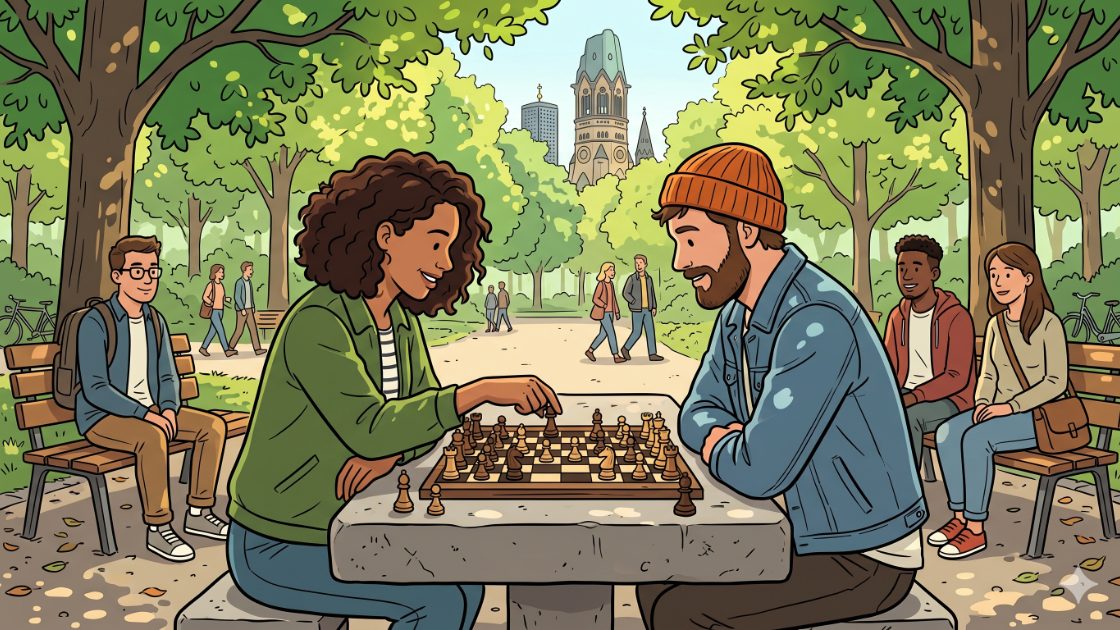
You can play chess in Berlin almost anywhere people gather: on the stone boards built into parks like Mauerpark, over coffee at board-game cafés such as Spielwiese in Friedrichshain, and at dozens of clubs under the Berliner Schachverband — from relaxed beginner evenings to SC Kreuzberg, the city’s biggest club. The board costs little or nothing and the rules are the same everywhere. The one thing you actually need, and the one thing a park bench can’t guarantee, is an opponent roughly at your level who is free when you are.
The short version:
- Free and outdoors: many Berlin parks have public stone chess tables — bring your own pieces and clock. Mauerpark on a Sunday is the loud, social end; a quiet corner of the Tiergarten is the calm one.
- Indoors with a coffee: Spielwiese in Friedrichshain (Kopernikusstraße 24) is a board-game café with 1,800+ games to borrow for about €1.50 an hour — chess set included.
- Serious play: the Berliner Schachverband lists dozens of clubs across the city, and SC Kreuzberg — founded in 1949 and Berlin’s largest club with ten teams — runs open tournaments anyone can enter.
- The catch: chess needs exactly one other person, at roughly your strength, at the same time. On MITRA you send a chess request to someone nearby; they accept if they’re up for a game, so the opponent stops being the hard part.
\n\n
Got a board and no one to play? Send a chess request on MITRA — free to download. Get MITRA on Google Play or grab it for iPhone.
Contents
- Where to play chess in Berlin: four kinds of game
- Park boards and the open-air game
- Board-game cafés: a table, a clock, a coffee
- Chess clubs: where Berlin plays in leagues
- Tournaments and summer opens anyone can enter
- From chaturanga to the Berlin Defence: the city’s chess pedigree
- The opponent problem: chess needs exactly one other person
- Finding a chess partner on MITRA
- Your first club night: what to expect
- Online to over-the-board: making the jump
- Frequently asked questions
Where to play chess in Berlin: four kinds of game
Berlin gives you four distinct ways to play chess, and they suit very different moods. The parks are free, social and weather-dependent — stone tables where strangers drift over to watch or challenge the winner. The board-game cafés move the game indoors, warm and unhurried, with a coffee and no closing pressure. The clubs are where the game gets organised: weekly evenings, rated league play, coaching, and a fixed crowd you get to know. And the tournaments — including summer opens that take walk-up entrants — are where you test yourself against a clock and a rating.
A quick way to choose: if you want atmosphere and don’t mind who you get, go to a park. If you want a calm, guaranteed table, go to a café. If you want to actually improve and belong somewhere, join a club. The thread running through all four is the same one that runs through every guide in this series, like finding a tennis partner: the venue is the easy part, and the right person across from you is the part worth solving.
Park boards and the open-air game
Berlin’s parks are the cheapest chessboard in the city, and in summer the most alive. Several green spaces have fixed stone tables with the board moulded into the surface — you bring the pieces and, if you want a real game, a clock. The character changes completely by location: Mauerpark on a Sunday, with its flea market and karaoke, is the loud, anyone-can-sit-down end of the spectrum, where a game draws a small ring of spectators and the winner stays on. A bench in a quieter park like the Tiergarten or a side corner of Volkspark Friedrichshain is the opposite — slow, contemplative, two people and the pieces.
Park play has real charm and one real limit. The charm is serendipity: you never know whether you’ll get a five-minute blitz hustle or a thoughtful hour. The limit is exactly that unpredictability — you can’t count on someone being there, or on them being near your level. A strong player against a beginner is a quick, lopsided game; two mismatched strangers rarely make a satisfying afternoon. That’s the gap a park can’t close on its own, and it’s worth keeping in mind before you carry a set across town on spec.
\n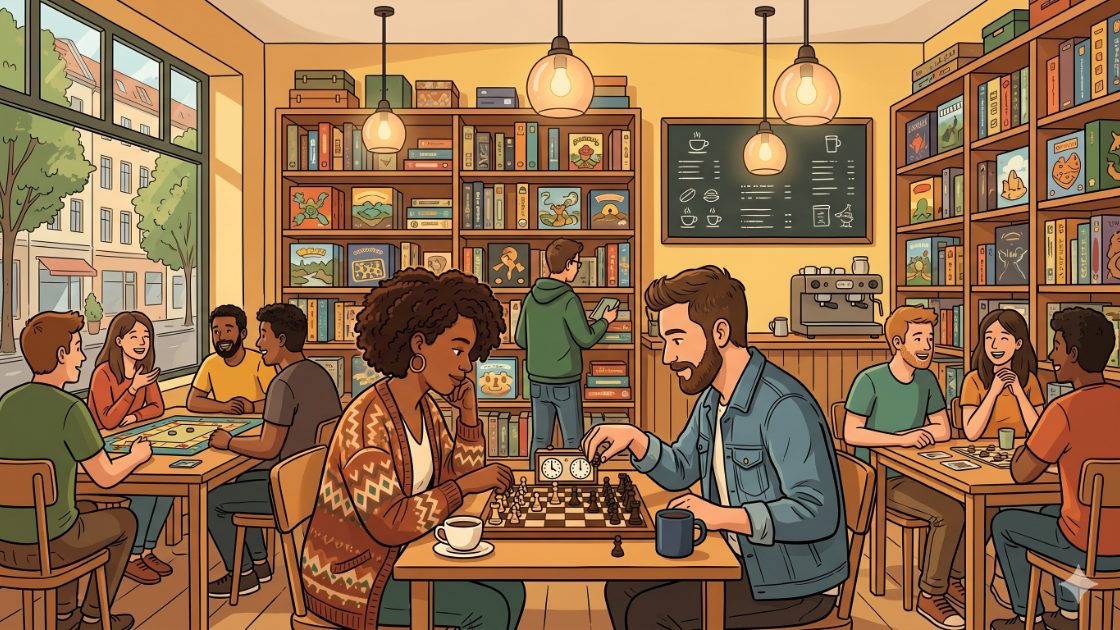
\n\n
Board-game cafés: a table, a clock, a coffee
A board-game café is the most reliable indoor chess table in Berlin, because the set is already there and so is the warmth. The anchor is Spielwiese in Friedrichshain, at Kopernikusstraße 24 in the Simon-Dach-Kiez — Berlin’s original board-game café, running since 2006, where more than 1,800 games sit on the shelves to borrow for roughly €1.50 an hour per adult. Chess is one request away from the staff, the coffee keeps coming, and nobody rushes you off the table. It’s a particularly easy place to bring someone who’s rusty: low stakes, no rating, no club formality.
The café route also solves a social problem the park doesn’t. Because these places are built for meeting people over games, it’s normal to arrive and be paired up, and Spielwiese runs regular game evenings where strangers sit down together — its Berlin game designers even meet on Mondays at 19:00 to test prototypes. If your German is still a work in progress, chess is the great equaliser: the game needs almost no shared language, which is why it pairs so naturally with the city’s language-exchange scene. You can play a whole evening on “your move” and a smile.
Rather not show up alone? Line up the game first. Post a chess meet-up on MITRA and arrive to a confirmed opponent. MITRA on Google Play · MITRA for iPhone.
Chess clubs: where Berlin plays in leagues
If you want to play chess seriously and regularly in Berlin, the clubs are the answer, and the Berliner Schachverband (the city’s regional chess federation, based at the Poststadion on Lehrter Straße) is the map to them. Its online directory lists dozens of clubs across every district, running the Berliner Mannschaftsmeisterschaft team league and the Feierabendliga — the “after-work league” built for people with day jobs. Most clubs hold one fixed playing evening a week, welcome newcomers, and will happily seat a beginner against someone gentle for a first night.
The flagship is SC Kreuzberg, founded in 1949 and now Berlin’s largest chess club, fielding around ten teams and a history that has reached the German Bundesliga. It runs its own tournaments and a lively calendar, and recently took its women’s team up into the 1. Frauenbundesliga. Other long-standing names worth knowing are SK Zehlendorf in the leafy southwest, SC Borussia Lichtenberg in the east, and SG Lasker — the Steglitz club that carries the name of Berlin’s own world champion. You don’t need a rating to walk in; you need an evening free and the willingness to lose a few games while you find your level.
Tournaments and summer opens anyone can enter
Berlin runs open tournaments that welcome amateurs, not just titled players, and they’re the fastest way to get a lot of real games in a short time. The standout is the Lichtenberger Sommer, an international open now well into its third decade: last August it drew 240 players from 19 nations, and the 2026 edition runs 8–16 August. “Open” means what it says — you enter, you’re paired by rating, and you can find yourself across the board from a club veteran one round and a fellow beginner the next. SC Kreuzberg’s summer programme, the Kreuzberger Schachsommer with its Werner-Ott-Open, fills a similar role in the warm months.
The honest note on tournaments: they use a clock, and that changes everything. A timed game is a different animal from a lazy park match — there’s pressure, there’s etiquette (press the clock with the same hand that moved), and there’s a result that goes on a list. That’s exactly why they’re worth doing. We checked the current 2026 tournament calendars and club pages of the Berliner Schachverband and SC Kreuzberg while writing this, in June 2026; dates and entry details shift each season, so confirm on the organiser’s page before you turn up.
From chaturanga to the Berlin Defence: the city’s chess pedigree
Chess arrived in Berlin along a thousand-year road that began far away: the game grew out of chaturanga, played in India around the sixth century, its Sanskrit name meaning the “four divisions” of an old army — infantry, cavalry, elephants and chariots. It travelled through Persia and the Islamic world into Europe, took its modern form in the fifteenth century, and acquired a global governing body, FIDE, founded in Paris in 1924. Germany organised early: the Deutscher Schachbund, today the world’s body’s German member with roughly 90,000 players in about 2,300 clubs, was founded back in 1877 and now has its head office in Berlin’s Olympiapark.
Berlin’s own contribution to the game is unusually deep. Emanuel Lasker, who lived in the city, was world champion for 27 years — from 1894 to 1921, still the longest reign in the title’s history — and a Berlin chess club bears his name to this day. And the city is stitched into the game’s very vocabulary: the Berlin Defence, a rock-solid answer to one of chess’s oldest openings, carries the city’s name and returned to fashion at the very top of world play. You’re joining a local tradition that produced a world champion and an opening line — not bad company for a Tuesday-night beginner.
The opponent problem: chess needs exactly one other person
Here is what makes chess different from almost every other activity in this series: it needs precisely one other person, no more and no less, and that person has to be somewhere near your strength. A run can absorb a faster or slower partner; a football game survives a few mismatched players; even tennis tolerates a gap. Chess does not. A game between a strong club player and a near-beginner is over in fifteen one-sided moves and satisfying for neither. The magic number is one well-matched opponent — and that is a surprisingly specific thing to find.
Cities make it harder, not easier. You can be surrounded by three million people and still not know a single one who plays at your level and is free on a Wednesday. Newcomers feel it sharpest: you arrive, you’ve got a board, maybe a decent online rating, and nobody to actually sit across from. Clubs solve it over weeks; parks solve it by luck; cafés solve it if the right stranger happens to be in. What none of them does is let you simply find a nearby player at your level and ask them for a game directly. That specific gap — right game, right level, right evening — is the one MITRA was built to close.
\n
\n\n
Finding a chess partner on MITRA
MITRA turns “I wish I had someone to play” into a concrete game. You see people nearby who are up for activities, you send one of them a chess request — “1500-ish, fancy a few rapid games at Spielwiese on Thursday evening?” — and they accept if it suits them. Nothing is automatic and nobody is assigned to you: you choose who to ask, they choose whether to say yes, and a no just means you ask the next person. Because you can say your rough level in the request, you skip the worst part of pickup chess — the mismatch — and arrive to a game that’s actually a contest.
It works just as well for the organised end. Put “chess” on your profile and let the requests come to you; mention whether you like blitz, rapid or a slow think, and whether you’d rather meet in a café, a park or before a club night. Berlin’s chess calendar runs all year — indoors in winter, on the park tables all summer — so a steady opponent is a steady habit, not a one-off. The same logic carries straight over to the other one-on-one games in the city, from a hitting partner in our tennis guide to a dance partner who needs exactly one other person too.
Your next opponent is probably within 3 km of you right now. Send a chess request on MITRA and find your level. Get it on Google Play · get it on the App Store.
Your first club night: what to expect
Walking into a Berlin chess club for the first time is far less intimidating than it sounds, because clubs survive on new members and know it. You turn up on the advertised evening, say it’s your first time, and someone will seat you against a friendly opponent rather than the club champion. Most clubs charge a modest annual membership, but a trial evening is usually free or a few euros, and you don’t need your own set — boards, pieces and clocks are provided. Bring nothing but yourself and the expectation that you’ll lose some games; that’s the tuition fee, and everyone there has paid it.
A few small courtesies make a good impression. Shake hands before and after — it’s the game’s oldest custom. If you play with a clock, press it with the hand you moved with, and don’t take a move back once you’ve let go of a piece. Say “good game” whatever the result. And don’t apologise for being a beginner: clubs would rather coach a keen newcomer than play the same twenty faces forever. If German is a barrier, say so — many Berlin clubs have international members, and the moves speak for themselves.
Online to over-the-board: making the jump
A lot of Berliners learned or relearned chess on a screen, and the move from online to over-the-board is the best upgrade the game offers. Online play is brilliant for volume — endless opponents at any hour, instant rating, puzzles on the train — and the recent global surge of interest has filled the city with people who can play but have never sat across a real board. The physical game is different and better: no take-backs, a clock you press with your hand, an opponent whose face you can read, and a handshake at the end. It’s slower, more human, and it sticks in the memory in a way a browser tab never does.
The trick is simply to make the first offline game easy. Pick a low-pressure venue — a café table beats a rated tournament for game one — keep the time control friendly, and line the opponent up in advance so you’re not standing in a park hoping someone shows. That’s exactly the bridge MITRA builds: take the rating you earned online, find a real person nearby at roughly that level, and turn a solitary habit into an actual evening out. The board has been waiting a thousand years; it’s a lot more fun with a face on the other side of it.
Frequently asked questions
Where can you play chess in Berlin?
Berlin offers four main settings: public stone chess tables in parks such as Mauerpark and the Tiergarten; board-game cafés like Spielwiese in Friedrichshain; chess clubs across every district listed by the Berliner Schachverband, including the city’s largest, SC Kreuzberg; and open tournaments such as the Lichtenberger Sommer. Parks are free and social, cafés are calm and reliable, clubs are for regular rated play, and tournaments let you test yourself against a clock.
Is it free to play chess in Berlin?
It can be. Public park chess tables cost nothing — you just bring your own pieces and, ideally, a clock. Board-game cafés like Spielwiese charge a small fee, around €1.50 an hour, which includes the set and the table. Chess clubs charge a modest annual membership but usually let you try a first evening free or for a few euros, with boards and clocks provided. So you can play for free outdoors or very cheaply indoors.
How do I find a chess partner at my level in Berlin?
Three routes work. Join a club through the Berliner Schachverband directory and you’ll be matched against members of similar strength. Enter an open tournament, where pairings are by rating. Or use MITRA to find one person directly: you send a chess request to someone nearby, mention your rough level in the message, and they accept if it suits them. That last route is the quickest way to avoid a mismatch and line up a game on a specific evening.
Are there chess clubs in Berlin for beginners?
Yes. Most Berlin chess clubs welcome newcomers and will seat a beginner against a friendly opponent rather than the club champion. The Berliner Schachverband lists dozens of clubs across the city, including SC Kreuzberg, SK Zehlendorf and SG Lasker. A trial evening is usually free or a few euros, no rating or own set required. Clubs survive on new members, so turning up as a beginner is genuinely welcomed.
Can you play chess outdoors in Berlin parks?
Yes — several Berlin parks have fixed stone chess tables with the board built into the surface. Mauerpark on a Sunday is the lively, social end, where games draw spectators and the winner stays on; quieter spots in the Tiergarten or Volkspark Friedrichshain suit a slower game. Bring your own pieces and a clock if you want a timed game. The only catch is that you can’t count on a suitable opponent being there when you arrive.
What is the biggest chess club in Berlin?
SC Kreuzberg is Berlin’s largest chess club. Founded in 1949, it fields around ten teams, has a history that reached the German Bundesliga, and recently took its women’s team up to the 1. Frauenbundesliga. It also runs its own events, including the Kreuzberger Schachsommer and the Werner-Ott-Open. Other well-known Berlin clubs include SK Zehlendorf in the southwest, SC Borussia Lichtenberg in the east, and SG Lasker in Steglitz.
Do I need to speak German to play chess in Berlin?
No. Chess needs almost no shared language — the moves do the talking — which makes it one of the easiest activities for newcomers and expats. Many Berlin clubs have international members, and board-game cafés are used to a mix of languages. You can play a whole evening on “your move” and a handshake. It pairs naturally with language exchange too: a quiet game is a low-pressure way to practise a few words between moves.
Where can I play chess indoors in Berlin?
For casual indoor play, board-game cafés are the most reliable option — Spielwiese in Friedrichshain (Kopernikusstraße 24) has been running since 2006 and lends from 1,800-plus games for about €1.50 an hour, chess included. For regular play, chess clubs meet indoors year-round on fixed weekly evenings. Public libraries such as the Zentral- und Landesbibliothek also offer quiet tables. In winter, cafés and clubs are where Berlin’s chess moves indoors entirely.
When are Berlin’s chess tournaments and can amateurs enter?
Many are open to amateurs. The Lichtenberger Sommer, an international open now in its third decade, runs 8–16 August 2026 and drew 240 players from 19 nations in a recent edition; you enter and are paired by rating, so beginners and veterans both have suitable games. SC Kreuzberg’s Kreuzberger Schachsommer fills a similar role in the warm months. Dates change each season, so check the Berliner Schachverband or club page before entering.
Are tandem chess or team formats common in Berlin?
The mainstream is one-on-one, but Berlin clubs also run team league chess through the Berliner Mannschaftsmeisterschaft and the after-work Feierabendliga, where you play a board number for a club side. Casual blitz and rapid evenings are common too. For your first games, though, a single opponent at your level is the goal — which is exactly what you can line up nearby on MITRA before you go.
Does Berlin have a notable chess history?
Yes, a deep one. Emanuel Lasker, who lived in Berlin, was world champion for 27 years (1894–1921), still the longest reign in the title’s history, and a Berlin club bears his name. The city is even written into chess vocabulary through the Berlin Defence, a solid opening line that returned to fashion at the top of world play. The German Chess Federation, founded in 1877, has its head office in Berlin’s Olympiapark.
How do I move from online chess to playing over the board in Berlin?
Make the first offline game easy. Take your online rating as a rough guide, pick a low-pressure venue like a board-game café rather than a rated tournament, and keep the time control friendly. Line up the opponent in advance so you’re not waiting around — on MITRA you send a chess request to someone nearby at a similar level and agree a time and place. Then it’s just a handshake and your first real-board game.
Want to keep reading?
- Board game cafés in Berlin — the indoor version, with prices, hours and a games night every day of the week.
- How to find a tennis partner in Berlin
- How to find a language exchange partner in Berlin
- How to find a dance partner in Berlin
- Canals, lakes and a tandem seat: kayaking in Berlin
- How to find a gym buddy in Berlin
- Two on the sand: where to play beach volleyball in Berlin
The boards are free, the clubs are open most evenings, and the parks fill up the moment the sun comes out. The only piece the city can’t hand you is the person on the other side of the board — and that’s a three-tap request away.
Find your opponent this week — send a chess request on MITRA, free on both stores. Get MITRA on Google Play or download it for iPhone.
Follow MITRA on Instagram for Berlin activity ideas and app updates. Berlin first. Bucharest and more EU cities coming soon.
Sources
- Deutscher Schachbund (schachbund.de) — Gründung des Allgemeinen Deutschen Schachbundes 1877 and Über uns — DSB founded 18 July 1877 in Leipzig; ~90,000 members in ~2,300 clubs; head office in Berlin’s Olympiapark.
- Berliner Schachverband (official) — berlinerschachverband.de — Berlin’s regional chess federation (Poststadion, Lehrter Str. 59); club directory, Berliner Mannschaftsmeisterschaft and Feierabendliga; Lichtenberger Sommer international open (8–16 Aug 2026; 240 players from 19 nations in the prior edition).
- SC Kreuzberg (official + Wikipedia) — schachclubkreuzberg.de / SC Kreuzberg — founded 1949; Berlin’s largest chess club (~ten teams); former Bundesliga side; runs the Kreuzberger Schachsommer / Werner-Ott-Open; women’s team promoted to the 1. Frauenbundesliga.
- Spielwiese (official) — team-spielwiese.de — board-game café at Kopernikusstraße 24, Friedrichshain (Simon-Dach-Kiez), open since 2006; 1,800+ games to borrow at ~€1.50/hour for adults; regular game evenings.
- Wikipedia — History of chess — chess descends from chaturanga, played in India c. 6th century (Sanskrit “four divisions of the army”); modern form from the 15th century.
- FIDE / International Chess Federation — fide.com — the world governing body of chess, founded in Paris in 1924.
- Encyclopædia Britannica — Emanuel Lasker — German world chess champion, who held the title from 1894 to 1921 (the longest reign in history) and was long resident in Berlin.