Vinyasa to yin: yoga classes in Berlin for beginners
Yoga classes in Berlin, for beginners: the styles, the best studios by district, what a drop-in costs, and how to find someone to practise with.
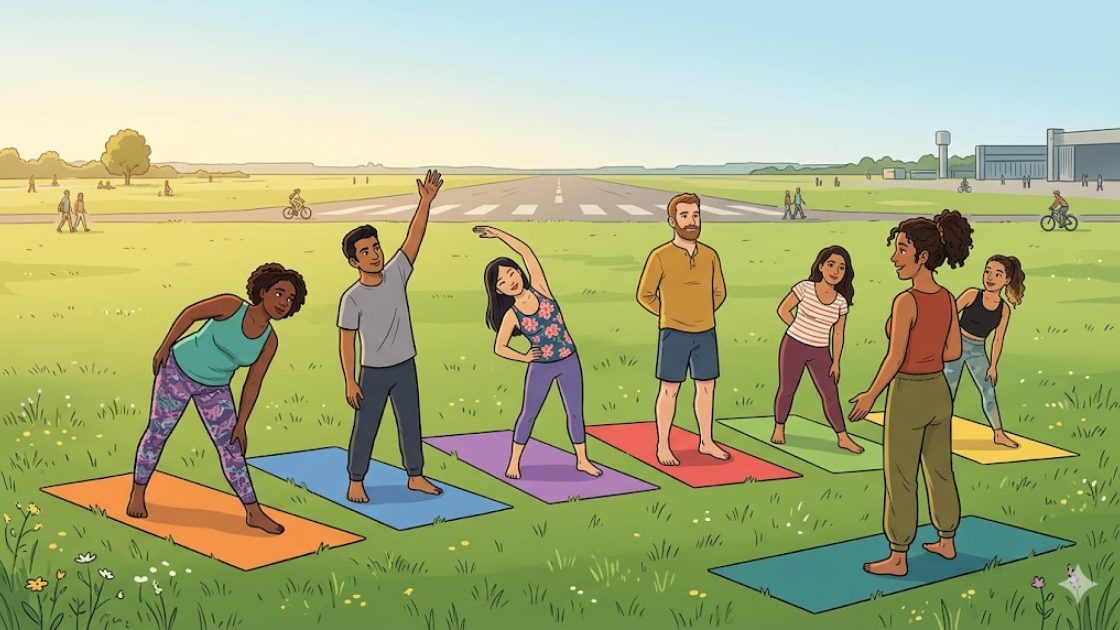
Yoga classes in Berlin come in three broad shapes: a regular studio where you pay per class or by the month, donation and pay-what-you-can community classes for people on any budget, and free or cheap outdoor classes in the city’s parks all summer. As a beginner, the two decisions that matter are which style to start with — a slow, foundational hatha class is the gentlest entry — and which neighbourhood is convenient enough that you’ll actually keep going back. The one thing a class timetable can’t hand you is the friend who drags you out of the flat on a grey Tuesday, which is usually the real reason a practice sticks or fizzles.
The short version:
- Start slow. A hatha class teaches the poses at a calm pace; vinyasa adds flowing movement; yin and restorative are gentle and stretchy. You do not need to be flexible to begin — that is what the classes are for.
- It’s cheaper than people think. A single drop-in runs roughly €18–€28, intro cards cut the first-class cost, and several Berlin studios run donation / pay-what-you-can classes — Green Yoga and Yoga on the Move among them.
- Summer is the best time to start. From May to September there’s free and donation-based outdoor yoga on Tempelhofer Feld, at Gleisdreieck and in Volkspark Friedrichshain.
- New to the city? Plenty of studios teach fully in English, including Yogicescape (Friedrichshain) and English Yoga Berlin (Kreuzberg).
- The catch: a class is easy to book and easy to skip. On MITRA you send an activity request to someone nearby who also wants to do yoga, they accept if they’re up for it, and suddenly Tuesday’s class has a person in it who’s expecting you.
Want to go but keep talking yourself out of it? MITRA is a free app for finding someone nearby to do an activity with — a beginner yoga class very much included. Send an activity request to people near you, and meet the ones who say yes.
Contents
- Which style of yoga to start with
- Where to take yoga classes in Berlin
- What a yoga class actually costs
- Donation and pay-what-you-can yoga
- Outdoor and summer yoga in Berlin
- Yoga in English: classes for newcomers
- What to expect at your first class
- Where yoga came from
- Why yoga is easier when you go with someone
- How to find someone to do yoga with in Berlin
- Frequently asked questions
- Sources
Which style of yoga to start with
The simplest beginner choice is to start with hatha or a slow vinyasa class, because both teach the poses at a pace you can follow. “Yoga” is not one thing — it’s an umbrella over a dozen styles that range from near-stillness to a sweaty workout, and walking into the wrong one first is the quickest way to decide, wrongly, that yoga “isn’t for you.” Pick the style to match the mood you want, not the one that sounds most impressive.
Hatha is the foundational, slower style: poses are held and explained, and there’s time to work out what your body is doing. Vinyasa links poses into a flowing sequence led by the breath — more movement, more of a rhythm, still beginner-friendly when the teacher pitches it that way. Yin is the slow end: a handful of seated poses held for minutes at a time to stretch deep tissue, lovely after a desk-bound week. Restorative goes gentler still, fully supported by bolsters and blankets, and is really about switching the nervous system off. At the energetic end sit ashtanga and power yoga, which are structured and athletic, and hot or Bikram yoga, practised in a room heated to around 38°C.
| Style | Pace | Good for | Where to try it in Berlin |
|---|---|---|---|
| Hatha | Slow, foundational | Absolute beginners learning the poses | English Yoga Berlin (Kreuzberg) |
| Vinyasa | Flowing, moderate | A breath-led, moving practice | Three Boons / Jivamukti, Yoga on the Move |
| Yin | Very slow, long holds | Deep stretching, winding down | Yogicescape (Friedrichshain) |
| Restorative | Gentle, fully supported | Stress, recovery, tired weeks | Spirit Yoga |
| Ashtanga / power | Vigorous, athletic | Structure and a workout | many vinyasa studios |
| Hot / Bikram | Intense, heated room | Sweating, looser muscles in warmth | Bikram Berlin (Friedrichshain) |
If you genuinely don’t know, book a class literally labelled “beginners,” “basics,” “Anfänger” or “Level 1.” Every serious Berlin studio runs them, and starting there beats being the only lost person in an advanced flow.
Where to take yoga classes in Berlin, studio by studio
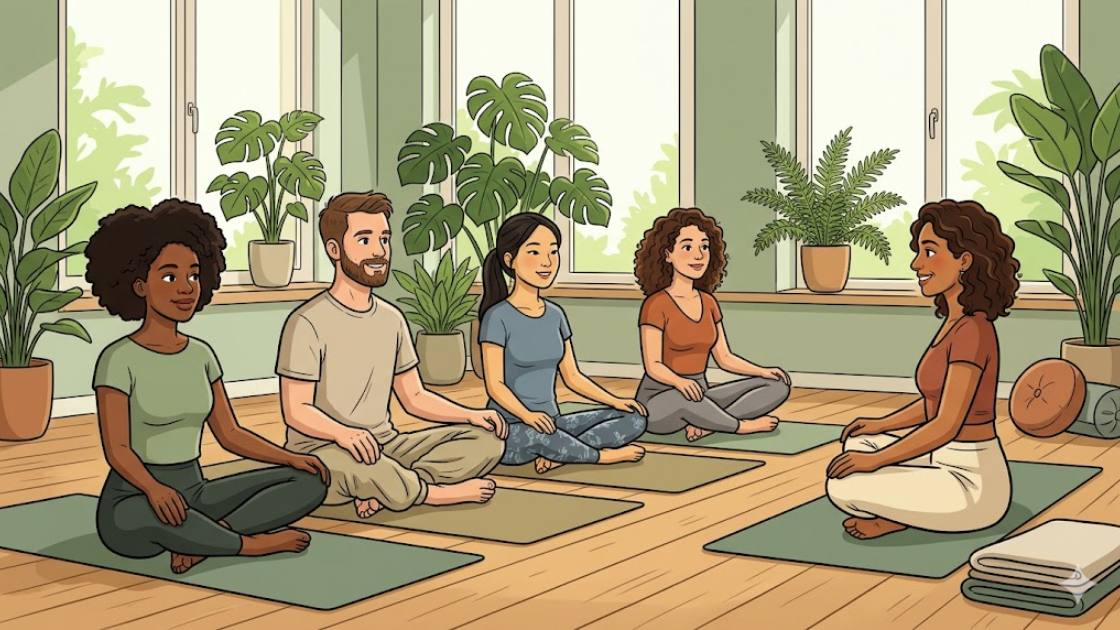
Berlin has hundreds of yoga studios, and to take yoga classes in Berlin as a beginner your job is simply to pick one that’s near home or work and offers a class at your level. Below are five well-established options spread across the city, chosen because each does something useful for a newcomer — a gentle entry, a budget model, English-language classes, or a spread of locations so there’s likely one near you.
| Studio | District(s) | Style focus | Drop-in | Good to know |
|---|---|---|---|---|
| Spirit Yoga | Charlottenburg, Zehlendorf, Moabit | Hatha, vinyasa, restorative, prenatal | €28 | Three-class intro card €59; day spa attached |
| Three Boons (ex-Jivamukti) | Mitte, Kreuzberg, Charlottenburg | Jivamukti vinyasa | €19.98 | Free “practice in front of the camera” option; student discount |
| Green Yoga | Kreuzberg, Pankow, the Hasenheide + more | Mixed, eco-minded | Pay-as-you-can | ~30 classes a day; summer park classes |
| Yogicescape | Friedrichshain, Prenzlauer Berg | Hatha, vinyasa, yin — in English | Drop-in / class packs | Built for expats; community feel |
| English Yoga Berlin | Kreuzberg | Hatha + Alexander Technique | Drop-in / courses | English since 2009; beginner-welcoming |
Spirit Yoga. One of Berlin’s longest-running studios, founded by Patricia Thielemann, with locations in Charlottenburg (Goethestraße 2–3, near Savignyplatz), Zehlendorf and Moabit. A single class is €28, but newcomers are pointed at a three-class intro card for €59 that’s valid across all studios for four weeks. The range is wide — vinyasa, restorative, back-focused and prenatal classes — and a small day spa is attached, so a class can end in a sauna, which pairs neatly with a wider tour of Berlin’s saunas.
Three Boons Yoga (the school formerly known as Jivamukti Berlin) runs three studios — Mitte (Brunnenstraße 29), Kreuzberg (Dresdener Straße 11) and Charlottenburg (Kurfürstendamm 177) — teaching the flowing, chant-and-philosophy Jivamukti style. A single in-studio class is €19.98, a month of unlimited classes is €135, and there’s a genuinely unusual option for the broke: you can practise for free if you’re willing to roll your mat out in view of their live-stream cameras. Students and people on low incomes get 20% more classes on any pack.
Green Yoga is the budget-and-community answer: a Berlin franchise with several locations including Oranienstraße and Virchowstraße in Kreuzberg-Friedrichshain, two sites in Pankow, and outdoor classes by the Hasenheide. It employs close to 100 teachers and runs around 30 classes a day, and crucially it works on a “pay-as-you-can-afford” principle, so the price is never the reason you can’t go.
For two more newcomer-friendly studios that teach in English, see the Yoga in English section below.
Found a studio but no nerve to walk in alone? That’s the normal blocker. On MITRA you can line up someone to go with first — send an activity request to people nearby and arrange a class together, so your first visit isn’t a solo one.
What a yoga class actually costs
A single drop-in yoga class in Berlin costs roughly €18 to €28, but almost nobody who practises regularly pays the full drop-in rate. The sticker price is the most expensive way to do yoga; the studios are built to move you onto something cheaper as soon as you’re hooked.
Three things bring the real cost down. First, intro deals: Spirit Yoga’s three-class card is €59 (under €20 a class) and is the standard way a studio gets a beginner through the door. Second, class packs and memberships: Three Boons sells a month of unlimited classes for €135 and a rolling flat-rate membership from €58.95 a month, which only makes sense once you’re going twice a week or more — at that point it’s far cheaper than drop-ins. Third, the multi-studio route: an Urban Sports Club membership bundles access to a long list of Berlin yoga studios (alongside gyms and pools) into one monthly fee, which suits people who like to sample different studios rather than commit to one.
And if money is genuinely tight, yoga in Berlin has answers that most activities don’t: donation-based classes, pay-what-you-can studios, and free outdoor sessions in summer. Those get their own sections below. The honest summary is that yoga is as cheap or as expensive as you need it to be — the cost is rarely the real barrier. Like a gym membership that only pays off when you actually show up, the maths only works if you keep going.
Donation and pay-what-you-can yoga
Berlin has a strong tradition of donation and “pay-what-you-can-afford” yoga, which makes it one of the cheapest cities in Europe to start a practice. This is not a watered-down version — the teachers are often the same ones who teach paid studio classes — it’s a deliberate model that keeps yoga open to students, freelancers between gigs and anyone counting euros.
Green Yoga runs its whole schedule on a pay-as-you-can-afford basis, so you decide what the class is worth to you that week, and the studio still donates 5% of its proceeds to a tree-planting project in southern India. Yoga on the Move, which began in 2017 as donation-based classes on Tempelhofer Feld, keeps the same spirit in its outdoor sessions: you pay what you can, and the practice happens in the open air. And Three Boons’ “practice in front of the camera” arrangement means a determined beginner can build a habit for literally nothing. Add the free park classes that run all summer, and there’s no budget low enough to be priced out of yoga in Berlin.
Cheap to try, easier with company. A donation class costs whatever you’ve got — the only missing piece is someone to go with. Find that person on MITRA: tell it you want to do yoga and send a request to people close by.
Outdoor and summer yoga in Berlin
From roughly May to September, the best yoga in Berlin moves outside, and a lot of it is free or donation-based. Practising on the grass with the sky overhead is a completely different experience from a studio mirror — and in a Berlin summer it’s reason enough to start now rather than “in the autumn.”
Tempelhofer Feld, the vast former airfield, is the city’s unofficial outdoor yoga ground; donation-based vinyasa classes have run there since 2017, and on a warm evening you’ll see several groups dotted across the grass. Yoga on the Move teaches at outdoor spots around the city through the summer, including B-Part am Gleisdreieck, Humboldthain and Volkspark Rehberge, while Green Yoga holds open-air classes in Volkspark Friedrichshain and by the Hasenheide. For a view, Lobe Block in Wedding runs rooftop and terrace classes across its stepped concrete levels, and on weekend mornings there are “wake up” flows on the Island of Youth in Treptower Park, right on the Spree. The official city tourism guide even points to drop-in summer sessions in the garden of the Neue Nationalgalerie and on the roof terrace of the old Tempelhof tower.
If you want the most Berlin-in-summer version of all, there’s SUP yoga — yoga on a stand-up paddleboard — run on the water at the Funkhaus in Oberschöneweide and the Wendenschloss lido. It’s harder than it looks and falling in is part of the deal, which makes it the kind of thing far better attempted with a friend than alone. The same goes for an early lake morning before a class, the way people pair a swim with a stretch in the open-water swimming spots around the city.
Yoga in English: classes for newcomers
You do not need any German to do yoga in Berlin — a large number of studios teach fully in English, which makes a yoga class one of the easiest first social moves for someone who’s just arrived. The shared, low-pressure setting does a lot of the work that small talk usually has to.
Yogicescape runs English-language classes at its studio in Friedrichshain (Rigaer Straße 25, a short walk from Samariterstraße and Frankfurter Tor on the U5) and at a second location in Prenzlauer Berg, with hatha, vinyasa, yin and restorative on the schedule and a deliberately expat-friendly, community feel. English Yoga Berlin has taught hatha yoga and the Alexander Technique in English from Kreuzberg since 2009, and its classes are explicitly open to and welcoming of beginners. Beyond those two, most of the big vinyasa studios — Three Boons among them — teach in English or in a bilingual mix, simply because so much of their clientele is international. If you’re also trying to pick up German while you’re here, a yoga habit pairs naturally with a language-exchange partner in Berlin: one keeps your body moving, the other your Sprachgefühl.
What to expect at your first class
Your first yoga class asks almost nothing of you: arrive ten minutes early, take your shoes off at the door, and tell the teacher it’s your first time so they can offer easier versions of the poses. You do not need to be flexible, you do not need special clothes beyond something you can move in, and you do not need to know any of the Sanskrit names — the teacher demonstrates everything.
Most studios have mats to borrow or rent for a euro or two, though buying a cheap mat early is worth it if you think you’ll continue. Bring water and, for a slower class, maybe socks for the final resting pose. That pose — Shavasana, lying still on your back for the last few minutes — is not optional padding; it’s the part many people come for, so don’t sneak out before it. The room will usually go quiet and a little warm, phones stay away, and nobody is watching you, because everyone else is busy looking at the back of their own eyelids. If a pose hurts in a sharp way, come out of it; if it’s just hard, breathe and stay. That’s the whole etiquette.
Where yoga came from
Yoga is far older and deeper than the studio version suggests: it began in ancient India as one of the six classical schools (darshanas) of Indian philosophy. The word itself comes from the Sanskrit root yuj, meaning “to yoke” or “to unite” — the union of individual awareness with something larger. The earliest surviving textbook, the Yoga Sutras attributed to Patañjali and dated to around the 2nd century BCE, lays out an eightfold path in which physical postures (asana) are only one limb, alongside ethical restraints, breath regulation, concentration and meditation. The fitness-and-flexibility yoga most of us meet in a Berlin studio is a modern, mostly 20th-century development of that much broader tradition.
It’s also a seriously organised activity in Germany, not a fringe one. The Berufsverband der Yogalehrenden in Deutschland (BDYoga), founded in 1967 and based in Göttingen, is the country’s leading professional association for yoga teachers, with several thousand members, and it sets training standards of at least a two-year, 500-hour qualification. The practical upshot for a Berliner is reassurance: behind the city’s hundreds of studios sits a real profession with real training, so a beginner class is in competent hands.

Why yoga is easier when you go with someone
Yoga is something you can do alone — but for most beginners, going with someone is the difference between a practice that lasts and one that quietly stops after three weeks. The hard part of yoga is almost never the hour on the mat. It’s the twenty minutes beforehand, when the sofa is warm and the studio is a U-Bahn ride away and “next week” sounds reasonable.
A person changes that equation. When someone is meeting you at the 18:30 vinyasa class, you go, because not going means letting them down, and that’s a much stronger pull than a private intention. You also try more: a style you’d never have booked alone — a hot class, a donation session on Tempelhofer Feld, SUP yoga on the Spree — becomes “let’s just see what it’s like” when there are two of you. And the bit afterwards, the walk home or the coffee where you both admit your legs are shaking, is half the point. It’s the same reason a standing dance class with a partner outlasts a solo resolution: the activity is easy, and the company is what keeps it on the calendar.
How to find someone to do yoga with in Berlin
The simplest way to find a yoga buddy in Berlin is to use an app built for arranging real-life activities: you say you want to go to a yoga class, you see people nearby who are up for it, and you agree on a class together. MITRA is activity-first — you pick yoga, send an activity request to people near you, and meet whoever accepts. Nobody is auto-paired and nothing is decided for you; you choose who to reach out to, and they choose whether to say yes. That request-and-accept design is what keeps it relaxed: you’re not assigned a stranger, you’re agreeing on a Saturday class with someone who’s just as keen to roll out a mat.
It works well for yoga because the ask is easy to state — a style (gentle, flow, hot), a part of the city, and a time — and because so much of Berlin yoga is drop-in, so two people can simply turn up to the same class without anyone needing a membership. If you’ve recently moved and don’t yet have anyone to text, this is the quickest bridge from “I keep meaning to start yoga” to actually being in a class this week, with a friendly face two mats over.
Turn “I should start yoga” into a date in the diary. Tell MITRA you want to do yoga, send a request to people nearby, and arrange your first class together — free to download.
How we checked
We read the current 2026 class and price pages for each studio named here in June 2026, plus Berlin’s official city tourism guide for the outdoor and seasonal options, and the relevant federation pages for the history and training facts. Drop-in prices, schedules and outdoor locations change seasonally and by studio, so always confirm the exact class and rate on the venue’s own page before you go.
Frequently asked questions
How much does a yoga class cost in Berlin?
A single drop-in class costs roughly €18 to €28, depending on the studio — for example, Three Boons in Mitte, Kreuzberg and Charlottenburg charges €19.98 a class, while Spirit Yoga charges €28. Almost everyone who practises regularly pays less than that, though: intro cards (Spirit’s three-class card is €59), monthly memberships, and multi-studio passes like Urban Sports Club all bring the per-class cost down. Donation and pay-what-you-can classes cost whatever you can afford.
Which type of yoga is best for a complete beginner?
Start with hatha or a slow vinyasa class. Hatha teaches the poses at a calm, held pace, so you have time to understand each one; slow vinyasa adds gentle, breath-led movement without being a workout. Avoid hot, ashtanga and power yoga for your very first class — they’re rewarding later but steep at the start. Best of all, book a class explicitly labelled “beginners,” “basics” or “Level 1,” which every established Berlin studio runs.
Can I do yoga in Berlin in English?
Yes, easily. Many Berlin studios teach fully in English. Yogicescape in Friedrichshain and Prenzlauer Berg runs English-language hatha, vinyasa and yin classes with an expat-friendly community, and English Yoga Berlin in Kreuzberg has taught in English since 2009 and welcomes beginners. Most large vinyasa studios also teach in English or bilingually, because so many of their students are international, so not speaking German is no barrier at all.
Where can I do yoga outdoors in Berlin?
In summer, in lots of places. Donation-based classes run on Tempelhofer Feld, and Yoga on the Move teaches at spots like B-Part am Gleisdreieck, Humboldthain and Volkspark Rehberge. Green Yoga holds outdoor classes in Volkspark Friedrichshain and by the Hasenheide, Lobe Block in Wedding offers rooftop yoga, and there are weekend “wake up” flows on the Island of Youth in Treptower Park. There’s even SUP (paddleboard) yoga on the water at the Funkhaus and Wendenschloss.
Is yoga free anywhere in Berlin?
It can be. Green Yoga runs its whole schedule on a “pay-as-you-can-afford” basis, so you can pay very little. Three Boons lets you practise for free if you’re willing to be in view of its live-stream cameras. Yoga on the Move’s outdoor classes are donation-based, and various free community sessions pop up in parks over the summer. Between those options, no budget is too small to start yoga in Berlin.
Do I need to be fit or flexible to start yoga?
No — that’s the most common myth, and it stops people before they begin. You start yoga to become more flexible and stronger, not the other way around, and teachers offer easier versions of every pose. Tell the teacher it’s your first class, go at your own pace, and skip anything that hurts sharply. Within a few weeks the poses that felt impossible start to open up. The official health bodies note that regular practice may improve flexibility, strength and balance over time.
What should I bring to my first yoga class?
Very little: comfortable clothes you can stretch in, a bottle of water, and that’s essentially it. Most studios lend or rent mats for a euro or two, so you don’t need your own to start, though a cheap mat is a good early buy if you continue. For slower or restorative classes, socks and a layer for the final resting pose are nice. Arrive about ten minutes early to sign in and settle.
How often should a beginner do yoga?
Once or twice a week is plenty to start, and consistency matters far more than volume. A single class you actually attend every week beats an ambitious five-a-week plan you abandon by month’s end. As it becomes a habit you can add more, and that’s usually the point where a monthly membership or class pack starts to save you money over single drop-ins. Going with a regular partner is the simplest way to keep the rhythm.
How do I find someone to go to yoga with in Berlin?
Use MITRA. You choose yoga, send an activity request to people near you, and arrange a class with whoever accepts — you’re never auto-paired, and both sides agree to it. Because most Berlin yoga is drop-in, two people can just turn up to the same class without a membership. Say which style and which side of the city suits you, find one regular, and a vague intention to “start yoga” turns into a standing weekly class.
What’s the difference between hatha, vinyasa and yin yoga?
Hatha is slow and foundational — poses are held and explained, ideal for learning. Vinyasa flows from pose to pose in time with the breath, so it feels more like continuous movement. Yin is the slowest of the three: a few seated poses held for several minutes each to stretch deep connective tissue, very calming. Beginners usually find hatha the gentlest start, then branch into vinyasa for energy or yin for a wind-down once they know the basics.
Sources
- Encyclopædia Britannica — Yoga (Indian philosophy): history, types and the Yoga Sutras (yoga as one of the six darshanas; Sanskrit root yuj = to yoke/unite; Patañjali’s Yoga Sutras, c. 2nd century BCE; the eightfold path).
- U.S. National Center for Complementary and Integrative Health (NIH) — Yoga: Effectiveness and Safety (regular yoga may improve fitness, strength, flexibility and balance, and help with stress; evidence summarised qualitatively).
- Berufsverband der Yogalehrenden in Deutschland (BDYoga) — official site and Wikipedia summary (Germany’s leading yoga-teacher association, founded 1967, Göttingen; several thousand members; minimum two-year/500-hour training standard).
- visitBerlin (official Berlin tourism) — 11 tips for extraordinary yoga experiences in Berlin (Green Yoga’s five locations, ~100 teachers and pay-as-you-can model; Lobe Block rooftop yoga; Island of Youth wake-up flows; SUP yoga; summer park sessions).
- Spirit Yoga — memberships and prices (drop-in €28; three-class intro card €59; studios in Charlottenburg, Zehlendorf and Moabit; founded by Patricia Thielemann).
- Three Boons Yoga (formerly Jivamukti Berlin) — price list and studios (single in-studio class €19.98; one-month unlimited €135; flat-rate membership from €58.95/month; studios in Mitte, Kreuzberg, Charlottenburg; student/low-income and free livestream-practice options).
- Yoga on the Move — about and pop-up outdoor yoga (donation-based classes begun on Tempelhofer Feld in 2017; summer outdoor sessions at Gleisdreieck, Humboldthain and Volkspark Rehberge).
- Yogicescape — English-speaking yoga studio, Friedrichshain (English-language hatha, vinyasa, yin and restorative classes; Rigaer Straße 25; expat-friendly community).
Want to keep reading?
- Cheapest gyms in Berlin — nine chains costed honestly, including the fees they leave off the poster.
- How to find a gym buddy in Berlin — why training with someone makes a habit stick.
- The best saunas in Berlin — the perfect way to end a class, and Spirit Yoga has one attached.
- How to find a language exchange partner in Berlin — pair a yoga habit with picking up German.
- How to find a dance partner in Berlin — another movement practice that’s better with company.
- How to find a swimming partner in Berlin — lakes and lidos for a summer-morning stretch-and-swim.
Ready to start? Download MITRA, tell it you want to do yoga, and send an activity request to people near you — you choose who to reach out to, they choose whether to say yes, and you meet on the mat.
Roll out your mat this week. MITRA is free, activity-first, and built for meeting people in real life around the things you already love doing.
Follow MITRA on Instagram for Berlin activity ideas and app updates. Berlin first. Bucharest and more EU cities coming soon.