Paddles and the kitchen: where to play pickleball in Berlin
Where to play pickleball in Berlin: courts at PBC Center, Moabit and Spandau, what a session costs, beginner courses, and how to find people to play with.
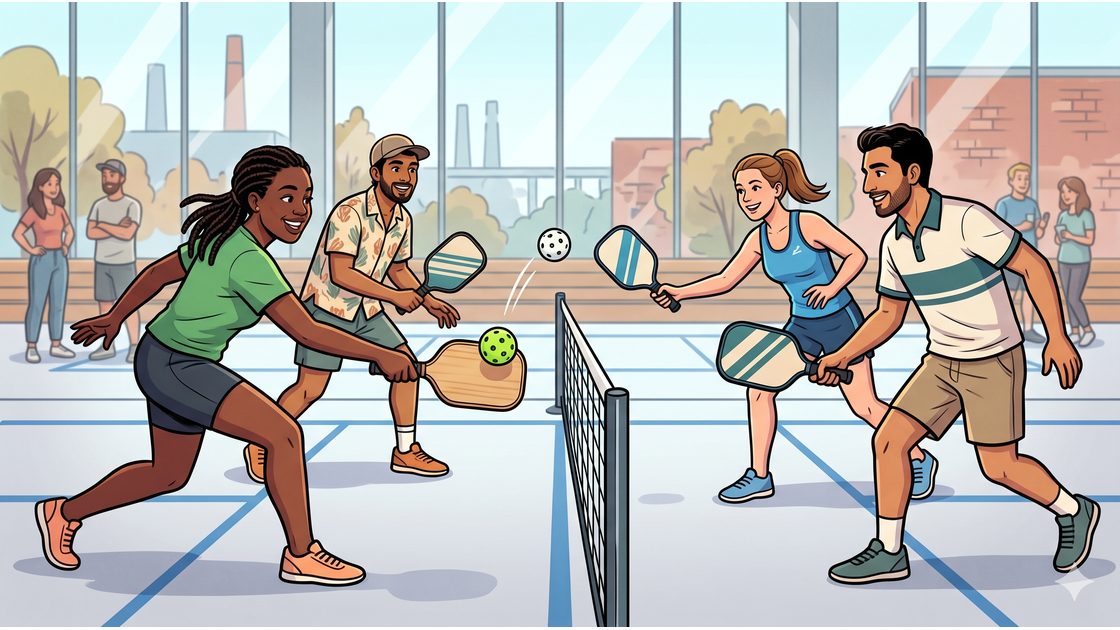
Where to play pickleball in Berlin still comes down to a small but fast-growing handful of places: PickleBall.Collective runs the city’s biggest community across outdoor courts in Alt-Treptow, an indoor hall in Moabit and the new PBC Center in Alt-Mariendorf, while a scattering of school gyms in Weißensee, Spandau and elsewhere host club sessions in the evenings. The whole sport is barely a few years old here, so courts are limited, sessions are organised, and the easiest way in is a beginner course or an open-play session where paddles, balls and a few other players are already laid on. The one thing none of them hands you is a regular crew to keep playing with — and pickleball, more than most sports, is built around the people you play with.
The short version:
- Where to go: PickleBall.Collective is the hub — outdoor courts in Alt-Treptow, an indoor sports hall in Moabit (Turmstraße), and its dedicated PBC Center in Alt-Mariendorf (Großbeerenstraße 2–10, U6 Alt-Mariendorf), which also has padel. Club and school-gym courts run at Maria Leo Elementary School, the Primary School at Weißensee, and TSC Spandau at the Heinrich-Böll-Oberschule.
- How many courts: roughly 5 locations and 16 courts city-wide as of June 2026 — small, but more than doubled in two years.
- Easiest way in: a beginner course or open-play session, where a paddle, balls, a trainer and other players are all included. You don’t need to own anything or know anyone.
- Gear is tiny: a solid paddle, a perforated plastic ball and clean indoor shoes — and venues lend the first two to beginners.
- The catch: pickleball is a doubles-first, social game. It only works with other people on the court. On MITRA you send a pickleball request to people near you, the ones who’re up for it say yes, and you show up to a session with someone to actually rally with.
Contents
- What pickleball actually is
- Where to play pickleball in Berlin: the courts
- What it costs and how to book
- The gear: paddle, ball and shoes
- The kitchen, and the rules that make pickleball different
- Beginner courses and open play in Berlin
- Where pickleball came from
- Why pickleball is the easiest racket sport to start with strangers
- How to find people to play pickleball with in Berlin
- How we checked
- Frequently asked questions
What pickleball actually is
Pickleball is a paddle sport that mixes tennis, badminton and table tennis: two or four players use solid paddles to hit a perforated plastic ball over a low net on a court the size of a badminton court. It’s usually played as doubles, the ball is light and slow compared to a tennis ball, and the court is small enough that long, chatty rallies are the norm rather than the exception. That combination — gentle pace, small court, easy-to-learn paddle — is exactly why it has become the fastest-growing sport in the United States and is now spreading through European cities like Berlin.
The court is 6.1 by 13.4 metres (20 by 44 feet), the same footprint as a doubles badminton court, with a net dropped to 0.86 metres at the sidelines. Scoring is gentle to follow once you’ve seen a game: in the traditional format only the serving side can score a point, games are played to 11, and you have to win by two. Because the court is small and the ball is slow, you spend far less time sprinting than in tennis or squash and far more time placing the ball and reading your opponents — which is why people of wildly different ages and fitness levels can have a genuinely close game.
The detail that gives pickleball its character — and its strange vocabulary — is the “kitchen,” a seven-foot no-volley zone in front of the net that you’re not allowed to smash from. More on that below, because it’s the single rule that turns pickleball from “easy first game” into something tactical enough to keep you coming back.
The court’s the easy part — you just need people on it. Get the MITRA app and line up a few players before your first session: Google Play · App Store
Where to play pickleball in Berlin: the courts
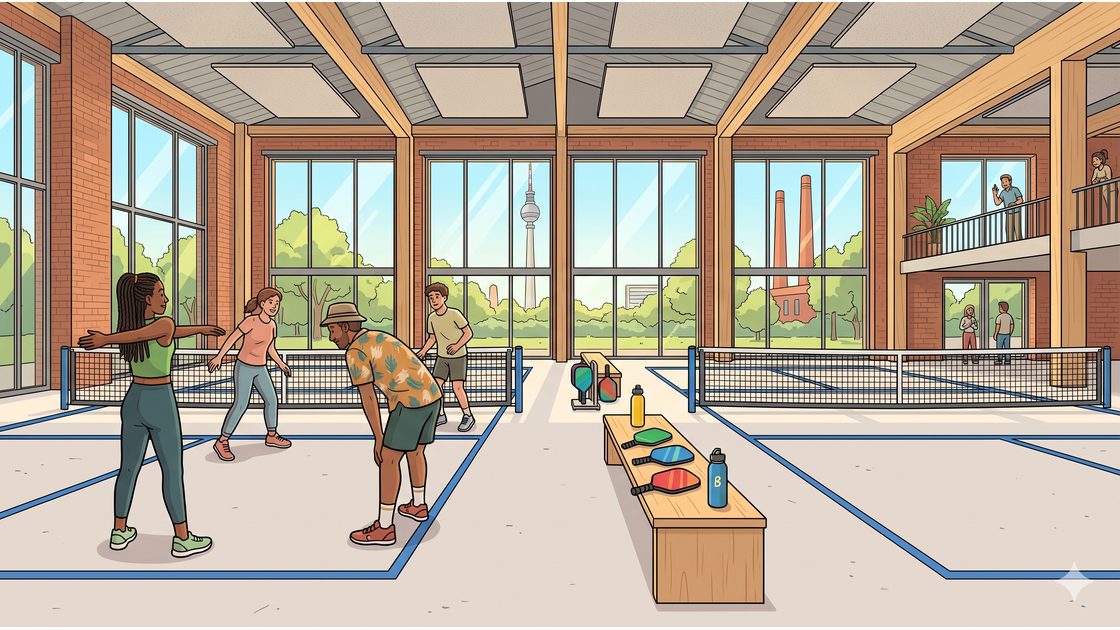
Berlin’s pickleball is concentrated around one community and a handful of club and school-gym courts, so you’ll get further by knowing the main names than by hunting for a court near you. As of June 2026 the city has roughly five locations and sixteen courts — tiny next to tennis or badminton, but growing fast. Here’s where to actually play.
| Venue | District | Indoor / outdoor | Courts | Good for |
|---|---|---|---|---|
| PickleBall.Collective — PBC Center | Alt-Mariendorf (Großbeerenstr. 2–10) | Indoor | multiple | dedicated centre, padel too, open 7 days, U6 to the door |
| PickleBall.Collective — Moabit hall | Moabit (Turmstraße) | Indoor | up to 4 | winter and evening open play, beginner courses |
| PickleBall.Collective — Alt-Treptow | Alt-Treptow | Outdoor | shared | warm-weather social sessions outdoors |
| Primary School at Weißensee | Weißensee (Pankow) | Indoor (gym) | 3 | evening club sessions in a school sports hall |
| TSC Spandau e.V. | Spandau (Heinrich-Böll-Oberschule) | Indoor (gym) | 4 | club-run sessions in the west of the city |
| Maria Leo Elementary School | Charlottenburg area | Indoor (gym) | 4 | scheduled group play, paddles often provided |
PickleBall.Collective is the centre of gravity for the sport in Berlin. Two friends, Lotti and Max, started it in 2023 to bring this laid-back, social take on racket sport to the city, and it has grown into the biggest pickleball community here, playing across three settings: outdoor courts in Alt-Treptow for the warmer months, an indoor sports hall in Moabit on Turmstraße, and — since August 2025 — a dedicated home, the PBC Center, in Alt-Mariendorf. The PBC Center sits at Großbeerenstraße 2–10 (12107 Berlin), a short walk from U Alt-Mariendorf on the U6, is open every day from morning until late, and shares the building with padel courts, so you can try both racket sports in one trip.
The rest of Berlin’s pickleball lives in school and club gyms booked for evening sessions: the Primary School at Weißensee in Pankow (three courts), TSC Spandau e.V. at the Heinrich-Böll-Oberschule out west (four courts), and Maria Leo Elementary School (four courts) all host scheduled play with portable nets and taped lines. These aren’t drop-in-any-time venues like a public tennis court — they run on session times set by the organisers, which is why checking a session schedule beats turning up on spec. It’s the same “book the slot, not the building” rhythm you’ll recognise from chasing down a game of squash in Berlin or an indoor badminton court.
What it costs and how to book
Pickleball in Berlin is mostly booked by the session rather than by the hour, and almost everything runs through PickleBall.Collective’s own platforms or a sports-membership app. There’s no city-run public pickleball court you can rock up to for free yet, so in practice you either book an open-play or beginner session at the PBC Center, or join a club gym session. Drop-in open play and beginner courses are bookable directly through PickleBall.Collective’s website and its CircleSquare booking app; many of their indoor sessions are also covered by an Urban Sports Club membership, which is how a lot of Berliners try the sport without paying per visit.
Prices vary by session type and aren’t fixed the way a tennis-court hour is, so the honest answer is to check the current rate on the booking page before you go — a single open-play or beginner session is typically in the modest single-to-low-double-digit euro range, with paddles included for newcomers. The PBC Center also offers memberships for regular players. Booking ahead matters more than it does for, say, a public tennis court: courts are few, sessions cap out, and popular evening and weekend slots fill, so reserve a day or two in advance rather than hoping for a space.
Sorted a session but want company on the court? That’s the easy half. Find a few people nearby to play with on MITRA: Google Play · App Store
The gear: paddle, ball and shoes
You need almost nothing to start pickleball, and beginner sessions lend you the two things that matter. A pickleball paddle is a solid, stringless bat — bigger than a table-tennis paddle, smaller than a tennis racket — and the ball is a light, hollow plastic sphere full of holes, a bit like a wiffle ball. That’s the whole kit. PickleBall.Collective’s beginner courses include the paddle, the balls, a trainer and other players, so your first time on court can cost nothing beyond the session fee.
When you’re ready to buy your own, a starter paddle is the only real purchase, and entry-level ones are inexpensive; you can spend a lot more on a carbon-faced paddle later if you get serious, but you absolutely don’t need to at the start. Indoor and outdoor balls differ slightly — indoor balls are softer with larger holes, outdoor ones are harder with smaller holes to handle wind — but for a beginner session the venue sorts this for you.
The one thing you should bring is a clean pair of indoor court shoes with non-marking soles, the same rule that applies to badminton and squash halls. Running shoes work at a push for an outdoor session, but proper court shoes give you the side-to-side grip the sport’s quick little movements demand, and indoor venues won’t let you on the floor in shoes you wore in the street. Bring a second pair and change at the door.
The kitchen, and the rules that make pickleball different
The “kitchen” is pickleball’s defining rule: a 2.1-metre (seven-foot) zone on each side of the net, officially the non-volley zone, where you are not allowed to hit the ball out of the air. You can step into it to play a ball that has bounced, but you cannot stand in it and volley a smash — and if your momentum carries you into the kitchen after a volley, you lose the point. This one rule is why pickleball isn’t just “small tennis”: it stops both teams from camping at the net and bashing winners, and forces the soft, looping “dink” rallies that make the game tactical and weirdly addictive.
The serve is gentle too. You serve underarm, diagonally, with the paddle below your waist, so there’s no booming tennis serve to be intimidated by — a complete beginner can put the ball in play on their first try. Combine the soft serve, the slow ball and the kitchen, and you get a sport where a beginner and an experienced player can share a fun rally within minutes, which almost no other racket sport allows. That low barrier is the whole reason it spreads so fast: people try it once at a friend’s session and are hooked by the end of the afternoon. It’s a different feel from the all-out sprint of a squash game, where a mismatch in level ruins the hour — in pickleball, a mixed-ability four can still have a great time.
Beginner courses and open play in Berlin
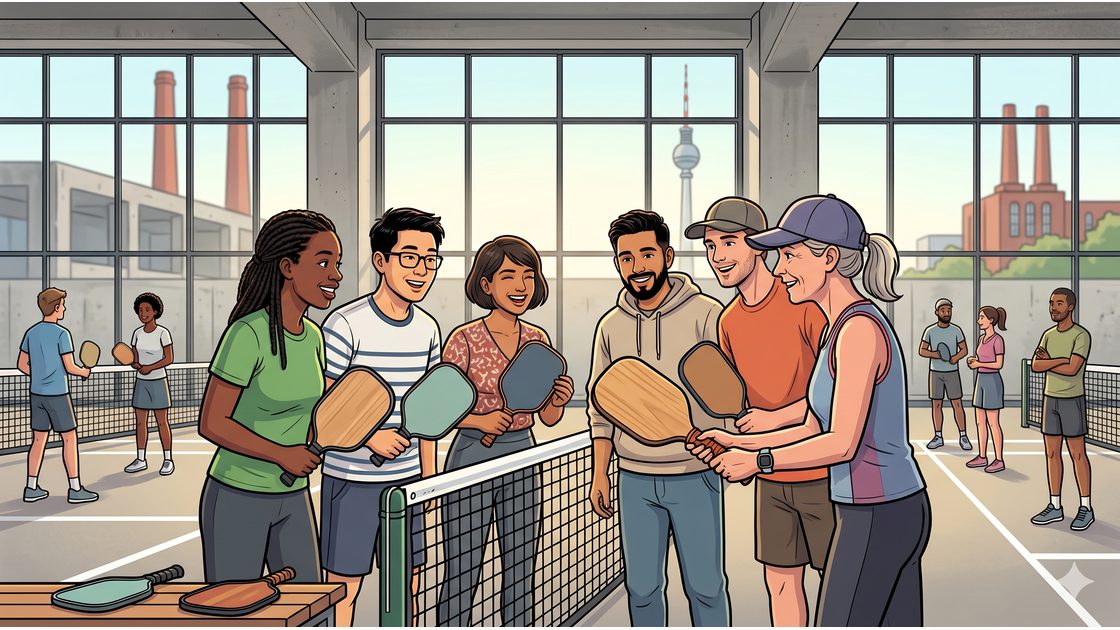
The best entry point to Berlin pickleball is a beginner course, because it solves the two things that stop people starting: not knowing the rules and not having anyone to play with. PickleBall.Collective runs structured beginner sessions where every class covers the basics — the serve, the kitchen, scoring and a bit of strategy — with paddles, a trainer and other learners all provided. You arrive knowing nobody and nothing, and leave able to play a real game. From there, open play is the engine of the scene: drop-in sessions where players rotate partners and opponents game by game, so you meet a steady stream of new people instead of being stuck with one fixed four.
That rotating, mixers-style format is what makes pickleball such a social on-ramp in a city where a lot of people arrived without an existing circle. You don’t need to bring three friends; you turn up, get slotted into games, and an hour later you’ve rallied with eight strangers and swapped numbers with two of them. Open play does for pickleball what a run club does for running or a drop-in night does for table tennis — it manufactures low-pressure repeat contact, which is how casual acquaintances quietly turn into friends.
Where pickleball came from
Pickleball was invented in the summer of 1965 on Bainbridge Island, near Seattle, by three dads — Joel Pritchard, Bill Bell and Barney McCallum — trying to keep bored kids entertained. They had a badminton court but no full set of rackets, so they improvised with ping-pong paddles and a perforated plastic ball, lowered the net, and made up rules as they went over the weekend. The badminton-court dimensions and the low net both date from that first improvised game, and the famous seven-foot non-volley zone was added in 1972 when the rules were first formalised.
The odd name has competing origin stories — one says it came from the family dog, Pickles, another from “pickle boat” crews of leftover rowers — and nobody fully agrees, which is very on-brand for a sport this casual. The first official rulebook appeared in 1984. For decades it stayed a niche North American pastime, then exploded: by the mid-2020s pickleball was the fastest-growing sport in the United States for four years running, with well over 20 million players, and that wave is now reaching European cities. Germany has its own national federation, the Deutscher Pickleball Bund, and Berlin’s first dedicated centre opened only in 2025 — so playing here in 2026 genuinely puts you near the front of the sport in this country.
Why pickleball is the easiest racket sport to start with strangers
More than any other racket sport, pickleball is built to be played with people you’ve only just met, which makes it a near-perfect activity for meeting new people in a new city. The reasons are baked into the game: it’s usually doubles, so you need company by design; the soft serve and slow ball mean a first-timer and a regular can share a fun rally, so mismatched levels don’t wreck the session; and open-play rotation throws you together with a rotating cast rather than one fixed partner. Where squash demands an evenly matched opponent and tennis can be brutal on a beginner, pickleball is forgiving on purpose.
It’s also genuinely sociable in a way fast sports aren’t. The rallies are slow enough to talk through, the kitchen forces you close to the net and to each other, and games are short, so you’re constantly resetting, laughing at a missed dink, and swapping partners. A lot of people in Berlin describe their week as full but a bit lonely — plenty of colleagues and acquaintances, not many easy, recurring, no-agenda hangouts. A weekly pickleball session is exactly that: a standing appointment with real people, with a clear point to it and zero small-talk pressure, because the game gives you something to do with your hands and eyes. The hard part was never learning to dink. It was finding the people to dink with.
How to find people to play pickleball with in Berlin
The simplest way to find people to play pickleball with in Berlin is MITRA: you open the app, send a pickleball request to people near you, and whoever’s up for a game accepts — then you pick a session and a time together. MITRA doesn’t pair you off automatically or decide who you play with; you choose who to reach out to, and they choose whether to say yes. It’s built around exactly this kind of activity, where the court and the session are easy to find and the only missing piece is a few other humans.
That fits pickleball perfectly. You’re not after a team or a crowd — you want one, two or three people, roughly up for the same thing, free for a session this week. Say you want to play pickleball, mention whether you’re a total beginner or already dinking, and arrange to meet at the PBC Center, the Moabit hall or a club gym near you both. The people who say yes are the ones who actually want to play, which is the entire point — and because the sport welcomes mixed levels, you don’t have to wait for a perfect match the way you would for squash.
Don’t wait for a friend who happens to play. Send a pickleball request to people near you on MITRA and turn up to a session with company: Google Play · App Store
If pickleball isn’t quite your thing, the same approach works across the city — from its close cousin padel at the same PBC Center to a hit of badminton or a game of table tennis. Pick the activity; the people are the part MITRA helps with.
How we checked
We checked Berlin’s current pickleball locations and court counts on Pickleheads and the PickleBall.Collective and PBC Center websites in June 2026, and cross-referenced the rules, dimensions and history against USA Pickleball, the SFIA participation reports and reporting on the sport’s origins. Court counts, session schedules and prices change quickly in a young, fast-growing scene — always confirm on the venue’s own booking page before you go.
Frequently asked questions
Where can I play pickleball in Berlin?
The main place is PickleBall.Collective, which runs outdoor courts in Alt-Treptow, an indoor hall in Moabit on Turmstraße, and a dedicated centre, the PBC Center, in Alt-Mariendorf (Großbeerenstraße 2–10, near U Alt-Mariendorf). Beyond that, club and school-gym sessions run at the Primary School at Weißensee, TSC Spandau at the Heinrich-Böll-Oberschule, and Maria Leo Elementary School. In total Berlin has roughly five locations and sixteen courts as of mid-2026, most of them booked by session rather than open all day.
Is pickleball easy for beginners?
Yes — it’s one of the easiest racket sports to pick up. The serve is underarm, the ball is light and slow, and the court is small, so a complete beginner can rally within minutes. Berlin venues run dedicated beginner courses that teach the serve, scoring and the kitchen rule, with paddles, balls and a trainer all included. Because the game is forgiving, a first-timer and an experienced player can share a fun game, which isn’t true of faster sports like squash or tennis.
Do I need my own paddle and ball?
No. Beginner courses and most open-play sessions in Berlin include a paddle and balls, so you can start with nothing of your own. When you’re ready to buy, an entry-level paddle is inexpensive and is the only real purchase you need; balls are cheap. The one thing to bring is a clean pair of indoor court shoes with non-marking soles, since indoor venues won’t let you play in shoes worn outside.
How much does pickleball cost in Berlin?
Pickleball in Berlin is usually booked as an open-play or beginner session rather than by the hour, and prices vary by venue and session type. A single session is typically in the modest single-to-low-double-digit euro range, with paddles included for newcomers, and the PBC Center offers memberships for regulars. Many indoor sessions are also covered by an Urban Sports Club membership. Always check the current rate on the booking page, as a young scene’s prices change often.
What is the kitchen in pickleball?
The kitchen is pickleball’s nickname for the non-volley zone — a seven-foot (2.1-metre) area on each side of the net where you are not allowed to hit the ball out of the air. You may step in to play a ball that has bounced, but you cannot stand there and volley a smash, and you lose the point if your momentum carries you into the zone after a volley. The rule exists to stop both teams from camping at the net, and it’s what forces the soft “dink” rallies that make the game tactical.
Is pickleball played as singles or doubles?
Pickleball can be played either way, but doubles is by far the most common format, especially socially and at beginner sessions. Doubles suits the small court, makes the game more sociable, and is why open-play sessions rotate groups of four. Singles exists and is more of a workout, but if you’re starting out in Berlin you’ll almost always be playing doubles, which is part of what makes the sport such an easy way to meet several people at once.
How is pickleball scored?
In the traditional format, only the serving side can score a point, games are played to 11, and you must win by two (so 10-10 continues until someone leads by two). In doubles the score is called as three numbers — your score, their score, and which server you are. It sounds fiddly written down, but after a couple of games the rhythm clicks. Some leagues use rally scoring, where every rally scores, but to-11 side-out scoring is what you’ll meet first.
What’s the difference between pickleball and padel?
They’re both fast-growing paddle sports, but they’re quite different games. Pickleball is played on a flat, open badminton-sized court with a solid paddle and a perforated plastic ball, and centres on the soft net game around the kitchen. Padel is played in a glass-walled enclosure where the ball can rebound off the walls, with a stringless but holed paddle and a tennis-like ball. Berlin’s PBC Center has both under one roof, so you can try each and see which suits you.
Do I need to bring other players, or can I join a session alone?
You can absolutely come alone. Open-play sessions are designed for it: you turn up, get slotted into games, and rotate partners and opponents through the session, so you meet a stream of new people without organising anything. Beginner courses are the same — you arrive solo and play with the others in the class. If you’d rather line up familiar faces first, an app like MITRA lets you send a pickleball request to people nearby and arrange to go together.
Is pickleball a good workout?
It’s a moderate, accessible workout rather than an all-out one. The court is small and the ball is slow, so you do less sprinting than in tennis or squash, but a session of constant short movements, quick reactions and long rallies still gets your heart rate up and is gentle on the joints. That balance is a big reason the sport appeals across such a wide age range — it’s genuinely fun and sociable while still counting as exercise.
Why is pickleball suddenly so popular?
Pickleball has been the fastest-growing sport in the United States for several years running, passing 20 million players, and the wave is now reaching Europe. The appeal is its low barrier: it’s quick to learn, easy on the body, intensely social thanks to doubles and open play, and needs minimal gear. In Berlin the scene is young — the first dedicated centre opened in 2025 — so it still feels like getting in early on something on its way up.
Sources
- Pickleheads — Pickleball Courts in Berlin (court and location counts, June 2026): pickleheads.com/courts/de/berlin
- PickleBall.Collective — Berlin community, locations and beginner courses: pickleballcollective.de
- PBC Center — Padel & Pickleball, Alt-Mariendorf: pbc-center.com
- USA Pickleball — official rules, court dimensions and the non-volley zone: usapickleball.org
- SFIA — U.S. Pickleball Participation report: sfia.org
- The Seattle Times — origins of pickleball on Bainbridge Island, 1965: seattletimes.com
Want to keep reading?
- Padel in Berlin for beginners
- Where to play badminton in Berlin
- Where to play squash in Berlin
- How to find a table tennis partner in Berlin
- How to find a tennis partner in Berlin
Get MITRA and find people to play pickleball with near you: Google Play · App Store
Follow us on Instagram @mitra.app for more ways to meet people through the activities you love. Berlin first. Bucharest and more EU cities coming soon.