No beer needed: meet people in Berlin without drinking
Sober meetups, mocktail bars, pools, courts and cafés: meet people in Berlin without drinking, with real 2026 prices, districts and stations.

You can meet people in Berlin without drinking by picking settings where the activity is the reason everyone turned up, not the round — pools, courts, dance floors, cafés and courses. Berlin has an unusual number of those, and most of them cost under €10.
The short version:
- The default invitation here is “let’s grab a drink,” and it is a habit, not a rule. Among 18–25-year-olds in Germany, 18.2% of women and 38.8% of men drink alcohol at least once a week — the lowest level since the survey began (BZgA, 2023). You are not the odd one out.
- Cheapest reliable rooms: a Category 3 indoor pool at €4.00 for 90 minutes, Tempelhofer Feld for free, a specialty café for the price of a filter coffee.
- Best sober nightlife: Sober Berlin’s ecstatic dance nights in Kreuzberg 36, and the conscious-clubbing nights that run at venues like
:// about blankand Panke. - The single strongest move is anything that repeats weekly for months — a VHS course, a run crew, a bouldering session. Repetition, not charisma, is what turns strangers into people you know.
- Skip: one-off “sober socials” you attend once. They’re pleasant and they build nothing.
How we checked: prices and opening rules below come from operators’ own 2026 published tariffs and house rules (Berliner Bäder-Betriebe, Volkshochschule Berlin) and from each venue’s own listing, checked in August 2026. Bars change fast — call before you cross the city for one.
Contents
- Why “let’s grab a drink” became Berlin’s default
- Daytime and outdoors: the settings that never needed alcohol
- Water and heat: pools and saunas are social rooms
- Sweat first, talk after
- Cafés you can sit in for three hours
- Sober nightlife actually exists here
- Courses that repeat: the strongest move on this list
- What to say when someone suggests a bar
- How to meet people in Berlin without drinking when you don’t know anyone yet
- A sober week in Berlin, mapped
- Questions people actually ask
Why “let’s grab a drink” became Berlin’s default
The drink is the default because it is the lowest-effort invitation that still counts as an invitation. It needs no booking, no equipment, no shared skill and no fixed end time, which is exactly why it gets suggested first — and exactly why it’s a weak way to get to know someone.
Berlin makes this worse than most cities. Späti culture means a beer is available within three minutes of wherever you are standing, at any hour, for about €1.50.
But the assumption behind it is out of date. In the BZgA’s 2023 survey of 7,001 people aged 12 to 25, regular weekly drinking among 18–25-year-old women sat at 18.2% and among men at 38.8% — the lowest figures since the study began. Most young adults in this country are not drinking weekly.
The commercial side agrees. German breweries produced around 616 million litres of alcohol-free beer in 2025, up 6.5% in a year and up 96.1% over a decade, according to the Federal Statistical Office. That is not a niche; that is a market being rebuilt.
None of this means you have to explain yourself. It means the room you’re worried about walking into mostly doesn’t exist any more.
If your wider problem is that Berlin feels closed rather than wet, our guide to making friends in Berlin covers the structural reasons — this piece stays on the alcohol-free half of it.
Know what you want to do this weekend, but not who with?
MITRA is built for exactly that: you post the activity, send a request to someone nearby, and meet the person who says yes.
Daytime and outdoors: the settings that never needed alcohol
Berlin’s best free social spaces are outdoors and were never built around a bar, which makes them the easiest place to start. The city has roughly 2,500 hectares of public green space, and the big ones function as open-air living rooms from April to October.

Tempelhofer Feld is the obvious one — a decommissioned airport with 6 km of runway, no cars, and enough space that nobody feels watched. Kite-flying, skating, cycling, picnics, community gardens. It is free and open from sunrise to sunset, U6 Paradestraße or U8 Boddinstraße.
Mauerpark on a Sunday is louder and more social by design: the flea market, the buskers, and the Bearpit Karaoke amphitheatre where a few hundred strangers cheer for whoever volunteers. You can spend four hours there and spend nothing.
The lakes are the other big one, and they’re properly reachable by S-Bahn — Schlachtensee, Krumme Lanke, Müggelsee. We’ve mapped the swimmable ones with stations and water-quality notes in our guide to Berlin’s best lakes.
| Free outdoor setting | District | Getting there | Good for |
|---|---|---|---|
| Tempelhofer Feld | Tempelhof / Neukölln | U6 Paradestraße, U8 Boddinstraße | Skating, cycling, long walking conversations |
| Mauerpark (Sun) | Prenzlauer Berg | U8 Bernauer Straße | Flea market, karaoke, big crowds |
| Görlitzer Park | Kreuzberg | U1 Görlitzer Bahnhof | Basketball, table tennis, pick-up football |
| Volkspark Friedrichshain | Friedrichshain | Tram M4 Am Friedrichshain | Beach volleyball courts, outdoor cinema |
| Schlachtensee | Zehlendorf | S1 Schlachtensee | Swimming, 5.5 km loop walk |
Water and heat: pools and saunas are social rooms
Berlin’s public pools are the most underrated alcohol-free social infrastructure in the city, partly because alcohol is formally not welcome in them. The Berliner Bäder-Betriebe house rules state plainly that entry is refused to anyone under the influence — which means a pool is one of the few large public spaces here where drinking simply isn’t part of the frame.
The 2026 tariffs are genuinely cheap. A 90-minute ticket at a Category 3 indoor pool — Schwimmhalle Kreuzberg, Schwimmhalle Fischerinsel, Stadtbad Tempelhof and eleven others — costs €4.00, with a full day at €6.00. Category 2 pools like Stadtbad Mitte run €4.50 for 90 minutes.
Outdoor pools sit a little higher: €7.00 for a day ticket at Category 1 Sommerbäder including Sommerbad Kreuzberg (the Prinzenbad), Sommerbad Neukölln and Sommerbad Humboldthain; €6.50 at Strandbad Wannsee. In 2026 the heated Sommerbäder are held at a 22°C support temperature, so late-August evenings are still comfortable. Our outdoor pools guide breaks down which ones are worth the trip.
Saunas are the winter version of the same idea, and Berlin’s municipal ones are far cheaper than the spa-resort pricing people expect: a three-hour sauna ticket runs €13.00 to €20.00 depending on category, with the top tier covering Stadtbad Neukölln and Schwimmhalle Ernst-Thälmann-Park. Note that the municipal saunas take a summer break and reopen in autumn — plan for October, not August. We’ve compared them in our Berlin sauna guide.
| Setting | Example venue | 2026 price | Note |
|---|---|---|---|
| Indoor pool (Cat. 3) | Schwimmhalle Kreuzberg | €4.00 / 90 min | Cheapest reliable indoor option |
| Indoor pool (Cat. 1) | Stadtbad Neukölln | €6.00 / 90 min | Listed 1914 building, worth seeing |
| Outdoor pool (Cat. 1) | Sommerbad Kreuzberg | €7.00 / day | Water held at 22°C |
| Lake bath (Cat. 2) | Strandbad Wannsee | €6.50 / day | S1/S7 Nikolassee |
| Municipal sauna (Cat. 1) | Stadtbad Neukölln | €20.00 / 3 hrs | Closed in summer, reopens autumn |
Sweat first, talk after
Physical activities solve the hardest part of sober socialising, which is what to do with the first twenty minutes. You don’t need an opening line when you’re both trying to get up the same wall.

Bouldering is the strongest single recommendation for anyone who finds small talk hard. Berlin has a dense gym scene — Boulderklub in Kreuzberg, Ostbloc in Lichtenberg, Der Kegel in Friedrichshain — and the sport has a built-in social protocol: you take turns, you watch, you suggest beta. Conversation is functional and low-stakes.
Run crews are free, weekly, and end in a café rather than a bar more often than people expect. Berlin has dozens, from beginner-friendly parkruns to fast city crews; our running clubs roundup lists the ones that genuinely welcome newcomers.
Group fitness with fixed class times works for the same reason a course does — the same faces, at the same hour, every week. If you want the version with the strongest built-in community, our CrossFit in Berlin guide covers drop-in prices and which boxes run beginner ramps.
Karting deserves a mention because it is the rare high-adrenaline group activity with nothing alcoholic anywhere near it — most tracks won’t let you race if you’ve been drinking. Going as a group? Our go-karting guide has track prices and which venues take walk-ins.
Sober plans are easier when someone else is already up for them.
On MITRA you pick the activity first — bouldering, a lake swim, a run — send a request to people near you, and meet whoever accepts.
Cafés you can sit in for three hours
Berlin’s specialty coffee scene is the direct alcohol-free equivalent of a neighbourhood bar, and it operates on the same logic: become a regular somewhere small and the staff start to know you.
Bonanza Coffee at Oderberger Straße 35 in Prenzlauer Berg is the roaster most people cite as the start of Berlin’s third-wave scene, with a second site on Adalbertstraße in Kreuzberg. The Barn at Schönhauser Allee 8 in Mitte is famously serious about the coffee and famously relaxed about you staying. Five Elephant at Reichenberger Straße 101 in Kreuzberg is the one to pick if you want cake with it.
The trick is not which café. It’s going to the same café at the same time each week — Saturday at 10, say — until the barista recognises you and the other regulars do too. That’s a two-month move, not a two-week one.
Board game cafés are the sociable upgrade on this: you pay a small table fee, you’re seated with a game, and talking to strangers is the actual format rather than an awkward add-on.
A café you visit once is a transaction. A café you visit fifty times is a social circle. The variable is not the coffee.
Sober nightlife actually exists here
Berlin has a real alcohol-free night scene, and it is not a compromise version of the normal one — it’s a different format built on dancing rather than drinking.
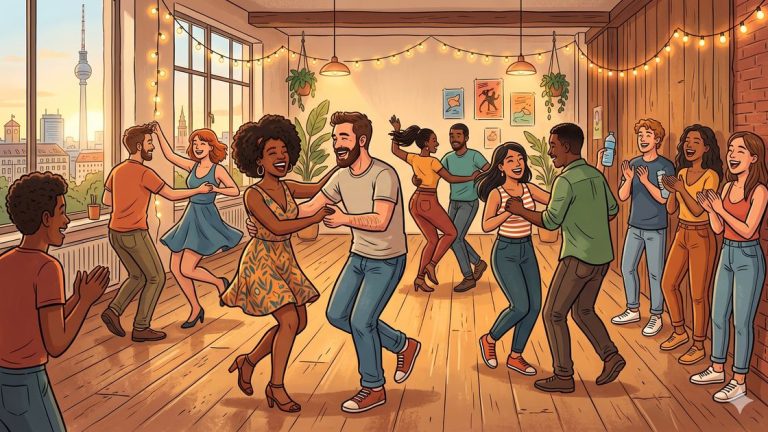
Sober Berlin – Ecstatic Dance and More runs alcohol- and drug-free dance nights in the heart of Kreuzberg 36: DJ sets, a cacao ceremony, live mantra singing, and a tea-and-snacks corner for the talking part. It is explicitly for people who are sober, in recovery, or just sober-curious, and the organisers donate a share of earnings to women- and child-focused NGOs. Events are listed on Meetup. There is no bar, so there is no bar tab and no drift towards one.
Conscious clubbing nights run at established Berlin venues including :// about blank in Friedrichshain and Panke in Wedding. These are usually one-off or monthly dates rather than fixed weeklies, so follow the organisers rather than the venue.
On the bar side, Berlin’s dedicated alcohol-free bar Zeroliq at Boxhagener Straße 104 in Friedrichshain — Germany’s first — is worth knowing about, but listings disagree about whether it is currently trading. Check before you cross the city for it.
Where you’ll reliably find serious alcohol-free cocktails is in bars that treat them as a real menu rather than an afterthought. Green Door at Winterfeldtstraße 50 in Schöneberg keeps a genuine list of them alongside the classics — you can sit at the bar all night and never touch alcohol without anyone noticing or caring.
Courses that repeat: the strongest move on this list
If you only do one thing on this page, enrol in something that meets weekly for at least eight weeks. Repetition is what converts acquaintances into friends, and a course is the cheapest repetition Berlin sells.
Berlin’s twelve Volkshochschulen are the obvious route: language courses, cooking, pottery, photography, drawing, dance, at municipal prices. Enrolment is central, through volkshochschule.berlin, and courses can be cancelled free up to 14 days before they start.
The social mechanics matter more than the subject. A cooking course puts you at a shared table for three hours. A pottery course is quiet, hands-busy and forgiving of people who don’t talk much. A language course gives you a cohort with a shared struggle — the fastest bonding agent there is.
If German is the barrier rather than the alcohol, our guide to making friends in Berlin without German maps which rooms in this city run in English on purpose.
What to say when someone suggests a bar
The honest answer is that you rarely need a script — you need a counter-proposal. Declining an invitation feels like rejection; replacing it doesn’t.
Three lines that work, in order of how little explanation they require:
- “I’m not drinking at the moment — want to do X instead?” No reason given, alternative supplied. Most people say yes to the alternative and never revisit the first half.
- “Bars aren’t really my thing, but I’d genuinely like to hang out. Sunday walk?” Names the preference as a preference rather than a rule.
- “Sure, I’ll come — I’ll just be on the alcohol-free stuff.” Fine when the group matters more than the venue. This is a normal order in every Berlin bar and nobody at the counter will react.
The failure mode is disappearing. People read a declined invitation as disinterest unless you give them something to accept instead. If you’re finding solo days hard right now, our list of things to do alone in Berlin is a decent place to restart from.
How to meet people in Berlin without drinking when you don’t know anyone yet
Most of the advice above has the same gap: it tells you where to go and assumes you already have someone to go with. That assumption is usually the actual problem.
MITRA is built for that gap specifically. You choose an activity you want to do — a lake swim, a bouldering session, a Sunday coffee — and send an activity request to people nearby who want the same thing. The other person decides whether to accept, so nobody is paired with anyone, and nothing happens without both sides saying yes.
It is activity-first by design, which is also why it fits this article: nothing on it defaults to a bar unless you choose one. If you want the wider comparison of how Berlin’s group options work, we’ve covered social and meetup groups in Berlin separately.
Pick the activity, not the venue.
Post what you want to do, send a request to someone nearby, and meet the person who accepts. Free to start, Berlin-first.
A sober week in Berlin, mapped
This is what a realistic week looks like if you’re rebuilding a social life without alcohol. It costs about €25 and takes roughly seven hours.
| Day | Move | Cost | Why it works |
|---|---|---|---|
| Tue | Bouldering session, same gym each week | ~€15 drop-in | Built-in turn-taking; no small talk required |
| Thu | VHS course evening | ~€4–9 per teaching hour | Same cohort for weeks — the compounding one |
| Sat | Specialty café, same time each week | €3–5 | Slow-build regular status |
| Sun | Tempelhofer Feld or Mauerpark | Free | Big, loose, easy to bring someone to |
| Any | 90 min at a Category 3 pool | €4.00 | Cheapest alcohol-free room in the city |
The pattern matters more than the items: three of the five repeat at a fixed time, which is what makes strangers turn into familiar faces. A calendar of one-offs produces a nice month and no friends.
Questions people actually ask
How much does an alcohol-free night out in Berlin cost?
Far less than a drinking one. A 90-minute ticket at a Category 3 municipal indoor pool is €4.00 and a day ticket €6.00; an outdoor Sommerbad day ticket is €7.00 at the top category and €6.50 at Strandbad Wannsee. Parks like Tempelhofer Feld, Görlitzer Park and Mauerpark cost nothing at all. A specialty filter coffee runs €3–5, and a bouldering drop-in is usually €12–18. Sober dance events are typically priced like a club ticket.
Do I need to book any of these in advance?
Mostly no, with three exceptions. Municipal pools sell tickets at the door, but Berliner Bäder-Betriebe offers up to 20% off if you book an online time-slot in advance, and on hot days popular Sommerbäder hit capacity and admit only online-ticket holders. Volkshochschule courses need enrolment through volkshochschule.berlin and fill up before the term starts. Sober dance events usually run on Meetup with limited places, so RSVP rather than turning up.
Are Berlin’s sober meetups English-friendly?
Generally yes. Sober Berlin’s dance events and most sober or ecstatic-dance groups in Berlin run bilingually or in English, because their audience is heavily international. Bouldering gyms, run crews and specialty cafés also work fine in English. The places where German genuinely matters are traditional sports clubs and some municipal courses. If language is your bigger barrier, our separate guide to making friends in Berlin without German maps which rooms run in English deliberately.
How do I get to Berlin’s pools and lakes without a car?
All of them are reachable on the BVG and S-Bahn network. Sommerbad Kreuzberg (the Prinzenbad) is at U7 Gneisenaustraße, Strandbad Wannsee at S1/S7 Nikolassee, Schlachtensee at S1 Schlachtensee, and Tempelhofer Feld at U6 Paradestraße or U8 Boddinstraße. A Deutschlandticket covers every one of them plus regional trains out to the Brandenburg lakes. Bring a bike lock if you cycle; the lake stations get busy on hot weekends.
What are the alcohol-free options when it rains?
Indoor pools and municipal saunas are the obvious answer, and they’re cheap: €4.00 for 90 minutes at a Category 3 pool, €13–20 for a three-hour sauna session depending on category. Bouldering gyms are the other reliable rainy-day room, as are board game cafés, specialty coffee shops and Volkshochschule evening courses. Note that the municipal saunas close for a summer break and reopen in autumn, so they’re a cold-season option.
Is there an actual alcohol-free bar in Berlin?
Zeroliq at Boxhagener Straße 104 in Friedrichshain opened as Germany’s first fully alcohol-free bar, but listings disagree about whether it is currently trading — check before you travel across the city. More reliably, several established Berlin bars keep a serious non-alcoholic menu rather than a token one, including Green Door at Winterfeldtstraße 50 in Schöneberg. Ordering alcohol-free is completely unremarkable in any Berlin bar.
What do I say if my friends only ever suggest bars?
Don’t decline — counter-propose. “I’m not drinking at the moment, want to do X instead?” works because it supplies an alternative rather than a refusal, and most people simply accept the second half. If the group matters more than the venue, “sure, I’ll just be on the alcohol-free stuff” is a normal order everywhere in Berlin. The failure mode is quietly disappearing, which people read as disinterest.
Does not drinking make it harder to meet people in Berlin?
Not really, and the numbers back that up. In the BZgA’s 2023 national survey, only 18.2% of women and 38.8% of men aged 18–25 in Germany drank alcohol at least weekly — the lowest since the study began. Alcohol-free beer production has nearly doubled in a decade. Practically speaking, the harder variable is repetition: showing up at the same place weekly beats any particular venue choice.
Pottery is one of the strongest sober options in the city: our guide to pottery classes in Berlin compares seven studios, and two people can book a beginner taster together for €150 to €190.
Volunteering belongs on the same list for the same reason: nobody is drinking, everybody has something to do, and you see the same faces next week. Our guide to volunteering in Berlin has nine ways in and the shift times each one runs.
A bar is not automatically a drinking night. A quiz gives you a task, a team and a finish time, and several of them charge €2 or less at the door — the full list is in our guide to pub quizzes in Berlin.
Dancing belongs on this list too, and it is cheaper to try than most people assume — a first class costs nothing to €15, and no studio asks you to bring a partner. We checked four of them in dance classes in Berlin.
Looking for something you turn up to every week? We also mapped choirs in Berlin that take new singers, with fees, rehearsal nights and which ones audition.
Want to keep reading?
- Board game cafés in Berlin — bright rooms, no bar, and a reason to talk to strangers.
- How to make friends in Berlin — the structural reasons this city is hard, and what works
- Make friends in Berlin without speaking German — which rooms run in English on purpose
- Things to do alone in Berlin — solo days that don’t feel like waiting
- Berlin’s best lakes and outdoor pools — the free and near-free summer options
- Running clubs in Berlin — weekly, free, beginner-friendly
- Social and meetup groups in Berlin — where the organised version lives
One last thing.
If you’ve read this far, the missing piece probably isn’t ideas — it’s a person to do one of them with. That’s the whole job MITRA does.
We post Berlin activity ideas and real meetups on Instagram — come say hello. Berlin first. Bucharest and more EU cities coming soon.
Sources
- Bundeszentrale für gesundheitliche Aufklärung (BZgA), Die Drogenaffinität Jugendlicher in der Bundesrepublik Deutschland 2023 — 7,001 respondents aged 12–25, surveyed April–June 2023; regular weekly alcohol use among 18–25s at 18.2% (women) and 38.8% (men), the lowest since observation began. Reported 4 November 2024 via the Federal Government Commissioner on Addiction and Drugs: https://www.bundesdrogenbeauftragter.de/presse/detail/rauschtrinken-bei-jugendlichen-steigt-auf-vor-corona-niveau/
- Statistisches Bundesamt (Destatis), Produktion von alkoholfreiem Bier 2025 gegenüber Vorjahr um 6,5 % gestiegen, Zahl der Woche, 7 July 2026 — ~616 million litres produced in 2025, +96.1% over ten years: https://www.destatis.de/DE/Presse/Pressemitteilungen/Zahl-der-Woche/2026/PD26_28_p002.html
- Berliner Bäder-Betriebe, Preise & Tarifsatzung 2026 — indoor, outdoor and sauna tariffs by pool category, valid 2026: https://www.berlinerbaeder.de/preise-tarifsatzung/
- Berliner Bäder-Betriebe, FAQ / Haus- und Badeordnung — 22°C support temperature in heated Sommerbäder for the 2026 season; no admission under the influence (section III, para. 6d): https://www.berlinerbaeder.de/faq/
- Volkshochschulen Berlin (Berlin Senate) — the twelve Berlin Volkshochschulen, course catalogue and central enrolment: https://www.berlin.de/vhs/
- Sober Berlin – Ecstatic Dance and More (Meetup group listing) — alcohol- and drug-free dance events in Kreuzberg 36: https://www.meetup.com/sober-berlin-ecstatic-dance-and-more/