Sorted by language: make friends in Berlin without German
How to make friends in Berlin without German: what actually runs in English, what needs no words at all, and the two rooms where German is unavoidable.

You can make friends in Berlin without German — 976,419 people registered here hold a foreign passport, and a whole layer of this city runs in English on purpose. What you can’t do is assume it: Berlin sorts its rooms by language, and knowing which room you’re walking into is most of the skill.
The short version:
- Tier 1 — no words needed. Bouldering, parkrun, touch rugby, social dancing. You turn up, you do the thing, the talking happens afterwards and it’s short.
- Tier 2 — English on purpose. Comedy Café Berlin’s Sunday improv jam (free), English Theatre Berlin, board game cafés, original-version cinemas, the Tuesday language café in Neukölln.
- Tier 3 — the big English-speaking meetups. Berlin Evening Socials (Fridays, 23,000+ members) and Berlin Social Meet Up (Thursdays) are free and genuinely enormous. One famous group in this tier has been dead since 2025 — details below.
- Where English stops: sports Vereine, most authority paperwork, and your building. That’s a smaller list than people fear, but it’s real.
- The one move that beats all of them: something that repeats weekly for months. A four-week VHS German course at 205 € per 100 teaching units is a social mechanism disguised as a language class.
Contents
- How much German do you actually need in Berlin?
- Tier 1: rooms where nobody talks much anyway
- Tier 2: places that run in English on purpose
- Tier 3: the big English-speaking meetups — and the dead one
- Where English genuinely stops working
- The expat bubble has a shelf life, and the data shows it
- A German course is a social move before it’s a language move
- Volunteering with a “no German required” filter
- If the problem isn’t the language but the doorway
- Questions people actually ask
How much German do you actually need in Berlin?
Less than you’ve been told for socialising, more than you’d like for admin — and the gap between those two facts is where most of the frustration lives.
The numbers are unusually kind here. At the end of 2025 Berlin had 3,913,644 registered main residents, of whom 976,419 — 24.9% — held a foreign passport, and 42.3% had a migration background. That’s not a niche. That’s a quarter of the city that also arrived without the language.
On the other side of the conversation: in the European Commission’s Europeans and their languages survey, 65% of respondents in Germany said they speak English well enough to hold a conversation, against an EU average of 47%. Berlin skews younger and more international than the German average.
The honest version: in Berlin, English is not a fallback. It is a second working language that a lot of the city has quietly agreed to.
Where that stops being true is officialdom. Berlin’s immigration authority (LEA) runs a full English website — but on its own English contact page, most departmental forms are labelled “in German language.”
Only the units for skilled workers, students and researchers offer an English contact form. And there is no official statement anywhere that a Bürgeramt counter will serve you in English, so plan for German or a friend.
One genuinely good exception: the Willkommenszentrum Berlin, the Senate’s counselling centre, offers free drop-in counselling in English with no appointment at all.
Tier 1: rooms where nobody talks much anyway
The fastest route into a Berlin social life with no German is an activity where the activity does the talking — you stand next to someone for ninety minutes, you both fail at the same thing, and language turns out to be about a tenth of it.
| Where | District · nearest station | When | Price (2026) | Book? |
|---|---|---|---|---|
| Boulderklub Kreuzberg, Ohlauer Str. 38 | Kreuzberg · U1/U3 Görlitzer Bahnhof | Mon–Fri 07:00–22:00, weekends 09:00–22:00 | 13,50 € day pass · 11 € before 15:00 weekdays · shoes 4 € | No |
| Berta Block, Mühlenstraße 62 | Pankow · S+U Pankow | Mon–Fri 09:00–23:00, weekends 10:00–22:00 | 14,50 € day pass · 12,50 € before 14:00 (to 30 Sept) | No |
| Hasenheide parkrun, Columbiadamm 160 | Neukölln · U7/U8 Hermannplatz | Saturdays 09:00, 5 km | Free | Register once online |
| Swing Patrol, Statthaus Böcklerpark, Prinzenstr. 1 | Kreuzberg · U1/U3 Prinzenstraße | Tuesdays, starter class 18:15 | 12 € drop-in · 10 € reduced · 5 € solidarity | No |
| Berlin Bruisers touch rugby, Hänselstr. 14 | Treptow-Köpenick | Mondays 19:30 (indoor) | No published fee — ask first | Contact form |
Two of those deserve a note. Boulderklub Kreuzberg holds the first course of every month in English, which is unusual enough to be worth planning a month around; its training workshops are in English too.
Swing Patrol’s classes are taught in German and English, and the crucial detail is on their own page: no registration and no partner needed. You show up alone and get rotated through the room. Thursday’s class at Frannz in Prenzlauer Berg is followed by a social dance from 20:30.
The Berlin Bruisers are the clearest case in the city of a sports club that has made a decision about this. Their own words: “We train in english to maximise inclusiveness.” Touch rugby is non-contact, mixed, and built for people who have never played.
The tell for a club that will actually work for you: it says what language it trains in, out loud, on its own website. Almost nobody does. The ones who do have thought about you.
Hasenheide parkrun is free, timed, 5 km, every Saturday at 09:00, with no time limit — and the socially useful part is on their page too: the group walks to Café Blume afterwards.
If organised running appeals more than you expected, we mapped Berlin’s run crews night by night — most of them cost nothing either.
If you want something louder and equally language-free, go-karting in Berlin needs roughly four words of German and a helmet, and CrossFit boxes in Berlin count reps in numbers everyone already knows.
Language requirement across this whole tier: near zero. Social payoff on day one: also fairly low — that’s the trade. These are places to become a regular, not places to make a friend on Tuesday.
Berlin is full of people doing this alone. If walking into a room of fifty strangers is the actual obstacle, MITRA does the smaller version of it: you send someone nearby an activity request, they say yes or they don’t, and you meet one person instead of a crowd.
Tier 2: places that run in English on purpose
These are venues where English isn’t tolerated, it’s the house language — which means the small talk starts working immediately instead of after six months.

Comedy Café Berlin (Roseggerstr. 17, Neukölln) is the single best free entry point in the city. Its CCB Improv Jam runs every Sunday at 20:00 and costs nothing — you can watch, or you can put your name on the sign-up sheet when you arrive and play. Their line is “anyone can join and everyone can play.” Ticketed shows run Wednesday to Sunday at around 10,50 € online, two euros more at the bar.
English Theatre Berlin (Fidicinstraße 40, Kreuzberg, U6 Platz der Luftbrücke) describes itself as the only organisation in the city dedicated to English as its working language. A recent August 2026 show priced at 13,20 € for students, 19,80 € full, 27,50 € solidarity — you pay the band you’re in. The venue is barrier-free and the bar opens an hour before.
Solidarity pricing is common in Berlin’s English-language venues. Paying the middle band when you can afford it is what keeps the bottom band open for someone who can’t.
Boardroom (Hohenstaufenstraße 69, Schöneberg, U Nollendorfplatz) opened in July 2026 with 350+ games, a bilingual site and hourly pricing: 2,50 €/hour Tuesday–Thursday capped at 10 €, 3,50 €/hour Friday–Sunday capped at 14 €. Drop in or book a table. The older option, Spielwiese in Friedrichshain, runs an open game night every Monday from 18:00 for a flat 5 € — the format where strangers get seated together is the whole point.
For films, the reliable move is Berlin’s original-version cinemas. The Odeon in Schöneberg has shown exclusively original versions with no German dubbing since 1985 (13,50 €).
Rollberg in Neukölln did the same from 2010 (12,50 €), and Wolf Kino on Weserstraße shows every film in original version (12 €, 10 € reduced). All of the Yorck cinemas price Monday as Kinotag at 9 €.
| Listing tag | What it means | Safe if you have no German? |
|---|---|---|
| OV | Original version, no subtitles | Yes, if the original is English |
| OmU | Original with German subtitles | Yes — the audio is the original |
| OmeU | Original with English subtitles | Yes, including non-English films |
| No tag | German dub | No |
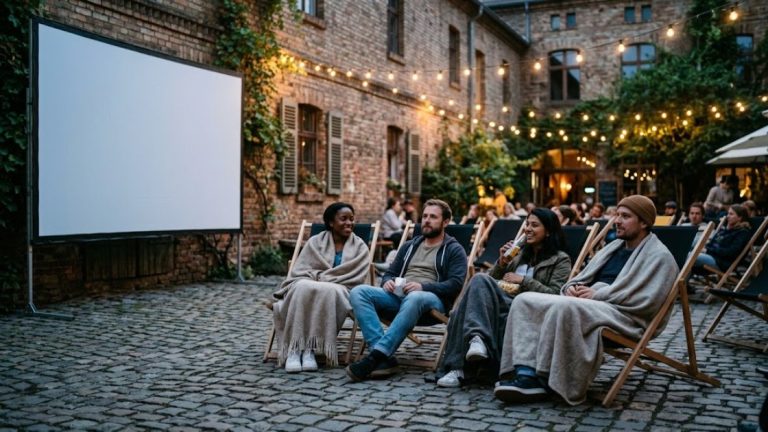
And the free weekly one nobody outside Neukölln knows: Hejmo’s English Language Café at the Blue House, Donaustr. 15, runs Tuesdays 18:00–20:00, free, no registration — their words: “just come by.” (If you’ve read older guides, this is the organisation formerly called Give Something Back To Berlin.)
Berlin also has roughly 60 free Sprachcafés — conversation evenings scattered across the districts, including one at the Amerika-Gedenkbibliothek on Blücherplatz on Tuesdays from 17:00. Nominally they’re for practising German. In practice, as the directory itself admits, English is spoken widely — “sometimes too widely.”
Worth knowing before you go: a Sprachcafé is not a class and nobody teaches. It’s a table, a volunteer host, and whoever turned up.
That’s the honest bridge into the next section. A language exchange partner in Berlin is a more deliberate thing than a language café.
And if you want the reading-in-company version instead, Berlin’s English book clubs meet in bookshops that keep proper evening hours.
Tier 3: the big English-speaking meetups — and the dead one
Berlin’s large English-speaking meetups are free, weekly, genuinely huge, and the most common first move newcomers make — so it matters that one of the best-known is no longer running.
| Group | Night | Size (checked 7 Aug 2026) | Cost | Status |
|---|---|---|---|---|
| Berlin Evening Socials | Fridays 19:30 | 23,355 members · 46–52 people at recent events | Free | Active |
| Berlin Social Meet Up | Thursdays 19:00 | 16,738 members · 154 people on 6 Aug | Free (venue charges possible) | Active |
| International Activities Berlin | Near-daily | 41,277 members | Mixed: free socials, donation-based comedy | Active |
| r/berlinsocialclub | No fixed night | ~117,000 subscribers | Free | Active, no organiser |
| Berlin Expats (Meetup) | — | 18,281 members | — | Dead — no event since Sept 2025 |
Berlin Expats still ranks near the top of most search results and is still recommended by half the listicles online, and it has not held an event since September 2025. If you joined it and concluded that Berlin’s meetup scene was quiet, that was the group, not the city.
The two that actually run are worth understanding differently. Berlin Evening Socials is a fixed Friday drinks meetup with a rotating venue and around fifty people — big enough to hide in, small enough to talk. Berlin Social Meet Up runs Thursdays and pulled 154 people on 6 August; it coordinates on Slack rather than the usual chat apps.
r/berlinsocialclub works on a different mechanic entirely: there is no organiser, no weekly thread and no official group chat. People post their own “looking for someone to…” threads and other people reply. It’s closer to a noticeboard than a club, which suits some personalities enormously and suits others not at all.
If comparing all of these properly is where you are, we’ve already done that in the best apps to meet people in Berlin and in Berlin’s social and hobby meetup groups.
The thing nobody tells you about the big meetups: fifty people on a Friday is not fifty chances. It’s usually one or two conversations and a lot of standing. That’s fine — as long as you go back the following Friday.
Where English genuinely stops working
Three places, and it’s worth naming them precisely so you stop bracing for the language barrier everywhere else.
Traditional sports clubs (Vereine). Not the street crews and not the drop-in halls — the registered clubs with annual membership, a committee and a season. Training is often in German because most members are German, and the paperwork always is. That’s why the Berlin Bruisers making English their training language is notable rather than normal.
Authorities. As above: written information is broadly available in English, human contact often isn’t. Budget for a German-speaking friend, a paid Behördenbegleitung, or the Willkommenszentrum’s free drop-in.
Your building. The Hausverwaltung, the caretaker, the neighbour with a view on your bin habits. This is the one that quietly makes people feel foreign in their own flat, and no meetup fixes it.
Everything else — cafés, gyms, cinemas, clubs, courses, shops, most workplaces in tech and creative fields — will meet you in English.
Still in the arriving phase and wondering what order to do all this in? The first 30 days in Berlin, alone puts the paperwork and the social side on the same timeline.
The expat bubble has a shelf life, and the data shows it
An all-English social circle works beautifully for about a year, and then it starts leaking — because the people in it are the most likely people in Berlin to leave.
This isn’t a moral point about integration. It’s a churn problem. The English-speaking layer of Berlin is disproportionately made of people on two-year contracts, one-year masters and open-ended experiments, and a circle built entirely from that layer rebuilds itself from scratch every eighteen months.
The people easiest to befriend in your first month are, statistically, the people most likely to be gone by your second winter. Build with that in mind rather than being surprised by it.
There’s harder evidence underneath it. Berlin’s own Sozialbericht 2025 found that just under one in four people surveyed in the city often feel lonely — and that among people with a migration background, in both the first and second generation, the share of lonely people is almost twice as high as among people without one.
The federal Einsamkeitsbarometer found the same shape nationally: in 2021, 16.3% of people in Germany with migration experience reported elevated loneliness, against 9.9% of those without.
Arriving without the language isn’t just a practical problem. Statistically, it’s a loneliness risk factor — which is a good reason to build something that doesn’t depend entirely on other newcomers.
If that landed uncomfortably close, we wrote about the timing of it in why Berlin feels lonely at month three, and the full toolkit sits in how to make friends in Berlin.
The practical conclusion is small and cheap: keep the English-speaking circle, and add one thing that puts you in a room with people who live here permanently. Which brings us to the least romantic recommendation in this article.

A German course is a social move before it’s a language move
Sign up for a German course for the wrong reason — not to learn German, but because it is the only cheap thing in Berlin that puts the same twelve strangers in the same room repeatedly for a month.
Repeated contact with the same specific people is what actually produces friendships, and almost nothing in an adult expat life supplies it. A course does. Everyone in the room is new, everyone is bad at the same thing, and nobody has to invent a reason to come back.
A meetup asks you to be interesting on the night. A course only asks you to come back on Thursday. The second bar is much lower and the results are much better.
The prices are public and low. Berlin’s Volkshochschulen charge 205 € per 100 teaching units of 45 minutes for German at A1, A2 and B1 level.
A real current course record: B1+ at VHS Treptow-Köpenick, 100 units, Monday to Friday 08:30–13:00 for four weeks, 216 €.
That schedule is the point. Twenty mornings with the same people in four weeks beats twenty different meetups in a year, and it isn’t close.
| Route | What you pay | Structure |
|---|---|---|
| VHS German course, A1–B1 | 205 € per 100 units (195 € for admitted integration-course participants) | e.g. 100 units over four weeks, weekday mornings |
| VHS German course, exempted integration-course participant | 0 € | same |
| BAMF Integrationskurs | 2,29 € per unit — 1,603 € for the 700-unit course | 600 language + 100 orientation units |
If you qualify for a BAMF Integrationskurs, exemptions apply for people receiving Bürgergeld or on low incomes — and half your contribution comes back if you pass the final test within two years.
One practical warning that catches everyone: VHS German courses cannot be booked online. VHS Mitte, in its own English text, says registration is only possible in person, without an appointment — Mondays and Thursdays 11:00–14:00, Tuesdays 14:00–17:00, at Antonstraße 37 in Wedding. Go early. Bring a book.
Nobody should have to attend a language course alone to meet one person. If you’d rather skip the room entirely: on MITRA you pick someone nearby who wants to do the same thing you do, send them an activity request, and go if they accept.
Download MITRA on Google Play · Download MITRA on the App Store
Volunteering with a “no German required” filter
Berlin’s main volunteering platform lets you filter opportunities by how much German you need, which removes the guesswork entirely.
vostel.de runs a full English version of its site, and its search has a “German skills” filter with five levels, the first of which is literally “No German skills.” Every listing carries its level inline. On 7 August 2026 the platform listed 601 volunteering opportunities in Berlin, and using it is free for volunteers and organisations alike.
The mechanism is well-suited to this problem: you’re placed alongside the same people, doing something with an obvious purpose, and there is never an awkward gap where you have to explain why you came. One catch worth knowing — the platform only places volunteers who already live in Germany.
Hejmo (the Neukölln organisation behind the Tuesday language café) is the other route: they report more than 2,500 volunteers a year across 80+ free activities a month, and the language cafés need no fixed commitment at all. Longer-term roles ask for six months and a Führungszeugnis.
If the problem isn’t the language but the doorway
For a lot of people the German is a cover story, and the real obstacle is walking into any room alone — which is a different problem with a different fix.
The tiers above all assume you can get yourself through a door where forty people already know each other. Plenty of people can’t do that on a Tuesday after work, in any language.
MITRA is built for the one-person version of the same evening. You find someone near you who wants to do the same activity, you send them an activity request, and they accept it or they don’t — nothing is automatic and nobody is assigned to anyone. If they say yes, you’ve got a bouldering session or a Sunday walk with one person instead of a room.
It works in whatever language the two of you have. That’s a much lower bar than a crowd.
Working from home makes all of this harder in a way that has nothing to do with vocabulary — we wrote the field guide for that.
And if you’d rather get out of the flat first and worry about company later, things to do alone in Berlin is the one to start with.
Questions people actually ask
Can you make friends in Berlin without speaking German?
Yes, and a large part of the city is set up for it. Roughly a quarter of Berlin’s registered residents hold a foreign passport, and 65% of people in Germany say they can hold a conversation in English. Comedy nights, board game cafés, bouldering halls, original-version cinemas and the big weekly meetups all run in English. The limits are traditional sports clubs, authority paperwork and your own building.
How much does it cost to go to English-speaking events in Berlin?
Less than most people expect. The largest English-speaking meetups — Berlin Evening Socials on Fridays and Berlin Social Meet Up on Thursdays — are free to attend; you only pay for your own drinks. The Sunday improv jam at Comedy Café Berlin is free. Language cafés are free. Where you do pay it is usually small: a bouldering day pass is 13,50–14,50 €, a board game café charges 2,50–3,50 € an hour, and Monday cinema tickets are 9 €.
Do you need to book English-language events in Berlin in advance?
Mostly no. Bouldering halls, language cafés, drop-in dance classes and board game cafés all take walk-ins. Meetups want an RSVP but nothing more. The exceptions worth planning ahead for are ticketed theatre and comedy shows — Comedy Café Berlin regularly sells out and pushes people to a waiting list, and tickets there cost two euros more if you buy at the bar rather than online.
Which Berlin meetup groups actually still run in English?
Berlin Evening Socials (Fridays 19:30, over 23,000 members, roughly 50 people per night) and Berlin Social Meet Up (Thursdays 19:00, over 16,000 members, 154 people at a recent August event) both run weekly and are free. International Activities Berlin posts near-daily events. Berlin Expats still ranks high in search results and still has 18,000+ members, but it has not held an event since September 2025 — do not judge Berlin by it.
How much does a German course cost at the Berlin VHS?
Berlin’s Volkshochschulen charge 205 € for 100 teaching units of 45 minutes at A1, A2 and B1 level, dropping to 195 € for admitted integration-course participants and nothing at all for those granted an exemption. A typical intensive runs weekday mornings for four weeks. One catch: German courses cannot be booked online — VHS Mitte, for example, requires in-person registration without an appointment during set weekday hours.
What can you do in Berlin in English when it rains?
Rain is the easiest weather for this, because almost everything on the English-language list is indoors anyway. Bouldering halls open from 07:00 or 09:00 and are unaffected. Board game cafés run all afternoon and evening. Original-version cinemas — the Odeon in Schöneberg, Rollberg in Neukölln, Wolf Kino — show every film in its original language. English-language comedy and theatre run Wednesday to Sunday.
What is the cheapest way to get around Berlin to all of this?
The Deutschlandticket costs 63 € a month in 2026 and covers every U-Bahn, S-Bahn, tram and bus in the city plus regional trains across Germany. It is subscription-only but can be cancelled monthly. A single AB ticket is 4,00 €, so the monthly ticket pays for itself in about eight journeys — worth it if you are travelling across districts for events more than twice a week.
Where does English actually stop working in Berlin?
Three places. Traditional sports clubs — the registered Vereine with annual membership and a committee — usually train and administer in German. Authorities are mixed: Berlin’s immigration office runs a full English website, but most of its departmental contact forms are marked “in German language”, and no official source says a Bürgeramt counter will serve you in English. And your building — the property management, the caretaker, the neighbours — will not.
How we checked: in early August 2026 we read every venue’s, organiser’s and authority’s own pages rather than aggregator listings — Boulderklub Kreuzberg and Berta Block’s price lists, parkrun Deutschland’s Hasenheide course page, Swing Patrol Berlin’s fee page, the Berlin Bruisers’ touch-rugby page, Comedy Café Berlin’s live box office, English Theatre Berlin’s ticket page, Boardroom and Spielwiese’s opening pages, Yorck Kinogruppe’s price page, Hejmo’s calendar, the four Meetup group pages (member counts read on 7 August 2026), vostel.de’s search filters, and the VHS and BAMF fee pages. Prices and schedules move; we’ve linked each source so you can re-check before you go. Where we couldn’t verify a figure from the organisation itself — InterNations’ Berlin pricing, the Bruisers’ membership fee, Another Country’s event entry — we’ve left the number out rather than guess.
Five of the seven studios in our guide to pottery classes in Berlin publish a class language, and four of them teach in English.
The same is true off the sports pitch: our guide to volunteering in Berlin sets out which organisations actually run in English, and which will expect German from the first shift.
You do not need German to sit in a cinema here either: English cinema in Berlin lists ten venues showing films in their original language.
And if you decide to learn some German after all, price it before you commit: we costed German classes in Berlin across six providers, and the cheapest monthly fee turns out to buy the least teaching.
Why a weekly group beats ten one-off events: our guide to how to make friends in Germany works through the hours it takes, route by route.
Want to keep reading?
- How to make friends in Berlin — the full pillar, including what friendship-formation research says actually works.
- Why Berlin feels lonely at month three — if the timing of this feels suspiciously specific.
- Social and hobby meetup groups in Berlin — the non-drinks version of tier 3.
- How to find a language exchange partner in Berlin — for when you decide to close the gap rather than route around it.
- Book clubs in Berlin — English-language, weeknights, low stakes.
Berlin will meet you in English further than you think, and stop exactly where you least want it to. Learn the map, pick one thing that repeats, and find one person going the same way.
Download MITRA on Google Play · Download MITRA on the App Store
Come say hello on Instagram — we post Berlin activity ideas every week: @mitra.app
Berlin first. Bucharest and more EU cities coming soon.
Sources
- Amt für Statistik Berlin-Brandenburg (2026). Einwohnerregisterstatistik Berlin, press release Nr. 16, 17 February 2026, reference date 31 December 2025 — 3,913,644 registered main residents, 976,419 foreign nationals (24.9%), 42.3% with a migration background. statistik-berlin-brandenburg.de
- European Commission (2024). Special Eurobarometer 540 — Europeans and their languages, fieldwork September–October 2023 — 65% of respondents in Germany report being able to hold a conversation in English, against an EU27 average of 47%. europa.eu
- Senatsverwaltung für Arbeit, Soziales, Gleichstellung, Integration, Vielfalt und Antidiskriminierung (2026). Sozialbericht 2025, section 6.1 “Einsamkeit”, based on SOEP data for 2023. berlin.de
- Bundesministerium für Familie, Senioren, Frauen und Jugend (2024). Einsamkeitsbarometer 2024, based on SOEP, UCLA-LS instrument — 16.3% of people in Germany with migration experience reported elevated loneliness in 2021, against 9.9% of people without. bmbfsfj.bund.de
- Bundesamt für Migration und Flüchtlinge (2026). Was kostet ein Integrationskurs?, page updated 1 July 2026 — 2,29 € per teaching unit, 1,603 € for the 700-unit general course, exemptions and 50% refund on passing within two years. bamf.de
- Volkshochschule Friedrichshain-Kreuzberg / Berliner Volkshochschulen. Deutschkurse — FAQ — 205 € per 100 teaching units of 45 minutes at A1/A2/B1, 195 € for admitted integration-course participants, free for exempted participants. berlin.de/vhs
- Volkshochschule Mitte / Berliner Volkshochschulen. German courses — information in English — registration in person only, without an appointment, Antonstraße 37, 13347 Berlin. berlin.de/vhs
- Volkshochschule Treptow-Köpenick (2026). Course record TK-6385-F, Deutsch B1+ — 100 teaching units, Monday to Friday 08:30–13:00, 216,00 €. vhsit.berlin.de
- Landesamt für Einwanderung Berlin. Contact (English pages) — most departmental contact forms are marked “in German language”; English contact forms exist for units B1–B4. berlin.de/einwanderung
- Willkommenszentrum Berlin. Counseling at the Willkommenszentrum — free drop-in counselling offered in English without an appointment. willkommenszentrum.berlin.de
- Boulderklub Kreuzberg (2026). Prices and opening hours — 13,50 € day pass, 11,00 € Early Bird before 15:00 on weekdays, shoe rental 4 €; the first course of every month is held in English. boulderklub.de
- Berta Block Boulderhalle (2026). Preise — 14,50 € day ticket, 12,50 € Early Bird before 14:00 on weekdays (1 May–30 September 2026). bertablock.de
- parkrun Deutschland. Hasenheide parkrun — course — free timed 5 km, Saturdays 09:00, start at Café Hasenschänke, Columbiadamm 160, no time limit. parkrun.com.de
- Swing Patrol Berlin (2026). Preise & Klassenkarten — drop-in 12,00 €, reduced 10,00 €, solidarity 5,00 €, no registration and no partner needed; classes taught in German and English. swingpatrolberlin.com
- Berlin Bruisers e.V. Touch rugby — “We train in english to maximise inclusiveness”; Monday 19:30 indoor and Friday 18:00 outdoor sessions in Treptow-Köpenick. berlinbruisers.com
- Comedy Café Berlin (2026). Box office — the CCB Improv Jam runs Sundays 20:00, free, with an on-the-night sign-up sheet; ticketed shows from 10,50 € online, +2 € at the bar; shows are in English unless otherwise stated. tickets.comedycafeberlin.com
- English Theatre Berlin | International Performing Arts Center (2026). Tickets — Fidicinstraße 40, 10965 Berlin, U6 Platz der Luftbrücke; August 2026 performance priced at 13,20 € students / 19,80 € full / 27,50 € solidarity. etberlin.de
- Boardroom Berlin (2026). Hohenstaufenstraße 69, 10781 Berlin; Tuesday–Sunday 14:00–22:00; 2,50 €/hour Tue–Thu capped at 10 €, 3,50 €/hour Fri–Sun capped at 14 €; 350+ games. boardroom.berlin
- Spielwiese Berlin (2026). Opening hours — Kopernikusstraße 24, 10245 Berlin; Monday open game night 18:00–23:00 at a flat 5 € per person. team-spielwiese.de
- Yorck Kinogruppe (2026). Prices and offers — Monday Kinotag 9 €; Odeon (Hauptstr. 116, Schöneberg) has shown exclusively original versions since 1985 at 13,50 €; Rollberg (Rollbergstr. 70, Neukölln) switched exclusively to original versions in 2010 at 12,50 €. yorck.de
- Wolf Kino (2026). Tickets — Weserstraße 59, 12045 Berlin; “All films are shown in original version”; 12 € / 10 € reduced / 9 € members. wolfberlin.org
- Hejmo Berlin (2026). English Language Café — Blue House, Donaustr. 15, 12043 Berlin, Tuesdays 18:00–20:00, free, “no registration needed — just come by”. hejmoberlin.org
- Hejmo Berlin (2026). Get involved — volunteers — more than 2,500 volunteers a year, 80+ free activities each month. hejmoberlin.org
- vostel.de (2026). FAQ and Volunteering projects in Berlin — “German skills” search filter including “No German skills”; free for volunteers and non-profit organisations; 601 Berlin opportunities listed on 7 August 2026. vostel.de
- Meetup group pages, member counts and event attendance read on 7 August 2026: Berlin Evening Socials, Berlin Social Meet Up, International Activities Berlin.
- Verkehrsverbund Berlin-Brandenburg (2026). Deutschlandticket — 63 € per month from 1 January 2026, subscription only with monthly cancellation. vbb.de