Tempelhof runways to canal paths: inline skating in Berlin
Where to go inline skating in Berlin: Tempelhofer Feld’s runways, the smoothest canal paths, skate rental, beginner spots and someone to skate with.
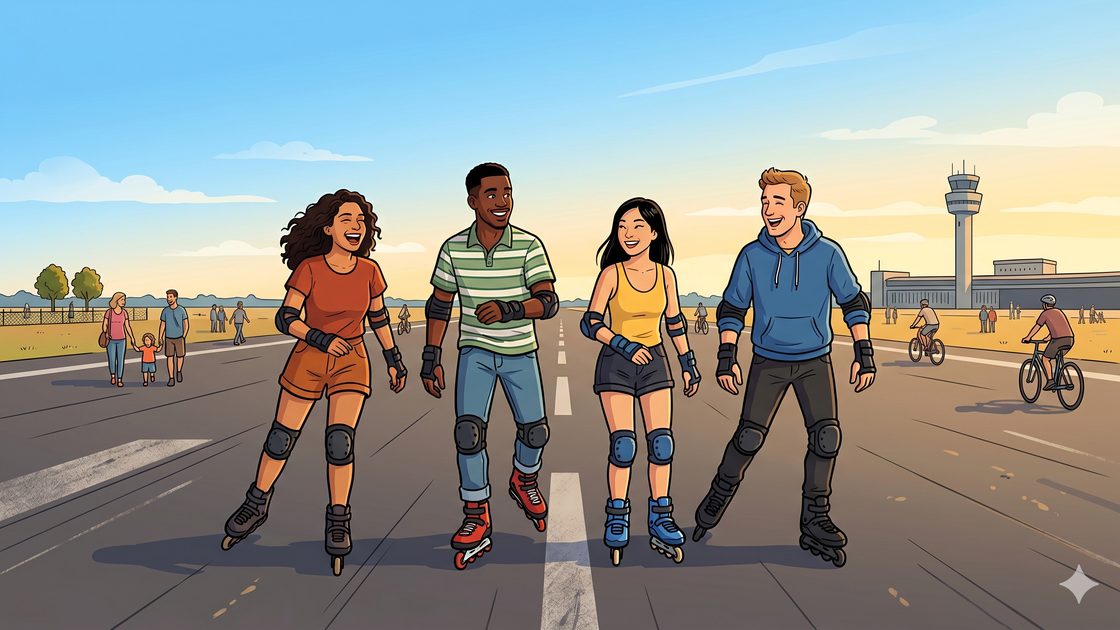
Inline skating in Berlin is one of the cheapest ways to spend a warm afternoon in the city, because the skating itself costs nothing: the best surface in town is the old runway at Tempelhofer Feld, and a string of canal towpaths and park loops add kilometres of smooth, traffic-free asphalt with no court fee and no ticket. If you don’t own skates, a handful of shops rent them with pads; if you do, you just pick a flat stretch and roll. The one thing no kiosk can hand you is the person who turns a solo lap of the field into a standing Sunday plan.
The short version:
- Best surface in the city: the old runways at Tempelhofer Feld — roughly six kilometres of flat, open tarmac (with a near-permanent headwind on one straight) plus a skatepark. Free and central.
- Smoothest beginner routes: the Spandauer Schifffahrtskanal towpath (~8 km, top asphalt), the Teltowkanal path in Treptow (~6 km, wide), Hans-Baluschek-Park in Schöneberg (short but glassy), and the newly built Karlshorst tracks.
- It’s basically free: you pay nothing to skate. If you don’t own a pair, shops like Skate & Glide in Prenzlauer Berg and Ski-Shop Charlottenburg rent skates and protective gear.
- Skate by Night is gone: Berlin’s famous mass night-skate last rolled in 2022, so don’t plan a trip around it. The field and the canals are the everyday scene now.
- The catch: skating is more fun, and far more likely to actually happen, with someone. On MITRA you send a skating request to someone nearby, they accept if they’re in, and your lap of the field has company.
Keep meaning to dig your skates out? Make it a plan, not a someday. MITRA is a free app for finding someone nearby to do an activity with — a first wobbly lap of Tempelhofer Feld very much included. You send an activity request to people near you, and meet the ones who say yes.
Contents
- Where to go inline skating in Berlin: the smoothest tarmac
- Tempelhofer Feld: skating on a former airport runway
- The smoothest routes for a first time on skates
- Skateparks, ramps and the Fläming-Skate day trip
- What happened to Skate by Night, Berlin’s mass skate
- Where to rent or buy inline skates in Berlin
- The gear that matters, and the one skill beginners skip
- Where inline skating came from
- Why skating is better with someone
- How to find someone to skate with in Berlin
- Frequently asked questions
- Sources
Where to go inline skating in Berlin: the smoothest tarmac
The best places to skate in Berlin are the ones with smooth, uninterrupted asphalt and no cars: the old airfield at Tempelhofer Feld, the canal towpaths along the Spandauer Schifffahrtskanal and the Teltowkanal, and a handful of park loops like Volkspark Friedrichshain and Hans-Baluschek-Park. For a skater, the surface is everything — a single stretch of cobbles or root-cracked path turns a glide into a stumble — so the city’s skating map is really a map of where the tarmac stays flat and clean.
Berlin is unusually good for this. The official tourism board, visitBerlin, keeps a running list of the city’s best skating routes, and they fall into a few clear types: the airfield at Tempelhof, the canal paths that run for kilometres beside still water, the park circuits dotted across the districts, the quiet forest routes out west like the Kronprinzessinnenweg and the Eiskeller trail in Spandau, and — for a proper day out — the long-distance Fläming-Skate in Brandenburg. Many of these double as cycle paths, so the same flat, scenic corridors that make Berlin a great city to find a cycling partner make it a great city to skate.
| Route | District | Roughly | Good for |
|---|---|---|---|
| Tempelhofer Feld | Tempelhof | ~6 km loop + skatepark | The classic: flat, open, free |
| Spandauer Schifffahrtskanal | Wedding / Spandau (Nordufer) | ~8 km | Top asphalt, beginner-ideal |
| Teltowkanal | Treptow (Ernst-Ruska-Ufer) | ~6 km | Wide, room to overtake, training |
| Hans-Baluschek-Park | Schöneberg | ~1.5 km | Very smooth, short, Südkreuz–Priesterweg |
| Volkspark Friedrichshain | Friedrichshain | flat loop | Idyllic central park circuit |
| Kronprinzessinnenweg | Zehlendorf | ~4 km | Forest route, quiet midweek |
| Karlshorst tracks | Köpenick (Hegemeisterweg) | 2 × ~1 km | Newly built, excellent asphalt |
| Eiskeller | Spandau | quiet | Forest and field; south end for beginners |
| Fläming-Skate | Brandenburg (day trip) | 11–92 km loops | Dedicated skating trail, long distances |
The practical takeaway is the same one cyclists learn: pick your surface to match your level. Learn on a glassy canal path or a fresh park track, save the busier shared routes for when you can stop on command, and treat the long Fläming loops as a reward for when your legs are ready.
Tempelhofer Feld: skating on a former airport runway
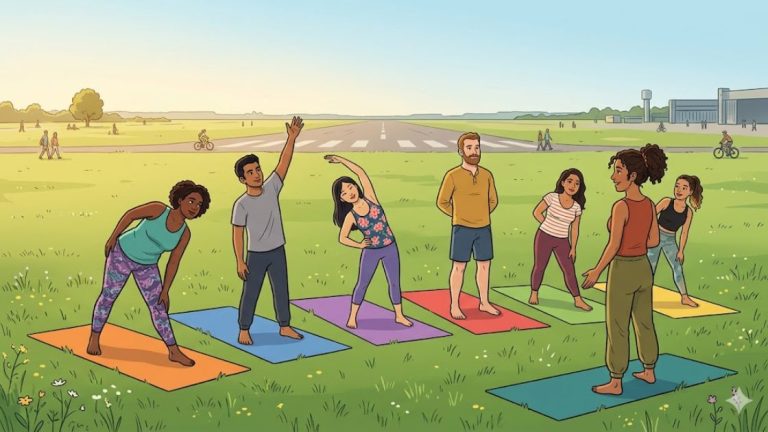
Tempelhofer Feld — the former Tempelhof airport, opened to the public as a park in 2010 — is the single best place to skate in Berlin, because its old runways and the taxiway around them give you roughly six kilometres of wide, flat, car-free tarmac in the middle of the city. At around 355 hectares it is Berlin’s largest open space, and it was built for aircraft, which means the asphalt is broad, smooth and dead level in a way no ordinary park path ever is.
Two things make the field special for skaters. The first is the famous headwind: the open expanse funnels a breeze down the runways, so one direction is an effortless push and the other is a built-in resistance workout — speed-skating groups train here precisely for that. The second is the skatepark near the Tempelhofer Damm side, with curbs, ledges, banks and manual pads for anyone who wants to do more than cruise; a quirky local detail is that some of its blocks are cut from the granite of the old Berlin City Palace. Enter from Platz der Luftbrücke, Columbiadamm or Tempelhofer Damm, and you’re rolling within minutes.
It’s also the gentlest place in Berlin to be bad at skating, because if you wobble there’s grass on either side and nothing hard to hit — no railings, no traffic, no canal edge. That’s why it’s the field where everyone learns, and why it’s an easy place to meet someone: it’s the same wide-open green that makes Tempelhof a magnet for running in Berlin, picnics and kite-flyers, all sharing one enormous flat horizon.
The smoothest routes for a first time on skates
If you’re just starting, skate the canal towpaths and the newest park tracks, where the asphalt is smoothest and the gradients gentlest. The Spandauer Schifffahrtskanal route in the north runs about eight kilometres between water and woodland on a wide, optimally surfaced path with only small climbs — visitBerlin flags it as ideal for beginners — starting around Nordufer. The Teltowkanal path in the south-east is similar: roughly six kilometres, wide enough that faster cyclists overtake you easily, best joined near the Späthstraße or Adlershof exits along the Ernst-Ruska-Ufer.
For shorter, lower-commitment first attempts, head to a park. Hans-Baluschek-Park in Schöneberg gives you about 1.5 kilometres of very good asphalt between Südkreuz and Priesterweg stations; the loop in Volkspark Friedrichshain is flat and central; and the Karlshorst tracks in the east are newly built, so the surface is excellent, with two roughly one-kilometre tracks reached from the Hegemeisterweg tram stop. The honest caveat on all of them is that you share the path with walkers and cyclists, so skate early, keep right, and pass with plenty of warning. Pair a morning canal skate with an afternoon dip and you’ve got a perfect hot-day plan — the same routes lead toward the lakes at the heart of Berlin’s open-water swimming scene.
No skates, no plan, no problem. MITRA is built for the “I’d go if someone came” moment. Send a skating request to people near you and meet the one who says yes — then learn the canal path together and split the after-skate ice cream.
Skateparks, ramps and the Fläming-Skate day trip
Beyond flat cruising, Berlin has proper skateparks and one of Europe’s best dedicated skating trails within a regional-train ride. In the city, the Park am Gleisdreieck in Kreuzberg hides bowls worth trying — go in the early morning, because by midday it fills with cyclists and walkers. Further out, Mellowpark in Köpenick (An der Wuhlheide 250) is a playground of concrete bowl, pump track and race track, while Liberty Park in Hellersdorf has a genuinely big ramp — four metres high and over twenty long — for anyone chasing air rather than distance.
The real prize for distance skaters sits just outside Berlin: the Fläming-Skate in Brandenburg, a network of eight circular tours from eleven to ninety-two kilometres on two-to-three-metre-wide paths built specifically for skating, winding through forests, meadows and villages. It’s a classic Berlin day trip — pack a picnic, take the regional train south, and skate further than you ever could in the city. And if racing appeals, the Berlin Half Marathon includes an inline division each year on the first Sunday in April, which gives the winter months a goal to train toward.
What happened to Skate by Night, Berlin’s mass skate
If you’ve heard of Skate by Night — Berlin’s mass evening skate, where up to two thousand people once rolled around thirty kilometres through closed streets into the sunset — the honest news is that it no longer runs. Its last editions were two summer dates in 2022, starting from Mercedes-Platz near the East Side Gallery, and the city’s official listing now records it as no longer taking place. For years it was an institution, a moving river of skaters with a police escort and a party atmosphere, but it has not returned since.
So don’t plan a trip around it, and be a little wary of older blog posts that still describe it as a weekly fixture. What the Berlin scene does now is more everyday than spectacular: Tempelhofer Feld is the de facto gathering point on any decent evening, skating clubs such as TSC Berlin run group sessions and weekend outings, and the Fläming-Skate is where people go when they want the long-distance, all-day version. It’s a quieter scene than the mass-skate years — which, honestly, is all the more reason to bring your own company rather than count on a crowd.
Where to rent or buy inline skates in Berlin
You don’t need to own skates to start: several Berlin shops rent inline skates and the pads to go with them, typically for a modest hourly or daily fee plus a deposit and ID. Skate & Glide in Prenzlauer Berg, on Greifswalder Straße, rents quality skates and safety gear and runs beginner courses; Ski-Shop Charlottenburg keeps inline skates in a full range of sizes, including adjustable pairs for children, plus protective equipment; Berlinliner pairs lessons with rentals in sizes roughly 37 to 46; and SkaMiDan, a combined skating school and skate shop, rents skates alongside its classes. Renting first is the smart move anyway, because it lets you find out whether you prefer a stable recreational skate or a nimbler freeskate before you buy.
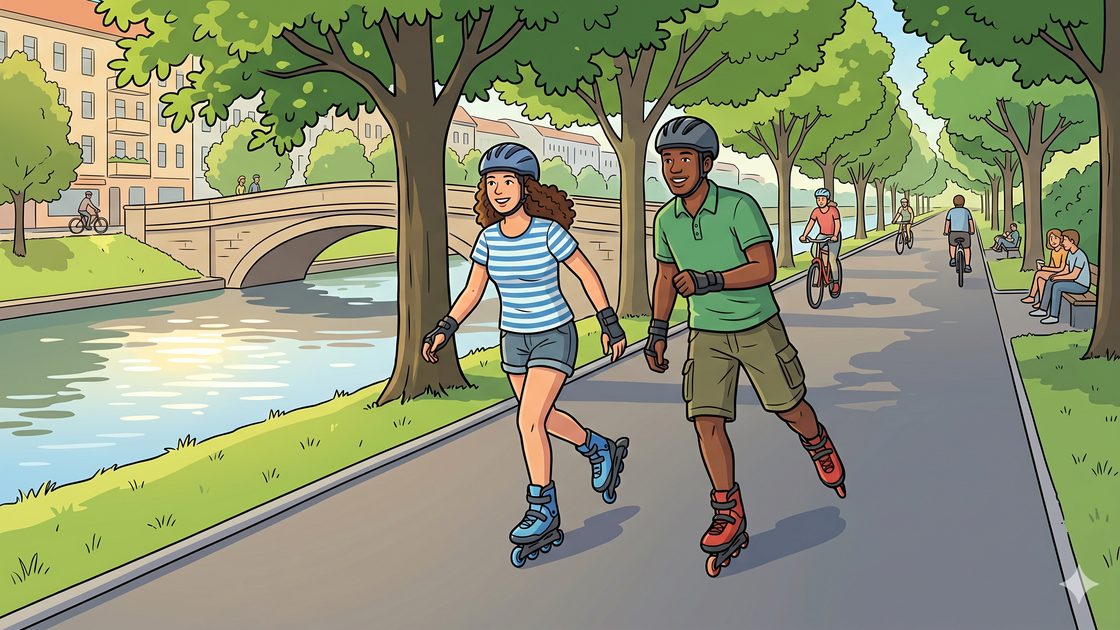
Here’s the part that makes skating such good value: the activity itself is free. There’s no court to book and no green fee — unlike, say, an hour on a padel court or a tennis court, where the clock is always running. Once you own a pair of skates, every lap of Tempelhofer Feld and every canal kilometre costs nothing forever. A basic fitness or recreational skate is the usual first purchase; spend on the wrist guards and helmet before you spend on fancy wheels.
The gear that matters, and the one skill beginners skip
The gear that actually prevents inline-skating injuries is wrist guards first, then a helmet and knee pads — and the skill that prevents most falls from mattering is learning to stop before you learn to go fast. Almost every beginner fall lands on the hands, and a broken wrist is the classic inline injury, so wrist guards are not optional; a helmet and knee and elbow pads round out the kit. Rental shops include protection in their packages for exactly this reason.
The skill nobody practises and everybody needs is braking. Most inline skates carry a heel brake on one boot — you roll one foot forward, lift the toe and press the brake pad down — but the more reliable stop, once you progress, is the T-stop: you trail one skate behind you, turned sideways, and let the wheels drag until you slow. Learn both somewhere wide, flat and soft-edged like Tempelhofer Feld, where a missed stop ends in grass, long before you take them to a canal path with water on one side. Get stopping sorted and the rest of skating is just confidence.
Turn “we should go skating” into a date on the calendar. Find someone nearby on MITRA who’s up for a lap of the field, agree an evening, and actually go — beginners welcome, falling-over included.
Where inline skating came from
Inline skates are far older than the 1990s craze suggests — crude versions appeared in the early 1700s — but the modern sport was born in a Minneapolis basement in 1980. The early history is full of false starts: a primitive inline skate turns up in eighteenth-century Europe, and the often-told tale has the inventor John Joseph Merlin rolling into a London ballroom on wheels and straight into a mirror, having never worked out how to stop. A first patent for an inline design followed in France in 1819.
The version we actually skate today came from two hockey-playing brothers from Minnesota, Scott and Brennan Olson, who found an old pair of inline skates in 1979, saw a way to train for hockey through the off-season, refined a prototype in their parents’ basement and founded Rollerblade Inc. in 1980 — which is why so many people still say “rollerblading” for the whole sport. Today inline skating sits under World Skate internationally, and in Germany under the Deutscher Rollsport- und Inline-Verband (DRIV), the national roller-sports federation based in Frankfurt, with around 37,900 members across eighteen regional associations. None of that is on your mind as you push down a Berlin canal path — but it’s a nice thing to know you’re doing something a couple of off-season hockey players reinvented in a basement.
Why skating is better with someone
Skating works alone, but it quietly wants a second person — for safety on shared paths, for the simple pull to actually go, and because a shared lap is better company than a solo one. There’s the practical layer: someone to skate at your pace, to call out the pothole or the dog ahead, to stop when one of you tires, and to mind the bag while the other tries the skatepark. For a beginner it matters even more, because falling over on the grass next to a friend is a laugh, while falling over alone in front of strangers feels like a verdict.
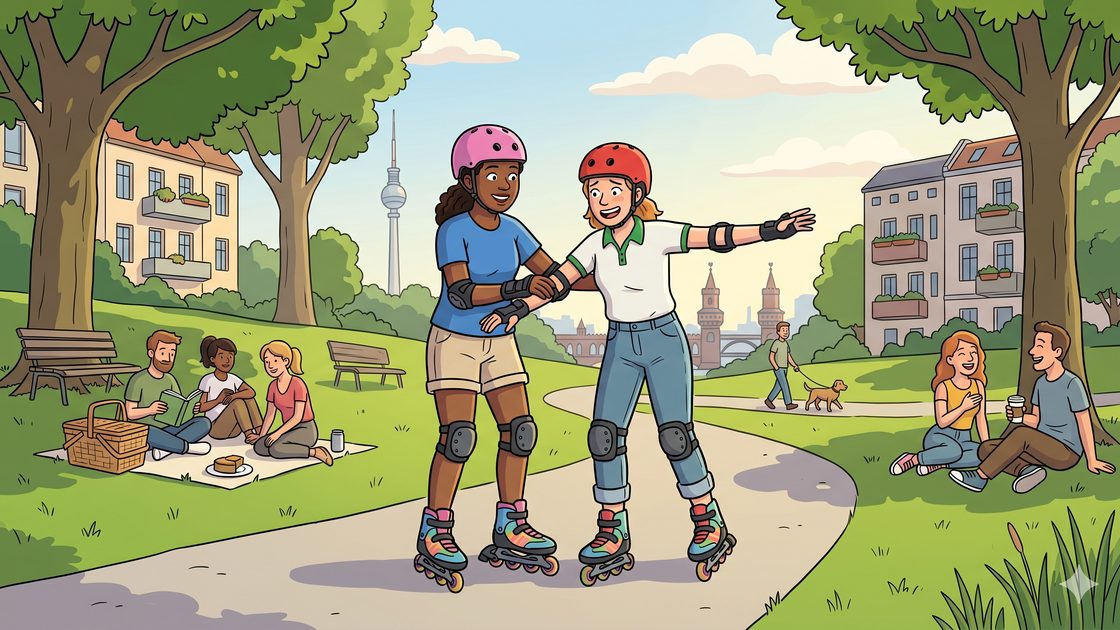
Then there’s the reason that has nothing to do with wheels. Berlin is a city of arrivals — people land here from somewhere else and rebuild a social life from scratch — and a low-stakes outdoor activity is one of the gentlest ways to turn a stranger into a familiar face. A loop of Tempelhofer Feld asks almost nothing of two people: you’re side by side, moving, with easy silences built in and a natural finish line at the gate. It demands far less than a sit-down coffee and gives back more, the same way a shared paddle or a lake day does in summer. That’s the gap MITRA is built to close.
How to find someone to skate with in Berlin
The simplest way to find a skating partner in Berlin is an app built around meeting people through an activity, which is exactly what MITRA is. Here’s the honest mechanic, because it isn’t an algorithm that pairs you off: you set up a quick profile, you see people near you who are up for activities, and you send an activity request — “fancy a lap of Tempelhofer Feld on Saturday?” The other person accepts if they’re up for it. Nobody is auto-matched and nobody is obliged; both sides choose. When two people say yes, you’ve got a plan and someone to skate beside.
It works well for skating specifically because the activity does the heavy lifting. You don’t need to be witty over text — you need two people, a flat stretch of tarmac and a free hour, and the field handles the rest. It’s an easy first meet for newcomers, for anyone rebuilding a circle after a move, or for people who simply find it easier to tap “I’m in” than to organise a group chat. Want to make a whole afternoon of it? Bring a cycling buddy along the same canal path, or line up a game once you’re warmed up — Berlin’s beach-volleyball courts aren’t far from the field.
Your first lap of the field shouldn’t be your last. Download MITRA free, send a skating request to someone nearby, and turn one good evening on Tempelhofer Feld into a regular thing.
Come say hi on Instagram @mitra.app for Berlin activity ideas and skate evenings. Berlin first. Bucharest and more EU cities coming soon.
How we checked
We checked the routes, surfaces and locations named here against the official visitBerlin skating-route guide and Berlin’s own event listings in June 2026, confirmed that Skate by Night Berlin is no longer running via the city’s official berlin.de listing, and verified the rental shops against their own websites. Surfaces, opening hours and prices change from year to year, so treat the details as a guide and confirm before you travel.
Frequently asked questions
Where is the best place to inline skate in Berlin?
Tempelhofer Feld is the best place to skate in Berlin: the old airport’s runways give you about six kilometres of wide, flat, car-free tarmac, plus a skatepark, all free to use. It’s also the easiest place to start, because there’s grass on either side and nothing hard to hit. The smooth canal towpaths along the Spandauer Schifffahrtskanal and the Teltowkanal are the next best thing for longer, quieter routes.
Is inline skating in Berlin free?
Yes. Skating on Tempelhofer Feld, the canal towpaths and the public park routes costs nothing — there is no court fee, ticket or green fee, unlike most racket or club sports. Your only real costs are the skates and protective gear. If you don’t own a pair you can rent them from a Berlin shop for a modest fee, but once you have your own kit, every kilometre of skating in the city is effectively free.
Where can I rent inline skates in Berlin?
Several shops rent inline skates with protective gear, usually for an hourly or daily fee plus a deposit and ID. Skate & Glide in Prenzlauer Berg rents skates and runs beginner courses; Ski-Shop Charlottenburg stocks a full range of sizes including children’s; Berlinliner offers lessons with rentals in sizes around 37 to 46; and SkaMiDan, a skating school and shop, rents alongside its classes. Renting first is wise, so you can try a recreational skate against a freeskate before buying.
Is Tempelhofer Feld good for beginners?
Very. The runways are perfectly flat, extremely wide and free of traffic, and there’s grass on both sides, so a fall ends softly with nothing to crash into. That combination makes it the gentlest place in Berlin to find your balance. The one quirk is the steady headwind down one straight, which is a free workout going one way and an easy push coming back — beginners often start into the wind so the return leg feels effortless.
Does Skate by Night Berlin still happen?
No. Skate by Night Berlin, the mass evening skate that once drew up to two thousand people on a roughly thirty-kilometre route from Mercedes-Platz, last took place on two summer dates in 2022, and the city’s official berlin.de listing now records it as no longer happening. Older articles that describe it as a regular event are out of date. For a big skate today, locals head to Tempelhofer Feld or take the train to the Fläming-Skate trail in Brandenburg.
What’s the smoothest route for a first time on skates?
The Spandauer Schifffahrtskanal towpath in the north is among the smoothest, with about eight kilometres of optimal asphalt and only gentle climbs, and visitBerlin lists it as beginner-ideal. The newly built Karlshorst tracks in the east and the short Hans-Baluschek-Park path in Schöneberg also have excellent surfaces. All beat a cracked or cobbled street, where a single bad patch can stop you dead — for skating, surface quality matters more than anything.
What protective gear do I need for inline skating?
Wrist guards first, then a helmet, then knee and elbow pads. Most beginner falls land on the hands, and a broken wrist is the classic inline injury, so wrist guards do the most to keep you skating. A helmet protects against the rarer but serious head knock, and knee pads save your joints on harder surfaces. Rental shops include protection in their packages; if you buy your own kit, prioritise the pads and helmet over fancy wheels.
When is the inline skating season in Berlin?
Roughly April to October, whenever the paths are dry and clear of leaves and grit. Skating needs clean, dry tarmac, so a wet or icy surface is both slow and unsafe. The shoulder months are fine on a clear day, but high summer is the easy season, with long evenings perfect for a lap of Tempelhofer Feld. The inline division of the Berlin Half Marathon, held on the first Sunday in April, traditionally opens the season for racers.
Do you need to learn to stop before skating in Berlin?
Yes, and most beginners skip it. Practise braking before you take to any busy or water-side path. Most skates have a heel brake on one boot, which you press by rolling that foot forward and lifting the toe; the more reliable method as you improve is the T-stop, dragging one sideways skate behind you. Learn both on a wide, flat, grass-edged space like Tempelhofer Feld, where a missed stop ends harmlessly.
How do I find someone to skate with in Berlin?
Use MITRA. You make a short profile, see people nearby who are up for activities, and send a skating request; they accept if they’re keen. Nobody is auto-matched — both people choose — so it’s a low-pressure way to line up a partner for an evening on the field. It’s especially handy if you’re new to Berlin and building a social circle from scratch, because the activity carries the meeting and you just have to show up.
Sources
- visitBerlin (official Berlin tourism) — The 11 most beautiful skating tracks in Berlin: named routes and surfaces (Tempelhofer Feld ~6 km of old runway plus skatepark; Spandauer Schifffahrtskanal ~8 km beginner-ideal asphalt; Teltowkanal ~6 km; Hans-Baluschek-Park ~1.5 km; Volkspark Friedrichshain; Kronprinzessinnenweg ~4 km; Karlshorst new tracks; Eiskeller; Mellowpark and Liberty Park; the Fläming-Skate; and the Berlin Half Marathon inline race on the first Sunday in April).
- Berlin.de (official website of the State of Berlin) — Skate By Night Berlin: event “no longer takes place”; last held on two dates in July and August 2022; ~30 km route from Mercedes-Platz; up to 2,000 participants in recent years.
- Deutscher Rollsport- und Inline-Verband (DRIV, official) — driv.de: Germany’s national roller-sports and inline federation, seat in Frankfurt am Main, ~37,900 members across 18 regional associations, member of the DOSB and World Skate; took on responsibility for inline skating in 1998.
- Encyclopedia.com — Olson, Scott and Rollerblade Inc.: Scott and Brennan Olson, hockey-playing brothers from Minnesota, found old inline skates in 1979 and founded Rollerblade Inc. in 1980; the modern inline-skate revival.
- Scott B. Olson — Wikipedia (encyclopedia reference): primitive inline skates date to the early 1700s; first inline-skate patent in France in 1819; the Olsons’ role in popularising the modern sport.
Want to keep reading?
- How to find a cycling partner in Berlin — the same canal paths and parks, on two wheels.
- How to find a running partner in Berlin — Tempelhofer Feld on foot, with run crews and parkrun.
- Paddleboarding in Berlin — another low-cost, warm-weather way onto Berlin’s open spaces.
- How to find a swimming partner in Berlin — cool off in the lakes after a canal-path skate.
- Where to play beach volleyball in Berlin — keep the warm-weather, meet-people momentum going.